Sardinia on the road

A tutta Barbagia, a pastoral tour to discover the most authentic 'Sardinian-ness'

Motorbikes and off-road vehicles off the usual routes take you into the heart of the island through valleys, canyons and nuragic settlements

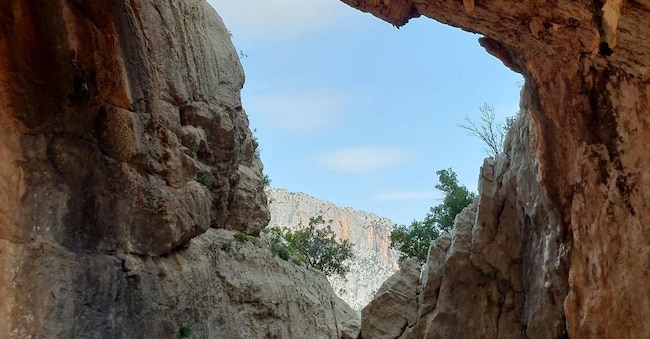
by Donata Marrazzo

5' min read

5' min read

If you have visited the Costa Smeralda, every inlet of Porto Rotondo, all the coves of Porto Cervo and inebriated yourself with the colours and scents of Gallura, if you have admired the beaches of La Maddalena and held your breath on the Palau overlook, if you have gone as far as Stintino and immersed yourself in its dazzling beauty. And again if the Capo Caccia promontory gave you chills as you gazed out over the surface of the sea, as well as those 45 km between Alghero and Bosa - beautiful Alghero, so Catalan in its language, culture, architecture, even its cuisine and its hand-painted cork fans and coral in all its sauces -, In short, if you have travelled around the island, from East to West, along the coast, even touching the soft sands of Cala Goloritzé, in the municipality of Baunei, first in the World's 50 Best Beaches 2025 ranking, but you have left out the interior, the heart of Sardinia, well, then yours has been half a trip. Which is what I also did, as a passenger, riding a Bwm Gs 1200, starting, however, from the hinterland.
Barbagia, discovering sardinia

The pastoral depth of the inland landscape and all its elements, geographical, anthropological, historical and cultural, those that express the sense of the most authentic Sardinian character, can only be grasped there. So, after a night on the ferry, having arrived in beautiful Cagliari, with its palaces overlooking the port, between neoclassical, Art Nouveau and Umbertine (barely covered by a few tarpaulins for work in progress), we typed into the tom tom the destination of Oliena, in Barbagia. Our friends follow us on a Honda Transalp 750.

Loading...

We are immediately sucked into the Gennargentu, Silver Gate of deepest Sardinia. As we skirt it, one hairpin bend after another, a golden eagle flies over us. At altitude, nature expands as if to express all its power. The scents of thyme, peonies and broom soften the harsher parts of the landscape, as do small herds and flocks in the wild, amid the traditional sound of cowbells. First stop, the Gorropu canyon, along the legendary Route SS 125, a section of the Sardinian orientale: for motorcyclists, it is a legendary road.

Birroncino on Supramonte

We are on the Supramonte and toast with an Ichnusa beer. It is less than 40 km to Oliena, where we will spend the night. The b& is at the entrance to the village, an unpretentious establishment run, however, by a superfine host: Giuseppe, very knowledgeable about the area, receives us with some good Cannonau Nepente di Oliena (that and only that!) and a board of pecorino and local raw ham, artichokes in oil, and pane carasau bread. He tells us late into the night about Sardinians and their feeling of being so un-Italian. He explains why they are shy, distrustful, touchy, but 'serious, loyal and then, friends forever. What has Italy given us after all? We can do without,' he concludes on the second round of filu 'e ferru.

The Secret Sardinia of Fabrizio Caggiari

.

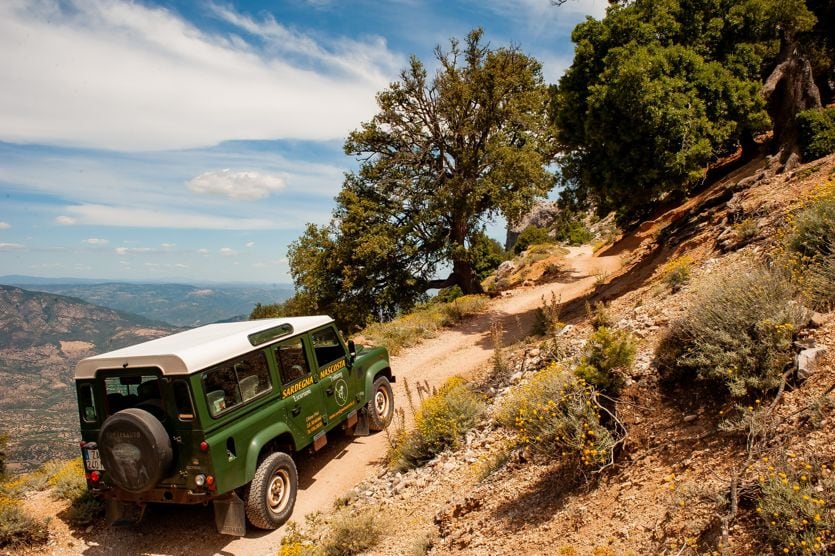
Fabrizio Caggiari arrives at 9 o'clock. His military green Land Rover, with yellow 'Sardegna Nascosta' sticker, a team of guides specialising in excursions and trekking of all kinds and degrees (even caving in the underground world of Supramonte), is ready for adventure. It climbs the rocks, almost pecking at the edge of the cliffs. In the car, there are eight of us, with a group from Rimini. In the second off-roader, driven by Etta, there are some Milanese and some Poles.
Between karst landscapes and nuraghi

The first stop is at the Cedrino river, the longest in Sardinia, surrounded by lush Mediterranean scrub, at the source of Su Gologone. It is not known exactly how the watercourse winds its way through the area, which splits and excavates the rock, constructing evocative karstic scenery. In the small country church of Nostra Signora della Pietà, there are a few tourists in meditation, while the masks of the Mamuthones sprout frighteningly behind the poplars, but it is only handicraft. There are those who choose the canoe excursion among herons, cormorants and mouflons that come down to drink on the banks.

The Village of Tiscali

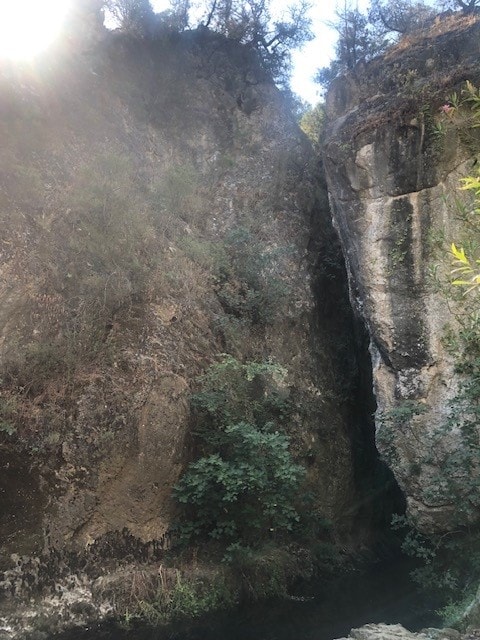
At the end of the dirt road stands the crest of Mount Tiscali, which conceals within it a Nuragic settlement of exceptional topography and architecture. We climb up, then round the mountain, passing through a narrow crevice in the rock. From above, we look down on the centre of the earth. The trek - strenuous, yes - continues along the mountainside. Up, to the right again, then a bend and here is the Nuragic village - perhaps there are two - inhabited, it is thought, until the Roman or late Roman age. The settlement is set in a large sinkhole. Down, wide open, the Lanaitto valley.

Su pistiddu

But it is in the prehistoric village of Sa Sedda Sos Carros that our guide gives shape, through storytelling, to ancient stories that were born, lived and died in Sardinia, along with its 15,000 nuraghi. "Which were huge towers made of giant stones, carried up to more than 20 metres above the ground. The sign of a prehistoric civilisation whose writing, for example, is unknown. Indeed, we ask ourselves, did the Nuragic people write? And what did they write? Did they need to? And us, do we look for an alphabet that is the same as ours or did they have another one?". Fabrizio elaborates: 'I remind you that we Sardinians do not write in the language, we only do it in Italian. We are starting now, imitating our phonetics. Our language is iridescent. For example, if I say hiju, with the sweet i I am saying son, if I pronounce the same word loudly, I say eyebrow. The truth is that we could live without writing, because we have oral rules that are more valid than written ones. Shall I point you in a direction? I leave you a sign at the point where you have to turn, su pistiddu, for example, a branch. That's it, that's our whole culture that is handed down in this way'.

The sacred spring with mouflon heads

.

We listen enraptured in the shade of the trees of the wild valley - the limestone caves of Sa Oche and Su Bentu and the distant roars of the water are spectacular - catching sight, a few metres further on, of the remains of another Nuragic site. A circular room and walls with carved mouflon heads, from which water gushed: a sacred spring around which 200 bronze pieces were found. "We Sardinians were not only shepherds, as many have wanted to portray us, but also engineers, astronomers, doctors. We invented a bread, round, that could last for months in the stocks of the shepherds who followed the flock, and we let the women run the household. We are inspired by the round shape, even our ballu is tundu, we dance to awaken the earth'.

Porceddu, herbs and Cannonau

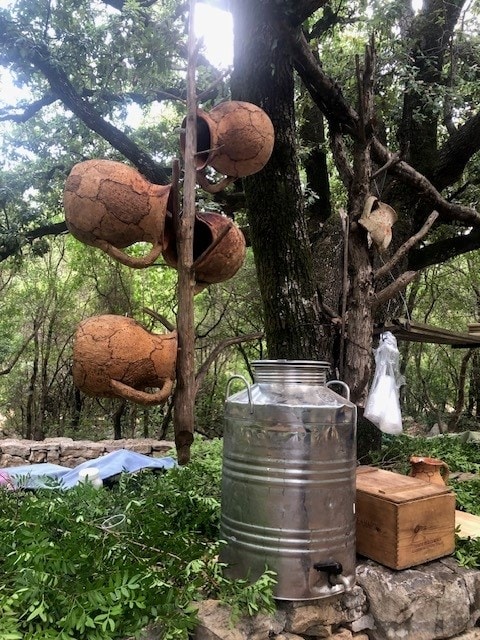
On board the Land Rover, we rock again on the rocks. Then Fabrizio shifts into low gear and the off-roader rolls on its side like a video game to Marco's sheepfold. Two porceddi cook on the spit. Between jugs of Cannau and water from the spring, they discuss the minimum and maximum systems: how beautiful Sardinia is ('But was Aga Khan the fifth of the 4 Moors?'). A pastry of carasau, ricotta and honey from the Mediterranean maquis: we discuss the South and the North, bandits and brigands, politics and health, and mutual friends ("But look what a combination!"). Of the power of the herbs of San Giovanni. Some people say that there in Barbagia, helichrysum, St. John's Wort, lavender, mint, rosemary, thyme and mullein really do wonders. Above all, they drive away the evil eye. The journey resumes the next day, by motorbike, towards Sant'Antioco. Back to the sea.

Copyright reserved ©
Loading...

Brand connect

Loading...

Newsletter

Notizie e approfondimenti sugli avvenimenti politici, economici e finanziari.

Iscriviti