
A2A: an underwater robot marks a breakthrough in dam cleaning
The energy group is trialling an innovation that will enable sediment to be removed from reservoirs without shutting down the plants. This offers benefits in terms of production and combating the effects of climate change

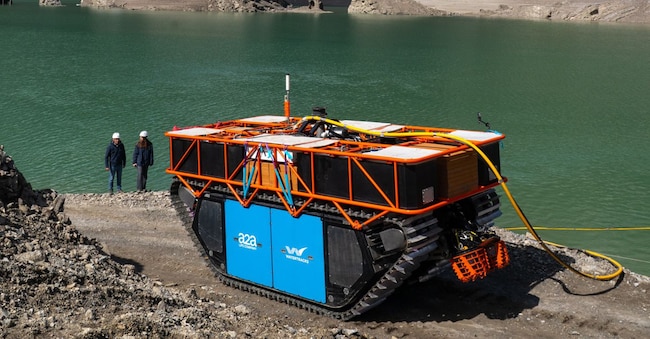
A2A is focusing on hydroelectric power as a strategic resource for the country and, in particular, on a technological innovation, developed in collaboration with the French start-up Watertracks, which enables sediment to be removed from the beds of reservoirs without the need to drain them. The “Teti Project” was presented by the group at the Cancano dam, above Bormio: Valtellina is home to the historic heart of the hydroelectric sector, making A2A Italia’s second-largest operator in the sector with 2GW of installed capacity and ready to invest, should the renewal of concessions go ahead, 1 billion euros, as emphasised by the CEO, Renato Mazzoncini.
The paradigm shift
The trial involves a tracked underwater robot operating at a depth of around 80 metres: two rotating side cutters dislodge the sediment, which is then sucked up by a pump and transferred to a designated area for recovery as part of a circular economy approach. What matters most, however, is that by doing so the plant remains operational: a paradigm shift compared to the past, given that similar operations still require the hydroelectric asset to be shut down for weeks for draining and cleaning. A shutdown of this kind, for a reservoir such as Cancano, can cost 45 GWh of generation (the annual equivalent of 40 hectares of solar panels), which is instead ‘saved’ thanks to the new underwater maintenance model, introduced for the first time in Italia.
A solution to the sediment problem
If replicated on a large scale, the robot could help alleviate the long-standing problem facing our hydroelectric reservoirs, a issue highlighted on several occasions by studies carried out by Utilitalia and Teha. Teha, for example, has found that Italia’s more than 530 reservoirs could hold almost 14 billion cubic metres of water, but on average 33 per cent of their volume is lost due to debris accumulated on the lake bed. It must be said that this problem is particularly prevalent in southern Italy. ‘Reclaiming’ those volumes, moreover, is a global challenge: an analysis carried out by the Institute for Water, the Environment and Health at the United Nations University, covering some 47,000 large dams across 150 countries, revealed that, without adequate countermeasures, reservoirs could lose a quarter of their capacity by 2050 due to sedimentation.
A response to climate change
Timely action in this area is made all the more urgent by the effects of climate change, which are reducing the amount of water available and, at the same time, require reservoirs to be filled to maximum capacity in order to ‘cushion’ the high volatility of rainfall. With this in mind, “innovation means rethinking the management of our infrastructure: using robotics to make reservoir maintenance more efficient helps to protect a precious resource such as water, benefiting both green energy production and the local areas”, pointed out Mazzoncini, who yesterday also presented A2A’s territorial sustainability report for Valtellina and Valchiavenna (78 million in value generated in the region). Now, he continued, “we intend to make the Teti Project available to all our plants and potentially extend it to other hydroelectric reservoirs in Italia”.


