
A2A, the 'autonomous' car sharing of the future starts in Brescia
The project developed with the Politecnico di Milano and Most for driverless electric cars kicks off: a key role for the decarbonisation of cities

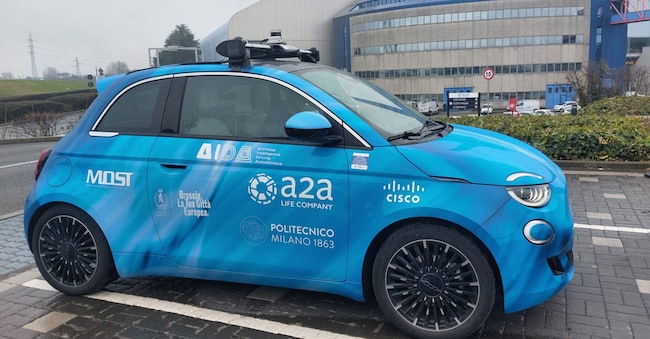
The electric car drives itself to the customer, who has called it and can drive it to the desired location. Then, still autonomously, at a speed of around 30 km/h, the car drives off again to a new user or to the nearest charging station, where it can fill up without plugs, i.e. by 'induction'.
A2A, together with the Milan Polytechnic and the Most (National Centre for Sustainable Mobiity), is taking a first step towards the car sharing of the future with an experiment that starts in Brescia, the headquarters of the energy group led by Renato Mazzoncini and a city at the forefront of the green transition and circularity.
Autonomous driving and decarbonisation of cities
The aim is to meet the challenges of decarbonisation of cities, contributing to traffic reduction and environmental sustainability. There is no lack of empirical evidence in this regard. An MIT study, for example, showed how the use of autonomous driving would halve - for the same number of journeys - the number of vehicles entering Manhattan every day. Other research has revealed that cars are used on average only 70 minutes per day, being idle 95 per cent of the time. Moreover, in Europe, they drive an average of only 10,000 kilometres per year. This is why we need to adopt new models for more efficient and sustainable urban mobility.
The first important step in this direction has been taken in Brescia: a Fiat 500 electric car has covered its first kilometre in fully autonomous driving mode, kicking off an innovative experiment. The aim is to redefine the concept of car sharing: the user will no longer have to reach the vehicle and operators will no longer need a large number of cars to make the service widespread. For the first time in Italia, a series of tests are being launched on roads open to traffic, in order to analyse the interaction between this type of car and the complexity of mobility in a city. With this experimentation," a note summarises, "A2A, Milan Polytechnic and MOST intend to develop a car sharing model that is unique in Europe. The project unites the potential of the electric car with that of autonomous driving, proposing a new paradigm of urban mobility, reducing the number of cars circulating in the city and transforming the service into a more practical and easy experience.
The opinion of the protagonists
"We believe that the project presented today in Brescia represents an important step in defining the urban mobility of the future. The potential of autonomous driving, combined with that of car sharing, can promote the efficiency of travel, traffic fluidity, safer and more sustainable transport, and progress in the decarbonisation of cities," said A2A CEO Renato Mazzoncini. "More than 70% of the population lives in Italian urban centres, a percentage that is destined to exceed 80% in the coming years. For a life company like A2A it is therefore important to study innovative and sustainable solutions, to help achieve climate neutrality, a game that is played and won precisely in cities. Our membership of the MOST partnership, one of the 5 National Research Centres created with PNRR funds and dedicated to sustainable mobility, was fundamental to the birth of this initiative". Enthusiastic Mayoress of Brescia, Laura Castelletti: "Our city confirms itself as a fertile ground for pilot projects of not only national importance: this one on self-driving car sharing is also an extraordinary lever for our candidacy as European Green Capital". According to Matteo Savaresi, Professor at the Milan Polytechnic, "this experimentation represents a fundamental step forward towards new models of sustainable mobility, gathering and exploiting years of experience gained by the Polytechnic in the field of autonomous car track competitions, the 2023 and 2024 editions of the 1000 Miglia, and also in the field of wireless recharging of electric vehicles". "This project is not only an example of technological excellence, but an expression of the potential generated by the integration of multidisciplinary skills," explained the president of Most, Ferruccio Resta. Most represents a valuable model thanks to a collaborative approach that overcomes the traditional boundaries between public and private in tackling the challenges of mobility.


