
Abete: "Luiss Business School increasingly international training hub
The president of the management school today inaugurates the new Milan location, functional to a multi-hub strategy that allows students to gain experience in different economic contexts

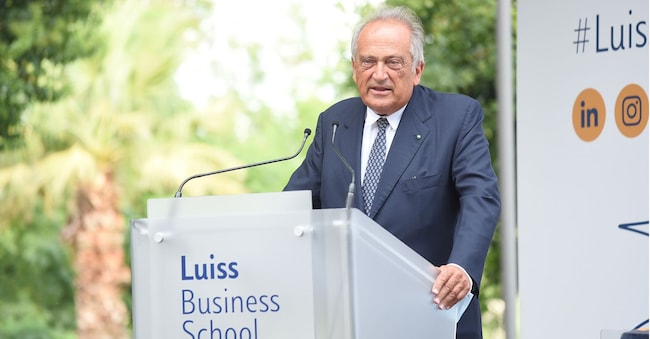
"We are one of the economic players in the country, and our goal is to facilitate the entry of young recent graduates into the world of work and give those who are already working the tools to evolve in their profession, in a world that requires increasingly multifunctional and multidimensional managerial skills, able to use technology as a tool to do their business better". This is why Luigi Abete, president of the Luiss Business School, is convinced that, in the coming years, the demand for first- and second-level masters and executive courses will increase, especially from small and medium-sized enterprises. "We must be able to offer training that is as personalised and diversified as possible, allowing our students to come into contact with different experiences and production contexts".
Does the new Milan office respond to this vision?
That's right: in this logic of introducing students to the business culture, we have been pursuing for years a strategy that we call 'multi-hub', which allows the master's course to be held in two or more different cities, offering different locations: in addition to the one in Rome, we already have the Milan and Belluno hubs in Italia, and those in Amsterdam and Dubai abroad. And within a couple of years we will also open a new location in Syracuse. In Milan we have already been active for several years, but we have operated until now inside the building that houses the Luiss University. Two years ago, some space became available in the adjacent building, so we rented and renovated about two thousand square metres on three floors, which we are inaugurating today and which will allow us to have a total of 12-15 classrooms, two of which are very large for the MBA, an events room, and the others for the masters and executive courses. In all, we will be able to accommodate up to 500 students at the same time.
A major investment. What will be the specificities of this location?
Our offer is unique, but it is specifically and customised according to territorial and production contexts and this is the added value that sets us apart. In fact, students have the opportunity to experience different business and economic environments. It is as if a person did Erasmus by changing the location of the university instead of the university. We propose a path entirely within the Luiss Business School, but we allow those who attend it to get to know different contexts. In this sense, an adequate presence in terms of space and offer in Milan is essential.

