
Abu Dhabi: modest progress on Ukraine. Trump’s envoys sent to Moscow
The Russians: mutual understanding on certain points. The Ukrainians: a possible agreement by the end of the year. Large-scale prisoner exchange

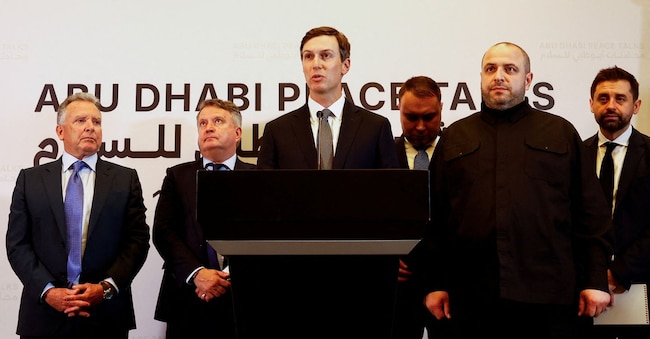
What may appear to be a dead end could in fact conceal a step forward, if handled correctly. On Wednesday in Abu Dhabi, the Russians, Ukrainians and Americans wrapped up the second day of talks on the war in Ukraine in less than two hours; as expected, these talks yielded no immediate results, apart from a substantial prisoner exchange that should see more than a thousand people from each side return home. For the rest, the scornful remarks directed at the Europeans by the Russian chief negotiator, Vladimir Medinsky; Moscow’s stubborn refusal to agree to a ceasefire prior to negotiations – the sequence of events on which Volodymyr Zelensky insists when he calls for an end to the killing first and foremost – and finally the evident lack of trust and the gulf between the parties over territorial claims: all this would suggest that, after Abu Dhabi, once again, peace does not appear any closer.
Yet, on taking stock of the situation, even Medinsky said that ‘on some issues we have reached a mutual understanding, on others we have not: the talks will continue’. David Arakhamia, leader of Zelensky’s parliamentary faction, offered a more optimistic assessment, stating that progress had been made in the Emirates that could even lead to an agreement by the end of the year. “The Russians,” he said, “arrived with very strict instructions. But the way in which the US representatives structured the discussion on the post-war scenario broke the deadlock in the dialogue, and we have begun to work more productively’. Arakhamia cited progress on which details will remain confidential.
Kushner and Witkoff are to hold talks with Putin
Meanwhile, on Thursday in Moscow, Donald Trump’s two envoys, Jared Kushner and Steve Witkoff, will present to Vladimir Putin the potential breakthrough in Abu Dhabi: the decision by the United States and European representatives, in agreement with Kyiv, to return to addressing the issues that gave rise to the conflict, as Moscow wishes. To do so, of course, Europe will have to take its place at the table alongside everyone else, rather than staying in a hotel like ordinary tourists – to use Medinsky’s offensive phrase, according to which Russia will address the European countries, ‘who are responsible for the mass killing of civilians and have deceived the Ukrainian people, when their consciences awaken’.
Kushner’s words were quite different: “We need the Europeans at the negotiating table,” said Trump’s envoy. “I hope that on Thursday in Moscow, Steve and I will be successful, and that Putin will give his blessing for this to happen. In that case, I think we’ll be able to make much more progress, because there are openings and opportunities.” Echoing Prime Minister Giorgia Meloni’s hope, Kushner called on Europe “to identify someone to speak on their behalf”. From Moscow, Kushner and Witkoff will travel to Dublin tomorrow to meet Zelensky.
The situation in Moscow
If this represents a step forward from the darkness of recent months and years, it will need to be handled with the utmost caution, a shared sense of purpose across Europe and few illusions: the Kremlin might treat it as a new way of playing for time, whilst continuing to bomb Ukrainian cities throughout the winter and beyond. Not least because, for Moscow, talking about a security framework in Europe means dusting off the demands made in December 2021, on the eve of the invasion: a veto on further NATO expansion eastwards, restrictions on defence systems deployed in territories closest to Russia, and an end to military aid to Kyiv. These conditions were unacceptable to the North Atlantic Alliance then, and are all the more so today, after four and a half years of war.


