Third factor

Access to finance unlocks the potential of women in Africa

E4Impact Foundation revolutionises empowerment in Kenya and Cameroon by giving women the tools to overcome obstacles to entrepreneurship

by Giulia Tarantini

5' min read

5' min read

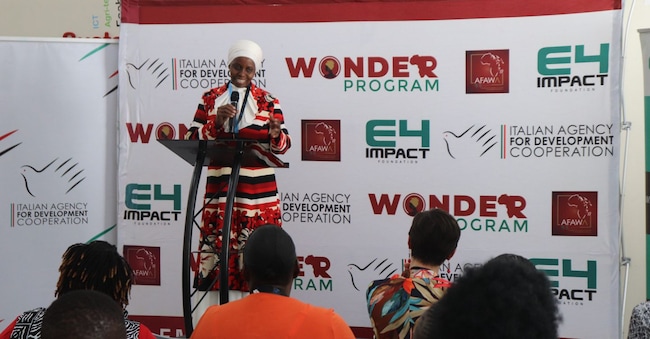
Did you know that Africa has one of the highest rates of female entrepreneurship in the world, yet many women still face barriers in accessing finance? In a continent where 25.9% of women are entrepreneurs, but access to finance remains a major barrier, E4Impact Foundation is acting as a driver of change. Through its Wonder programme, launched in Kenya and Cameroon, the organisation is revolutionising women's empowerment, offering women tools to overcome structural, systemic and cultural obstacles.

Gender equality in 134 years

.

Imagine a woman who, starting from an idea, a dream, an aspiration, manages to create a positive impact on her community. Now, imagine what would happen if millions of women around the world had the same opportunity. Have you ever wondered what the reality would be like today if their potential was fully realised?

Loading...

According to the World Economic Forum's Global Gender Gap Report 2024, it will take about 134 years before full equality is achieved, which is a full five generations beyond the 2030 Sustainable Development Goal. A figure that should push the international community to deep reflection, especially where women's voices continue to go unheard.

Funding gap of 42 billion

.

As in many European realities, women in Africa face gender stereotypes that relegate them to traditional roles, portraying them as incapable of managing complex economic initiatives or launching large-scale projects. These barriers, together with deeply rooted customs and beliefs in society, hinder their participation in entrepreneurship, limiting, for example, their access to capital. This exclusion leads to a financing gap of USD 42 billion across all value chains, of which USD 15.6 billion concerns the agricultural sector (African Development Bank, Why AFAWA?).

Although access to finance is a challenge for both sexes, interviews conducted with some African women entrepreneurs show how this difficulty particularly affects women, exposing them to systemic discrimination. If only Africa's female potential were fully realised, women could become the backbone of the continent's economy. In fact, many already are, although this is often ignored due to various barriers that limit their full recognition. This reveals how gender equality is not only a matter of ethical justice, but also a crucial factor for economic and social development.

An innovative approach: the E4Impact method

.

In Kenya, however, there is already a new air in the air, thanks to the contribution of organisations such as the E4Impact Foundation. This organisation, founded within the Catholic University and present in 20 African countries, has been promoting partnerships between Europe and Africa for over 10 years and is committed to training African entrepreneurs who combine profitability with social impact, providing solutions to the challenges of their countries. With the Wonder programme (Women-led Opportunities through Networking for the Development of Entrepreneursial Resources), E4Impact fits into this context with a concrete initiative to support female entrepreneurship in Kenya, helping to close the gender gap in access to finance.

Financing and favourable environment

Launched in 2022, Wonder is funded by the African Development Bank as part of the Afawa (Affirmative Finance Action for Women in Africa) initiative and supported by the Italian Agency for Development Cooperation (AICS), with the aim of bridging the financial gap that penalises female entrepreneurs in Africa. Thanks to this innovative approach, the initiative not only facilitates women's access to finance, but also creates an environment conducive to the flourishing of innovation, growth and female solidarity, supporting female entrepreneurs to overcome cultural and structural barriers.

The success of beekeeper Otila

.

Among the success stories, the one that stands out is that of Pauline Otila, director of Apiculture Ventures Ltd, who, thanks to Wonder, managed to turn her project into a real business that today employs 22 permanent employees, all young people, and creates a significant impact on the community. Apiculture Ventures Ltd is not just a beekeeping business, but a response to the daily challenges of small honey producers, who despite offering a highly sought-after product, find it difficult to earn adequate wages. Pauline's company supports them by aggregating their product and ensuring a stable market, putting the integrity and well-being of beekeepers at the centre of its business model. "Thanks to E4Impact I was able to get in touch with 400-500 farmers. Wonder is much more than just an accelerator: it is a platform that bridges the gap between entrepreneurs and communities."

Pauline recounts her entrepreneurial journey, which began against the advice of her father, who repeatedly urged her to look for 'a real job', and against the ingrained prejudices in society that tend to reduce women to a mere sexual object. "You are a woman. Why are you doing this? Is there a man behind this?" are just some of the phrases Pauline has had to face over the years. Today, her father is incredibly proud and speaks enthusiastically of her in their village.

A message of empowerment for women

.

"I have learnt as a woman to believe in myself," says Pauline. "Be intentional" is the advice the entrepreneur addresses to all women around the world. "Decide what you want, focus on it and pursue it with determination. And don't see gender equality as favouritism. It is not about receiving favours; it is about your rights as a woman'. Women's rights are human rights. This awareness is crucial to break down stereotypes and build a more equal and just world.

Strategic partnerships and replicable models

The experience of the Wonder programme shows how real change starts with investing in women, offering them not only concrete tools, but also spaces for growth, training, autonomy, sharing and recognition. When a woman succeeds, she lifts the entire community with her, generating a positive impact that extends far beyond the personal sphere. With the support of strategic partners such as the African Development Bank and AICS, E4Impact in Africa has demonstrated how targeted and well-structured interventions can really break down these barriers and make a difference. While recognising the many efforts already underway, similar initiatives could offer further insights for both Africa and Europe, fostering valuable synergies and strengthening global efforts to reduce the gender gap.

In this sense, the Mattei Plan, launched by the Italian government, could represent a concrete opportunity to extend and consolidate these models of female empowerment in other contexts as well. The story of Pauline - and of many other women beneficiaries of Wonder - shows how change is possible. Now it is up to us to embrace this lesson and turn it into concrete actions, because gender equity is not just a goal to be achieved, but an indispensable condition to build more just and resilient societies.

Giulia Tarantini participates in 'Terzo Fattore', a partnership between Il Sole 24 Ore and the Catholic University with the support of TechSoup. The initiative aims to promote knowledge of the third sector. Students carry out internships in non-profit organisations and report on the most significant aspects of their experiences.

Copyright reserved ©
Loading...

Brand connect

Loading...

Newsletter

Notizie e approfondimenti sugli avvenimenti politici, economici e finanziari.

Iscriviti