
CNEL estimate: even after the NRRP, there is still a shortfall of 236,000 student accommodation units
The CNEL report on public services examines in detail the gap compared with the EU average. Meanwhile, Minister Bernini responds to the protests: 72,000 new hospital beds have been created

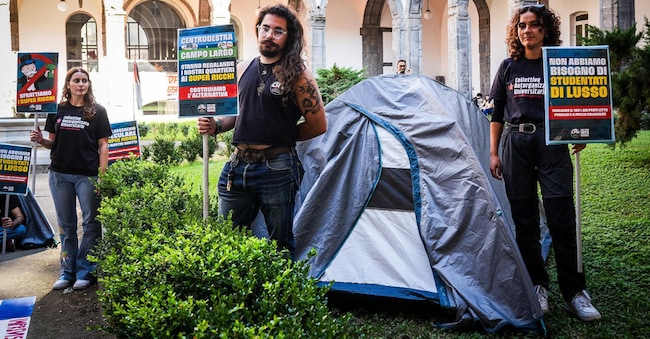
The issue of university accommodation is once again a hot topic. On the one hand, this is due to the resurgence of protest tents against the high cost of living, which university students have set up – just as they did three years ago – outside various universities across Italia and at the Chamber of Deputies. On the other hand, this is due to the CNEL’s annual report on public services for 2026, which was presented today in Rome and which is already looking ahead to the post-PNRR era.
The CNEL’s estimate
According to the CNEL’s estimate, based on ASVIS data, even after the Recovery Plan has ended, Italia will still be short of 235,887 halls of residence for university students if it is to reach the European average – covering 18 per cent of enrolled students – by 2030. And around €4.7 billion would be needed to build them. The same report also highlights that in 2021, the available accommodation covered just 2.2 per cent of enrolled students, amounting to around 41,000 places.
Looking at the regional breakdown, around half of the resources still required are concentrated in Lazio (45,911 homes and 916.7 million), Campania (32,280 and 764.3 million) and Lombardy (35,096 and 700.7 million). Only the Province of Bolzano has already met its target. As for public housing, social housing accounts for just 2.7 per cent of the national housing stock, compared with 17 per cent in France, 24 per cent in Austria and Sweden, and 29 per cent in the Netherlands.
Bernini’s defence on Radio 24
Minister Anna Maria Bernini also spoke about university accommodation during an interview on the ‘24 Mattino’ programme on Radio 24: ‘We have created 73,223 additional beds over the past four years, of which 43,000 are already occupied – that is, 43,000 keys have been handed over to 43,000 students. A further 30,000 have already been contracted and are set to be handed over by mid-2027. So, on the one hand, there are the student protests, the hardship, the high cost of living and inflation – all of which are very real and entirely legitimate. It is quite another thing to have the political exploitation by those who would like to take us back to 2022, when Schlein, Conte and Landini were taking selfies inside the students’ tents. And that is exactly what they did yesterday; yet, in the meantime, there are 73,223 more beds available.”
The head of the Ministry of Education then addressed the issue of excessively high costs in student halls of residence, at least according to the student unions: ‘Some of the opposition’s complaints are based on the cost of student accommodation. Some – Bernini thundered – have even claimed figures of 1,300 euros or 1,000 euros for accommodation. That is a lie. The letting agencies themselves say so. The average cost is between 400 and 500 euros, including internet and utility charges. We have provided links to all the halls of residence, showing all the costs as provided by the halls themselves, which dispel any propaganda and political controversy. There are no rents of 1,000 euros,” the minister concluded.

Brand connect


Newsletter Scuola+
La newsletter premium dedicata al mondo della scuola con approfondimenti normativi, analisi e guide operative
Abbonati