Innovation

Adaptronics, a pilot plant for the start-up that has patented electro-adhesion

The new factory in Bologna: official opening in January

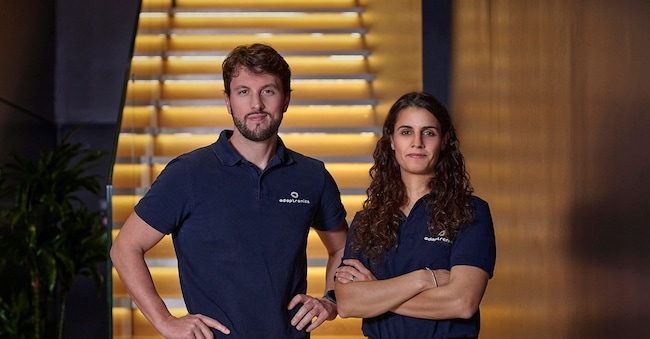
Lorenzo Agostini e Camilla Conti, fondatori di Adaptronics

3' min read

Translated by AI
Versione italiana

3' min read

Translated by AI
Versione italiana

Four years after its foundation, Adaptronics is ready to start production. The Bologna-based start-up has patented a new type of industrial socket, and the pilot plant (1,000 square metres just outside the centre of Bologna) is specifically designed to supply customers with the first products: “We are already using the new facility, but the official opening will take place by January,” says CEO Lorenzo Agostini.

Adaptronics is already working with large companies, mostly manufacturers of packaging machinery in Italia – particularly in Emilia-Romagna – and in Germany, who have already requested “an initial order of hundreds of products”, Agostini continues. Major partners are already on board. One example is the Apache project, which is being carried out in collaboration with Ima and the University of Bologna, and which aims to develop more flexible packaging machines for the pharmaceutical and e-commerce sectors.

Loading...

A new way to pick up objects

The idea behind the start-up is electroadhesion, and it stems from the research carried out by Agostini and Rocco Vertechy, a full professor in the Department of Industrial Engineering at the University of Bologna. It is a new way of grasping objects: the gripping surfaces can attract them simply by using an electrical pulse.

‘The technology ultimately began as a sheet,’ explains Agostini. The grip is achieved via that very thin sheet, which becomes adhesive when it receives an electrical signal; upon the next signal, the object is released. This represents a paradigm shift compared with current systems: “Today’s technological standard is based on pneumatics, with suction cups that grip objects but which, however, rely on an infrastructure comprising many components to move air and generate suction.”

Innovation in space

Right from the start, the company has been able to focus on different sectors, capitalising from the outset on the very favourable climate for the aerospace industry.

In 2023, the first round of funding came precisely in this area. It totalled 685,000 euros from A11 Venture and Galaxia, the national technology transfer hub for the aerospace sector promoted by CDP Venture Capital and Obloo Ventures. “We entered the space sector right from the start, partly because it was a favourable moment in history and there was a boom in object-gripping technologies,” continues Agostini. Electro-adhesion makes it possible to grasp satellites that do not have a dedicated attachment point, for example to move them or to hold them steady during a procedure.

Another capital increase on the way

The start-up’s initial structure has its roots in Italian higher education. “The original team came from various universities: the Politecnico di Milano and Sant’Anna in Pisa; we then came together at the University of Bologna, where I was a researcher at the time,” explains Agostini.

Adaptronics then expanded, largely thanks to new funding. In October 2025, a second funding round of 3.15 million was secured, led by 360 Capital, a European venture capital management firm, with Galaxia also participating; and over 500,000 euros came from various regional funding schemes in which Adaptronics had participated since 2022.

A further €2.5 million in non-repayable funding has been provided by the EIC Accelerator, the prestigious and selective programme run by the European Innovation Council. The European funding supports SpacEAAL, the project to develop the space-based version of the gripper and test it in orbit, which began in July 2026 and will run until June 2028.

However, the funding has not yet come to an end, and the start-up plans to pitch to investors again next year on a larger scale: “We’ll launch another funding round in 2027,” says Agostini. The new capital is therefore intended to make the projects even more ambitious: “The biggest challenge is finding the right talent,” concludes Agostini, because “we now need people who know how to turn a prototype into a product and sell it to car manufacturers.”

Copyright reserved ©
Loading...
Loading...

Brand connect

Loading...

Newsletter

Notizie e approfondimenti sugli avvenimenti politici, economici e finanziari.

Iscriviti