Sportwear

Adidas beats estimates and grows while Nike suffers

However, the German group did not revise its full-year estimates upwards due to the uncertainties of US duties. The share price penalised on the stock exchange

by Monica D'Ascenzo

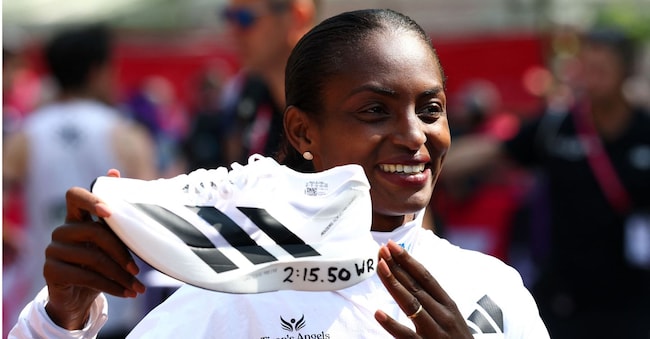
London Marathon - April 27, 2025 Ethiopia's Tigst Assefa holds up her Adidas shoe with her world record time on it after winning the women's elite race Action Images via Reuters/Matthew Childs

5' min read

5' min read

Eleven records were broken at the fifth Adizero: Road to Records event at the Adidas headquarters in Herzogenaurach, Germany last weekend. The sporting results are also reflected in the financial results: the German group today announced a better-than-market-estimated quarterly report with revenues up 13% at constant exchange rates (+17% excluding the Yeezy contribution) to 6.2 billion euros with an EBIT of 610 million euros. Gross margin stood at 52.1%, with no contribution from the Yeezy line.Net profit more than doubled to EUR 436 million and earnings per share stood at EUR 2.44 (EUR 0.96 in the same period of 2024). Both exceeded analysts' expectations, thanks to higher-than-expected margins and lower net financial expenses (EUR 25 million compared to EUR 39 million forecast). Estimates for the full year are confirmed, with no upward revision due to the lack of visibility on the development of duties creating uncertainty for the year. This was enough to penalise the stock in Frankfurt with a drop of about 3%, while on the same market Puma remains little moved, as does Nike on Wall Street.

The revenue map

.

The German sportswear group also provided the geographical breakdown of its results. The trend in Europe was positive, where sales rose 14% (against the +9% estimated by Barclays), driven by strong product momentum. In North America, growth was more subdued at +3% (Barclays: +1%), penalised by the gradual exit of the Yeezy line. Excluding Yeezy, growth would have been 13% at constant exchange rates. Sales in Asia also grew, where China saw sales improve by 13% (below expectations of +18%), while Japan and South Korea posted +13% (Barclays: +9%). Finally, emerging markets recorded +23% (against estimates of +15%) and Latin America a robust +26% (against expectations of +20%).

Loading...

Marginality

.

In terms of margins, there was a 50 basis point drop in Ebit margin in North America, now at 6.9%, partly attributable to the absence of the Yeezy contribution compared to the first three months of 2024. Europe was the biggest driver of margins, with Ebit margin up almost 5 percentage points year-on-year to 21.7%.

"Keeping margins at these levels for the entire year is very very difficult," the company's management commented during the conference call. 'If there is a chance to maintain high margins based on market trends we will do so, but we cannot promise it,' it was pointed out.

Outlook 2025 not revised upwards

Despite the better-than-expected results, Adidas kept its full-year guidance unchanged, citing the uncertain macroeconomic environment and pointing out that "the range of possible scenarios has widened". The company still expects mid-to-high single digit sales growth at constant exchange rates, with Ebit in the range of EUR 1.7 to 1.8 billion.

'Under normal market conditions - in light of the quarter's results, a particularly strong order book and positive sentiment towards the brand - Adidas would have revised its full-year forecasts upwards in terms of both revenue and operating profit. However, the current uncertainty related to the development of US duties has forced a pause on any revision,' the group's CEO Bjørn Gulden commented in the note. Despite minimising exports from China to the US, Adidas remains exposed to the current particularly high tariff levels. More worrying, according to the company, is the general tightening of US duties on imports from other countries. 'The lack of production capacity on US soil makes an increase in costs for products destined for the US market inevitable, with possible repercussions on final consumer prices. The uncertainty surrounding the negotiations between Washington and the exporting countries does not allow for the time being to make predictions on the final level of duties,' the CEO points out.

Adidas also emphasises that it is currently impossible to make any final strategic decisions. 'Duty-related cost increases will, inevitably, translate into list price increases, but the impact on demand dynamics remains difficult to quantify at the moment,' explains the CEO, who reiterates his commitment to manage the situation with pragmatism, flexibility and speed, involving all divisions to ensure that retail partners and American consumers can receive products at the best possible price.

Against the backdrop of the difficulties in the US market, Adidas is nonetheless registering a positive performance in the other global markets and aims to offset the US uncertainties with even better results in the rest of the world. Initial full-year forecasts are confirmed, while acknowledging that any negative developments on duties could exert downward pressure in the coming months.

"The strength of the Adidas brand, the excellence of our team and the resources at our disposal," the CEO concludes, "will enable us to emerge from this complex phase even stronger.

The analysts' evaluation

.

Based on consensus estimates, Adidas trades at a two-year price/earnings multiple of 18.3 times, slightly lower than the industry average of 19.8 times, note analysts at Barclays, who assign the stock an 'equal weight' rating with a target price of EUR 234 from the current price of EUR 211.

Competitors

.

Inversely proportional to Adidas' performance is that of its historical rival Nike, which has had to cash in on several sales declines in recent quarters. The third quarter of the 2024-2025 fiscal year (ended at the end of February) ended for the American group with revenues of $11.3 billion, down 9% on a reported basis and 7% at constant exchange rates compared to the same period last year. Revenues for the Nike brand alone were $10.9 billion, down 9% on a reported basis and 6% at constant exchange rates, with generalised declines across all geographic regions.

Direct-to-consumer sales declined 12% on a reported basis to USD 4.7 billion, down 10% at constant exchange rates. The result was weighed down bya 15% decline in the digital channel of the Nike brand and a 2% contraction in direct shops. Revenues from the wholesale channel also stood at $6.2 billion, down 7% on a reported basis and 4% at constant exchange rates.

Converse ended the quarter with revenues of $405 million, down 18% on a reported basis and down 16% at constant exchange rates, reflecting widespread weakening in all markets.

The gross marginality decreased by 330 basis points to 41.5%, mainly due to higher promotional discounts, higher provisions for inventory obsolescence, rising production costs and an unfavourable change in the sales channel mix. In part, the decline was offset by the absence of extraordinary restructuring adjustments incurred in the prior period.

Net profit stood at USD 800 million, down 32%, while diluted earnings per share fell 30% to USD 0.54.

Copyright reserved ©
Loading...

Brand connect

Loading...

Newsletter

Notizie e approfondimenti sugli avvenimenti politici, economici e finanziari.

Iscriviti