
Budrio Centre's advanced research drives snowboarders
The prostheses for Jacopo Luchini and Riccardo Cardani spearhead the studies of the Inail institute that collaborates with the University of Padua

CORTINA D'AMPEZZO
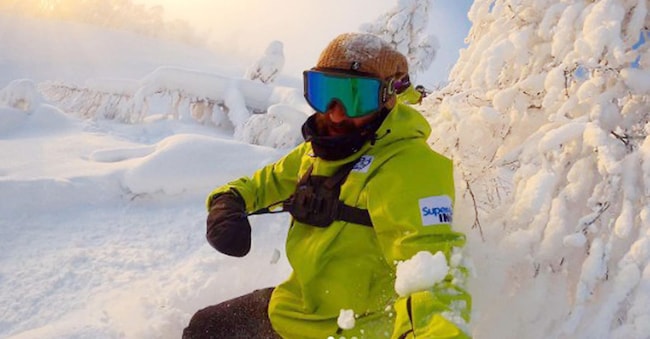
Temperatures too high yesterday for the snow in the Dolomites. But they can't melt the dreams of glory of the Italian snowboarders. Jacopo Luchini and Riccardo Cardani passed the qualification in the snowboard cross SB-UL (i.e. for athletes with disabilities in one or both upper limbs that impair balance) and today they will be playing for medals, also counting on the new prostheses made by the Inail Centre in Budrio. Luchini, born with an aplasia in his left hand, and Cardani, whose left hand was amputated after an accident, are counting on it: months of hard work and the tailoring work of the Bologna-based institute capable of equipping them with an upper limb that favours greater thrust from the gate and gives the athlete more balance.
The Inail facility, inaugurated in 1961, takes in occupational invalids and civil invalids to give them new prospects in life and has a research area that also follows 24 Italian athletes, both summer and winter: 'Studies for high-level sport,' explains Andrea Cutti, head of applied research, 'become daily practice for all patients who come to Emilia. The work on the snowboarders' prostheses has left nothing to chance, also because the competitive level has risen so much in recent years and the federal technicians are especially afraid of the Chinese, athletes 'kept hidden' at international events to then monopolise the Olympic podiums, through which Xi Jinping's regime makes propaganda.
"The complexity of Luchini's and Cardani's devices," says Cutti, "comes from finding the shape of the end part of the prosthesis that is best suited to the gate knobs, which are of varying nature, and from the 'tightness' of the prosthesis on the arm during thrust, which must be balanced with the overall comfort of the prosthesis. The snowboarders have chosen different solutions, demonstrating how each prosthesis is born from listening to the athletes, the real drivers of innovation, then used on amateur athletes and patients". And once the prosthesis has been found, we move on to measuring thrust, carried out with the Faculty of Sports Engineering at the University of Padua, led by Professor Nicola Petrone: performance is monitored with dynamometers placed on the gate or on the ski or boot to determine thrust. Olympia's project with the university has also led to the development of a monoski for people starting out in winter sports: it is a carbon-fibre shell, with a titanium and aluminium structure and suspension systems capable of amortising at a low cost, to offer an entry-level monoskifor 3 thousand euro, as opposed to the 5-8 thousand euro of mid-high-end monoskis for Alpine ski sitting (for people with spinal injuries). All this is part of the Budrio Centre's mission: to provide users with the prosthetic part to approach sport as a new path in life.
The élite are advanced research that becomes everyday life: depending on the exercise to be performed, different prosthetic feet are needed and the costs rise, but now a carbon foil-accessory has been developed that is fitted over the base foot to make it more or less rigid. This solution, which originated for sportsmen and women, has been proposed to children who have rapid growth rates and therefore need to change prostheses. Study after study, the Olympia project is growing thanks to digital technologies and a network that links Budrio to the USA, Germany, the United Kingdom and France: "To speed up laboratory techniques," explains the engineer, "we make artificial intelligence learn how technicians work, so they have more time to listen to the patient and understand his needs: the machine will never replace man, the best will come from dialogue. As well as from 3D printing for prostheses, but once again, underlines Andrea Cutti, 'what counts - and this is the organisational model of the Centre - is an integrated approach: to provide the athlete with prostheses and advice, from the doctor to the orthopaedist, in real time to avoid injuries and ensure maximum comfort'. Basically, what the two technicians Antonio Pujia and Massimo Rambaldi are doing here, in Cortina, following the Italian snowboarders. In the hope that the haul of 33 medals won by the Azzurri followed by the Budrio Centre in the Paralympics in the past can grow again today.


