Survey by Made-Competence Centre

Companies rush into the aerospace business

Of the companies surveyed that are not currently active in the sector, 85 per cent aim to enter it. For those already operating in the sector, the challenge is to scale up production efficiently

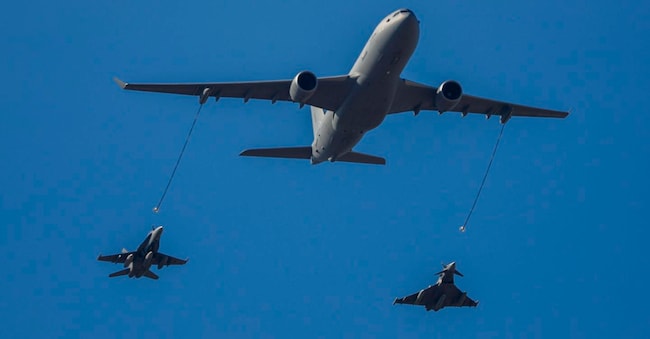
 EPA

4' min read

Translated by AI
Versione italiana

4' min read

Translated by AI
Versione italiana

Whilst the Italian and European automotive sectors are struggling, the aerospace industry is attracting growing interest from businesses seeking growth sectors and new business opportunities. This is also confirmed by a recent survey carried out by Made-Competence Centre, which highlights that, in technological terms, the gap between manufacturing companies already operating in this sector and those wishing to enter it is minimal.

What makes the difference, above all, is access to networks, the availability of information and knowledge of the documentation required to operate in the sector.

Loading...

These are the findings of a survey carried out by Made – Competence Centre for Industry 4.0, involving 202 companies: 94 already operating in the sector, 88 interested in entering it and 20 which, by contrast, have not expressed any interest.

This survey was conducted with the aim of examining the main challenges and needs of manufacturing companies, identifying the areas where action is required to support them as they enter and develop within the aerospace and defence sector. The results were presented in Milan at the event ‘MADE 4 Aerospace & Defence: challenges, requirements and opportunities’.

The starting point is the strong interest in the sector. Of the 108 companies not yet active in the Aerospace & Defence sector, 85 per cent have stated their intention to enter it. The areas of greatest interest are defence (73 per cent) and aeronautics (66 per cent), followed by drones (35 per cent) and the space economy (26 per cent).

This interest does not automatically translate into business opportunities: around two in three of the companies interested in joining the supply chain have not, in fact, yet received enquiries from potential customers.

For companies already in business, on the other hand, one of the main challenges is sustaining growth in production volumes whilst maintaining efficiency: nearly six in ten report difficulties in this area.

From a technological perspective, the gap between companies already operating in the aerospace and defence sector and those interested in entering it is relatively small. The former adopt, on average, 3.9 of the eight digital technologies covered by the survey, compared with 3.5 for the latter.

In digital design and simulation, adoption rates are broadly in line, at 76 per cent and 66 per cent respectively. The most significant gap, however, concerns data analysis and Business Intelligence, which are adopted by 50 per cent of companies already operating in the supply chain and by 24 per cent of those intending to enter it.

The difficulties in gaining access to the supply chain, therefore, do not depend solely on the level of technology adoption, but above all on the ability to establish relationships with prime contractors (cited as an obstacle by 47 per cent of both companies interested in entering the sector and those already operating within it) and to identify the right training topics (36 per cent).

Loading...

Operating in the aerospace and defence sector requires verifiable documentation of what is produced, the processes employed and the checks carried out, using tools and procedures that ensure traceability, documentary evidence and statistical process control. Implementation times represent a further challenge, whilst costs are cited by only 24 per cent of the companies in the sample.

This sector forms part of a growing industry that is becoming increasingly strategic for the country’s industrial competitiveness.

In 2024, the Italian aerospace sector recorded a turnover of 21.4 billion euros and employed 54,300 people, with 80 per cent of the supply chain comprising SMEs. Growth was driven primarily by the space sector, which rose from 1.9 billion in 2021 to 3.1 billion in 2024.

Globally, according to the report by the Mimit Research Centre, the space economy could be worth 1,790 billion dollars by 2035. Over the same timeframe, Confindustria estimates that investment in the national aerospace, defence and security sectors could generate up to 3 additional percentage points of GDP.

“Aerospace and defence,” comments Miriam Merenda, Managing Director of Made, “are two rapidly expanding sectors, and Italian manufacturing companies largely possess the skills and technologies needed to enter them: the data suggest that the gap is minimal. The gap is of a different nature and concerns access: understanding the requirements precisely, knowing how to demonstrate them through reliable documentation and data, and identifying the right contacts within a selective supply chain built on trust. These are areas where companies, especially smaller ones, need guidance. Made works precisely in this direction, helping companies to understand the sector’s requirements, identify areas for improvement and make the most of the skills they already possess. The aim is to make the process of gaining access to the supply chain clearer and more structured, facilitating connections between companies and the emergence of new opportunities for collaboration.”

The needs expressed by businesses confirm this trend: on average, around 65 per cent would like an assessment of their know-how, whilst 67 per cent would like clear information on how to access the supply chain.

Copyright reserved ©
Loading...

Brand connect

Loading...

Newsletter

Notizie e approfondimenti sugli avvenimenti politici, economici e finanziari.

Iscriviti