
AI agents: user numbers in Italia have increased 10.8-fold – 65 per cent of tokens compared with 55 per cent in the EU
The new OpenAI report provides an overview of how its tools are being used by European customers. These are indications of the use of ‘ChatGPT’, not evidence of measured savings or productivity gains.
by Luca Tremolada
 Aggiungi Il Sole 24 Ore
ai preferiti su Google
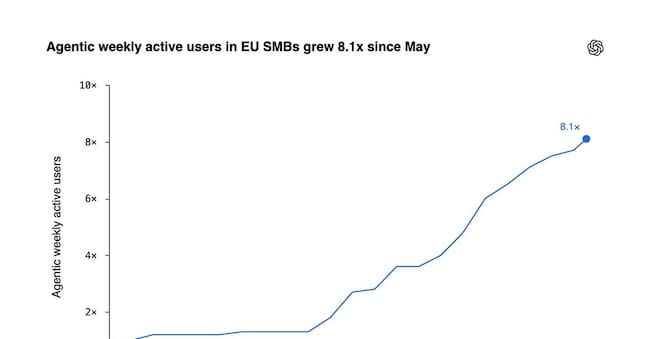
55 per cent of text tokens generated by OpenAI’s corporate clients in the European Union now come from the agent-based tools Codex and ChatGPT Work. In Italia, this figure rises to 65 per cent, whilst the number of weekly active users of these tools in the small and medium-sized organisations analysed increased 10.8-fold between May and early October, compared with 8.1-fold for the EU average. These are the key findings from *Europe’s Agentic Opportunity*, the October report in which OpenAI details the rise of intelligent agents in Europe. So, to be clear, this is what Sam Altman observes by looking at how ChatGPT is being used on his servers. The company measures the usage of its products, and these percentages describe the volume of text generated, not the proportion of businesses adopting agents or the gains in productivity.
The argument is that Europe must move on from the widespread adoption of artificial intelligence to a more in-depth application of it. Agents are systems capable of carrying out tasks involving multiple steps: planning an activity, using tools, processing documents or writing code. The user sets an objective and delegates part of the work, with a degree of autonomy that requires oversight.
There are marked national differences
The proportion attributed to agent-based tools stands at 85 per cent in Lithuania, 65 per cent in Italia and 51 per cent in Germany; it falls to 30 per cent in Spain and 22 per cent in Slovenia. These are differences within OpenAI’s user base: interpreting them as a ranking of European innovation would be a stretch.
The most interesting trend concerns small businesses (in the American sense). Between May and early October, the number of weekly active users of agency-based tools increased 8.1-fold in the EU and 10.8-fold in Italia. The report, however, classifies organisations with no more than 200 registered users as small and medium-sized, a criterion that differs from the European definition of SMEs. It does not provide the absolute baseline figures and specifies that much of the increase followed the launch of ChatGPT Work in July.
There remains a gap with the US.
The EU is home to around 10 per cent of the companies that OpenAI classifies as being in the highest usage bracket, compared with 65 per cent in North America. Here too, ‘high usage’ means more tokens per user: not necessarily greater efficiency. The opportunity for Europe lies in integrating these tools into business processes, particularly those of smaller companies. To determine whether this works, further metrics will be needed: time, costs, errors and the quality of work.

