
AgoraEU: Culture put to the test by the EU budget
The demonstration in Brussels on 29 October against the proposal to cut funding for AgoraEU by 30 per cent has reignited the debate on the priorities of the 2028–2034 EU budget: a sector with a turnover of 524 billion and 8.9 million employees

Key points
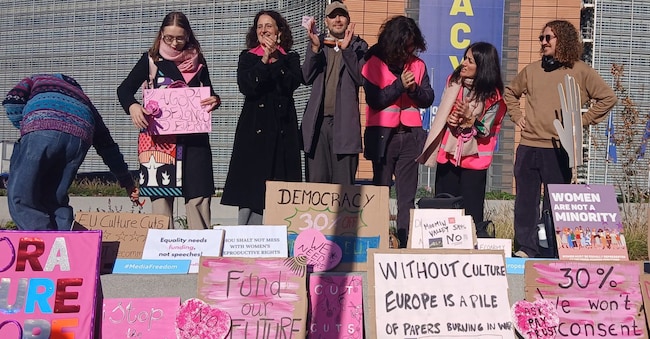
The battle over the future of European funding for culture has moved onto the streets. On 29 October, in Brussels, over 150 artists, cultural professionals, journalists and representatives of civil society gathered in Schuman Square, in the heart of the European institutions district, to protest against the proposed 30 per cent cut to funding forAgoraEU, the new framework programme dedicated to culture, media and democratic participation. Under the slogan Stand up for AgoraEU: Protect culture, media and civil society, the campaign promoted by Culture Action Europe, Civil Society Europe, European Civic Forum and European Federation of Journalists, in collaboration with Future of Europe, has given voice to a protest backed by over a thousand European organisations. Among the participants was Nela Riehl, Chair of the European Parliament’s Committee on Culture and Education, who drew attention to the consequences of funding cuts for cultural organisations, independent media and civil society. This mobilisation goes far beyond simply defending funding for the sector and draws attention to a broader question: what place does Europe intend to reserve for culture over the next seven years?
The issue of resources in the new European budget
The dispute over AgoraEU comes at a crucial juncture for the future of the European Union. The negotiations on the new multiannual financial framework for 2028–2034 do not, in fact, concern only the allocation of available resources, but also the definition of the strategic priorities in which Europe intends to invest over the coming years. These choices are set to influence the Union’s position in an international context characterised by growing tensions, new challenges and the redefinition of global balances. The budget proposal presented by the European Commission on 16 July 2025 alongside the Communication A dynamic EU Budget for the priorities of the future (COM(2025) 570), with a total budget of almost 2,000 billion euros, reshapes the Union’s investment priorities, placing particular emphasis on competitiveness, security and technological innovation.
Of particular significance is the establishment of the new European Competitiveness Fund, with a budget of around 234 billion euros which, when added to the 175 billion earmarked for Horizon Europe, would bring the total resources allocated to competitiveness, research and innovation to around 409 billion, within a framework in which the proportion of the budget allocated to competitiveness would rise from 17 per cent to 30 per cent between the current programming period and that proposed for 2028–2034.
Culture: cuts on the horizon
But what sort of innovation are we talking about? Whilst in the previous 2021–2027 programming cycle, culture and creativity were also recognised as drivers of innovation, capable of contributing to the experimentation with new social, economic and cultural models, in the proposal for 2028–2034, a conception of innovation linked to industrial and technological development, the reduction of dependence on foreign countries and the strengthening of Europe’s strategic autonomy appears to take centre stage. This shift in perspective is also reflected in the new architecture of Horizon Europe. Indeed, in the current programming period, the Cluster 2: Culture, Creativity and Inclusive Society explicitly recognises the contribution of culture, the humanities and the social sciences to research and innovation, by funding projects dedicated to cultural heritage, democracy and socio-economic transformations; a standalone thematic area which, however, appears to have disappeared from the proposal for 2028–2034.
Until now, the recognition of culture as a cross-cutting driver of innovation had enabled it to be funded through various European programmes, ranging from research to training, and from territorial development to social innovation. In the proposal for 2028–2034, however, a change of direction appears to be taking shape: culture risks losing its cross-cutting role in European investment policies, with the danger that support for it will become increasingly concentrated in AgoraEU. This perspective gives the financial allocation a very different weight: it is not merely a question of determining how many resources to allocate to culture, but also of understanding what scope and what tools will be recognised for it in future European strategies. At stake is a reduction of 2.6 billion euros compared to the initial allocation proposed by the European Commission on 16 July 2025, which provided for a budget of approximately 8.6 billion euros for AgoraEU.
This forecast was scaled back by the negotiating proposal put forward on 10 October 2026 by the Irish Presidency of the Council of the EU, which would reduce the funding to around 6 billion, a cut of 30 per cent. This proposal is not yet final, and the European cultural organisations, media and civil society organisations have responded by calling for at least 10 billion euros, in line with the position expressed by the European Parliament on 28 April 2026, which favoured an allocation of 10.72 billion – over 2 billion more than the Commission’s initial proposal.

