
The agri-voltaic market kicks off
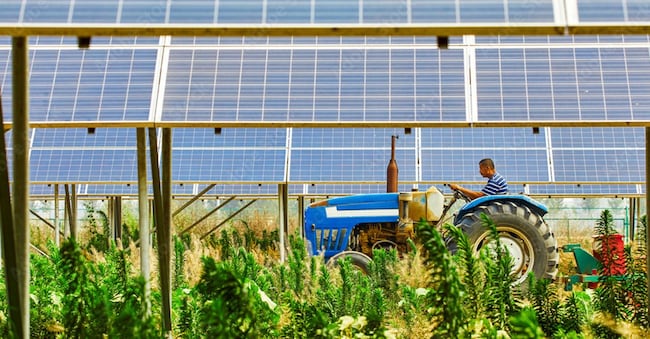
According to Althesys, solar panels raised in fields without clearing arable land offer many environmental, energy and economic benefits. Realistic target of reaching 22 Gigawatts installed in our country in 2030

3' min read
3' min read
The call for NRP funding for agri-voltaics closed last Wednesday. Of the 1.1 billion resources dedicated to the measure, applications received amounted to 920 million euro, for a total of 643 projects and a total capacity of over 1.7 gigawatts. The numbers come from the Gestore dei Servizi Energetici, the body that manages the measure to support plants with an incentive tariff and a contribution of up to 40 per cent of costs. For the Minister of the Environment, Gilberto Pichetto Fratin, this result 'certifies the mature attention of the agricultural world towards solutions that make quality production and new renewable energy solutions coexist'.
The yes of Italian agriculture to photovoltaics in the fields, however, was not unanimous. The main associations in the agricultural sector have long fought against the placement of solar panels on the ground, which take arable land away from domestic crops. In the Agriculture Decree that came into force in July, the tug-of-war between farmers on the one hand, and energy utilities on the other, had to be resolved with a compromise: photovoltaic panels for solar energy production can no longer be installed on the ground in agricultural areas, but only on supports raised at least two metres above the ground and on the roofs of stables and farmsteads. "Saved are thousands of hectares of fertile land that have become the object of the desires of speculative funds and energy players in recent months, driven by the race for decarbonisation and incentives," Coldiretti commented in a note.
Targets to 2030
.However, our country has set a target of more than 131 Gigawatts of energy produced from renewable sources by 2030: compared to 2021, this means installing 73 GW of new capacity, almost 80 per cent of which will come from solar technologies. This is why many are looking with interest at agro-voltaics. According to the latest Irex report by the consulting firm Althesys, the development potential of agrivoltage in Italy is very high: last year agrivoltage was the technology that grew the most, counting projects for almost 16 GW, about 41% of the total mapped, and worth about 12 billion euro. If the growth trend continues at this rate, by 2030 agri-voltaics in Italy could reach an installed capacity of about 22 GW, equal to 58% of the new ground-mounted plants that will be built by 2030.
Accounting in the Fields
.The impact of panels in the fields is not all negative: 'You have to make the algebraic sum between the cost items and the benefits,' argues Alessandro Marangoni, Althesys CEO. 'There is no doubt that with the placement of solar panels, the cultivatable surface area could be reduced and, with it, also part of the Pac contributions. But against these minuses, there are some plus signs: the first is the income from renting out land to energy producers. While from a strictly agricultural point of view, raised panels in the fields favour water saving because they reduce evaporation by keeping crops sheltered, as well as protecting them from extreme weather events. Althesys' calculations do not hide the fact that with agri-voltaics there would be a loss of arable land, quantified at 9,900 hectares, equal to 0.08% of the national Sau. But between the water saving, shading and microclimate that agrivoltaics manages to create with certain crops, the contextual increase in agricultural yields would compensate for the reduced land use, containing the loss of production to 44 million euro by 2030. Instead, the additional income from land rent would amount to more than EUR 320 million. The balance, therefore, would ultimately be positive.
Many investors are interested in agri-voltaic technology: 'Many subjects have presented projects, even beyond those financed by the NRP,' says Marangoni, 'and many of these are projects in partnership with farmers. Certainly, however, the risk of speculation or negative landscape impacts exists for renewable energy plants.


