
Agricultural land: 4,000 hectares lost in 2023, 400 due to photovoltaics
The land value of land that has gone solar is 9.7 million euro and is heavier in the North. For Ismea, 'this is not marginal land, but unlike concrete, the phenomenon is not irreversible'.
by E.Sg.
2' min read
2' min read
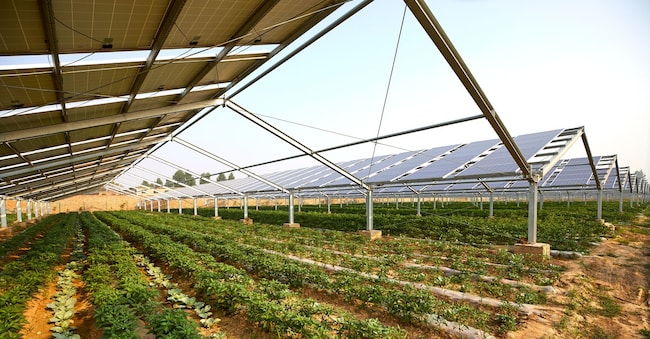
Between abandonment, concreting and changes of use, another 4,000 hectares of agricultural land were lost in 2023; a phenomenon also due to the installation of ground-mounted photovoltaic systems which, according to an Ismea estimate, involved just under 400 hectares, 9.5% of the agricultural land consumed in the year, albeit with a different territorial intensity.
These are data from a focus by the Istituto servizi per il mercato agricolo alimentare (Institute for Agricultural Food Market Services), combined with an Ispra report, highlighting at the level of geographical macro-divisions a higher incidence of land converted to photovoltaics in the North, with 46.5% of the approximately 400 hectares, against 40% in the South and Islands and 13.5% in Central Italy. Veneto, with just over 17% of the total, leads the regional ranking, followed by Piedmont and Sicily, with about 14% each, and Lazio and Sardinia with 11.5% and 11% respectively. Marginal is the 'covering' effect in Apulia, with just over 2%, and especially in Umbria, Marche, Tuscany and Campania, each with 1%; no contribution, however, from Trentino-Alto Adige, Val d'Aosta, Liguria, Molise and Calabria.
The phenomenon, which implies an effective consumption of agricultural land but which, unlike concrete, does not take on an irreversible character, Ismea points out, involved 51% of rural areas with intensive agriculture, mostly in the plains and hills, whose economic and productive impact is greater than in other contexts; 28% fall in areas classified as 'intermediate', 13% in inland areas with development problems, also subject to depopulation phenomena, and only 8% in urban and peri-urban areas. There is therefore no question of marginal areas; it should also be noted that there is an overwhelming prevalence of arable land, mostly in lowland territories; in the Centre-North it concerns 95% of agricultural land, compared to 77% in the South. Overall, national soil coverage with photovoltaic panels has accumulated over the years an extension of about 18,000 hectares, between agricultural and non-agricultural land.
Overall, national land coverage with photovoltaic panels has cumulated an extension of about 18,000 hectares over the years, including agricultural and non-agricultural land. The focus also provides an estimate of the land value of the land switched to "solar" in 2023, amounting to 9.7 million euros, carried out from agronomic-estimative indicators derived from the Institute's databases.
"The inter-institutional collaboration with Ispra (Higher Institute for Environmental Protection and Research) and Snpa (National Environmental Protection System), for now of an experimental nature, is part of a broader Ismea project that envisages the establishment of an 'Observatory of national agricultural and rural lands'," a note specifies.
"The aim," explains Ismea's director general Sergio Marchi, "is to continuously monitor data on land consumption and use in Italy, with a view to assessing and anticipating possible agricultural, rural and food sovereignty implications. These are issues that will contribute to a better understanding of the phenomena at work in support of the governance of the agri-food system, with impact assessments on the relationships between different options, including on the trade-off between the preservation and strengthening of the country's agricultural production potential and the development of renewable energies'.


