
Agriculture, the hydrogel that makes plants grow with zero impact. The project by the University of Bolzano and the Iit of Genoa
A scaffold that makes it possible to grow plants above ground with very little water Biodegradable materials that disintegrate in the soil without residue
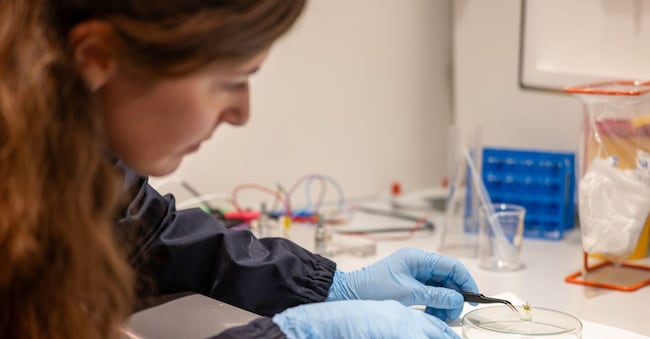
2' min read
2' min read
A completely biodegradable and biosustainable hydrogel system that can grow plants with very little water and in the future aims to monitor their health in real time. This innovation, which could rapidly revolutionise agriculture, is the result of joint research by the Faculty of Engineering of the Free University of Bolzano and the Italian Institute of Technology (IIT) in Genoa.
Fighting drought and pollution
In particular, in the laboratories of the IIT in Genoa, a biopolymer hydrogel scaffold was created with the addition of natural biostimulants that allows plants to be cultivated in soilless (hydroponics) and therefore with very little water, with biodegradable materials that disintegrate in the soil without residues. The biopolymer used is carrageenan, a polysaccharide extracted from red algae that is commonly used for its gelling, thickening and stabilising properties. In this work, whole algae extracts were added to carrageenan as biostimulants, i.e. products that, when applied to plants, stimulate natural processes to improve nutritional efficiency, stress tolerance and crop quality, regardless of nutrient content. Experiments on actual plant growth were carried out in the Bolzano laboratories. This is a waste-free and environmentally neutral solution for agriculture, which is threatened by climate change, drought, pollution, loss of biodiversity and soil degradation.
Low water and zero impact irrigation
.In agriculture today, super-absorbent polymer scaffolds, which are, however, made of polluting materials, are becoming increasingly popular. At the same time, biopolymers in agriculture are now being used as a sustainable alternative to plastic materials for mulch films, pots and plant ties. In Bolzano and Genoa, super-absorbent scaffolds made of biopolymers are being tested and created, which promote plant growth by retaining water (swelling up to 7000% in various substrates) and enhancing nutrient supply, but which are additionally sustainable and biodegradable, ensuring water-saving and zero-impact irrigation. The South Tyrolean scientists also plan to insert sensors - also flexible and biodegradable - into these hydrogel scaffolds in the future, enabling precision agriculture by monitoring plant health and soil conditions in real time.
Multidisciplinary project
.The research, published in the journal ACS Agricultural Science & Technology, published by the American Chemical Society (ACS), is the result of a multidisciplinary project involving a team of researchers from the Faculty of Engineering at the University of Bozen/Bolzano: IIT and uniBz researcher Camilla Febo, professors Paolo Lugli and Luisa Petti from the Sensing Technologies Lab at unibz, in collaboration with prof. Tanja Mimmo and Luigimaria Borruso from the Faculty of Agricultural, Environmental and Food Sciences at unibz, within the framework of the collaboration of the Plant Health Competence Centre, and Athanassia Athanassiou, researcher in charge of the Smart Materials unit at the IIT with Danila Merino, IIT researcher.

