
Agrigento Capital of Culture 2025 will bring Melqart back to Sciacca
A loan of the Phoenician statuette from the Salinas Museum, closed for 13 years, is planned. At the G7 Culture in Naples, the importance of returning cultural assets to their communities of origin to strengthen ties with the territory

5' min read
5' min read
While many were already giving it up, slowly, 'Agrigento Capital of Culture 2025' is taking shape. The Foundation that had been expected since last winter was established last August. Also in late summer, the decrees for expenditure were approved. Among them, Regional Decree 2931 of 29 July 2024 with the Programme for the financial year 2024 sets out the initiatives for the promotion and organisation of 'Agrigento Capital of Culture 2025'. Among the expenditure items totalling €4 million, €25,000 has been earmarked for 'The return of Melqart - exhibition of the work in the city of its discovery' with the assurance by Agrigento's councillor for Culture and Tourism Costantino Ciulla that 'it will be exhibited in Sciacca itself' without commuting to the territory of Ragusa.
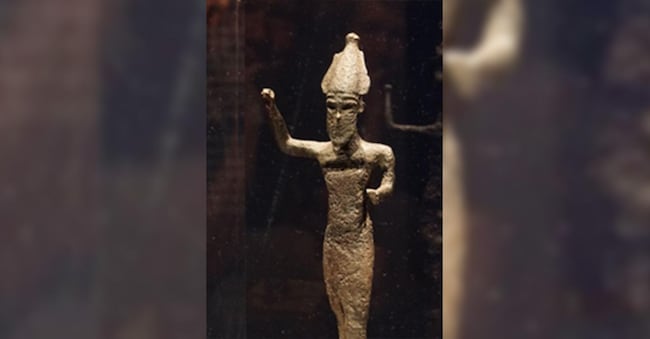
This seemingly negligible budget item is dense with significance. The Melqart (recently identified with the god Haddad) is a Phoenician bronze statuette, dated between the 13th and 11th centuries B.C., found off the coast of Sciacca, Agrigento and kept at the 'Antonino Salinas' Regional Archaeological Museum in Palermo. The story of the find and the change of hands is interesting because it shows how, at times, the cultural policy of autonomous regions differs from that of the country where the logic of assigning small museums to the 'diffuse museum' prevails.
The Journey
.To understand this divergent trend, we need to retrace the story of the Melqart. In January 1955, off the coast of Sciacca (over 20 miles), the crew of the motor vessel Angelina Madre found a small statuette in the net. The motorman on board, a certain Santo Vitale, takes it home and gives it to his father Calogero Vitale, the owner of a grocery shop in Mazara del Vallo where the find is displayed. Shortly afterwards, the statue is in the hands of the Saccense Giovanni Tovagliari, who has it studied and appraised by the art historian, Stefano Chiappisi. The scholar is the first to identify the asset as one of the three representations of the Phoenician sea deity. Once Tovagliari became aware of the object's precious value, he decided to donate it to the municipality of Sciacca to be preserved in the town. The Melqart was entrusted to Monsignor Aurelio Cassar, who kept it in the municipal library. The Superintendency of Agrigento, which learnt of the donation, opposed it, claiming that the asset was State property (non-transferable and not usucapable) and, therefore, could not be donated. Thus began a dispute before the Court of Sciacca between the municipality, the Superintendency of Agrigento, in which Tovagliari and the owner of the fishing boat, Scaglione, argued that the asset was, at the time of its discovery in international waters, res nullius or res derelicta. In a ruling of 9 January 1962, the Court of Sciacca sanctioned the Italian State's ownership of the Melqart, claiming, with double fictio iuris, that a ship flying the Italian flag is considered an extension of State territory and so is its net, and arranged for the archaeological asset to be entrusted to the Agrigento Superintendency, which exchanged it for a crater with the Salinas in Palermo, where the Melqart is still located today. However, since the Salinas has been closed for restoration since 2012, the statuette has not been available to the public for 13 years, except for a few temporary loans.
The discovery of the statuette provides important information on Phoenician expansion in the West that tends to lower its dating, but there is more: from the moment it was assigned to the Salinas, the people of Sacceno have expressed the desire for the Melqart to be exhibited in their city, demonstrating an 'attachment' to the archaeological asset that should not be underestimated. While the Salinas was closed to the public (from 2012 to the present day), the Saccensi's requests for its return were reiterated by means of three questions, two of which were submitted to the Sicilian Regional Assembly between 2013 and 2018 and one local and formalised in a proposal to entrust it to the municipality on loan for use at the premises of the 'Aurelio Cassar' Municipal Library in Sciacca, which were deemed unsuitable.
In the years that followed, Gaspare Falautano headed the association 'Friends of the Museo del Mare' and also the local association L'AltraSciacca with the initiative and video 'Sciacca wants it back'. In support of his request, Falautano cites the recent interpretations of the Code of Cultural Assets, 'in which,' he writes, 'a principle is sanctioned on the basis of which an artefact must be kept within the territory in which it was found, provided, of course, that the conditions exist on site to ensure adequate protection and conservation, conditions that exist at the Sciacca Sea Museum, which is also equipped, ad abuntantiam, with a special case with controlled humidity and temperature'. Of the same opinion is Sciacca's culture councillor Salvatore Mannino who explains that there is already a copy of the Melqart in a room of the museum. The president of the AltraSciacca, Stefano Siracusa, hopes that the temporary loan will pave the way for a rethink about the final location of the asset.

