
'Aguante': Giovanni de Cataldo's art between Italy and South America
International project supported by the Italian Council interweaves sculpture, urban cultures and football fans, including exhibitions, residencies and partnerships

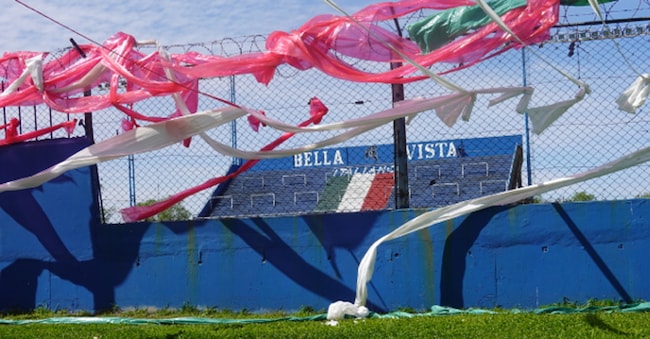
With "Aguante", the new project by Giovanni de Cataldo, among the winners of the 14th edition of the Italian Council supported byThe Fondazione Pastificio Cerere of Rome, in partnership with Muntref - Museos de la Universidad Nacional de Tres de Febrero of Buenos Aires strengthens the international vocation of Pastificio Cerere as a place of artistic research and experimentation. The Roman artist's work - born at the intersection of sculpture, urban languages and participatory practices - is now ready to develop on a global scale thanks to a network of institutions that will accompany it until 2027, when the works - eight large-scale tapestries (up to 5 metres wide) a visual map of a transnational identity that recalls the banners of the supporters' teams, emphasising the sacredness of football, accompanied by a video-documentary and a publication published by Yogurt - will enter the collection of the Palazzo Collicola Museum in Spoleto.
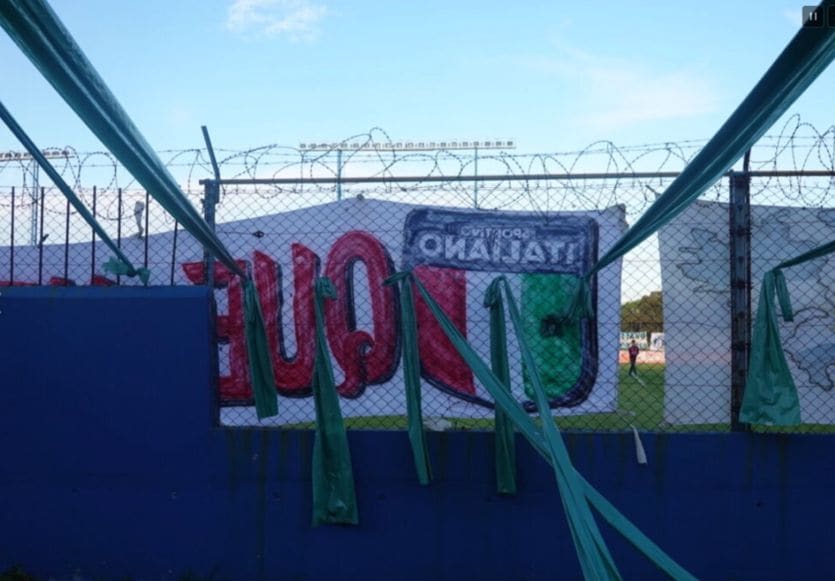
The project will take place in Rome, Buenos Aires, Mexico City, New York, Córdoba and Barcelona, alternating exhibitions, artist residencies and educational programmes. A path designed to create connections between artistic practices, metropolitan subcultures and technologies that are transforming the way contemporary sculpture is understood. This is also an important occasion for the Pastificio Cerere Foundation, which once again confirms its role in supporting emerging talents and projects of international scope.
At the basis of the selection by the Italian Council is a choral work involving the artist and the Foundation. In addition to de Cataldo, the Claudia Cavalieri, director of the Foundation, and Marcello Smarelli, artistic director, contributed to the construction of the project and followed its development step by step.
The Cheer of Giovanni de Cataldo
To understand the scope of 'Aguante', it is useful to look at the research that de Cataldo has been carrying out for years, often in the very spaces of the Pastificio Cerere. At the centre of his work is the world of organised supporters and the cultures that arise around stadiums. A theme tackled first with "Ultimo Stadio" (Last Stadium), a direct and unfiltered investigation into the ultras imaginary, and now with "Aguante", which broadens the gaze towards South America. Here, football fans are not just a sporting passion: they are collective memory, popular identity and, above all, the result of a long history of Italian migrations. 'The project comes from afar,' says de Cataldo. "I have been working on it for three years, ever since I did a residency in Buenos Aires. My practice stems from the urban context, but over time my interest has shifted to those who live that context: the subcultures, the communities. In Italy, I worked on organised supporters, and it was from there that the desire to go to Argentina to study not only supporters but also immigration was born. Seventy per cent of Argentinians have Italian origins: it is a huge story, which gave me the inspiration to develop Aguante'. The term 'aguante', the artist explains, encapsulates the profound meaning of Argentinean fans: resistance, unconditional support for the team, a visceral bond with the colours. "For me, it also recalls the resistance of the Italians who, after the war, left a destroyed country to seek a new life".
During his residence in Argentina, de Cataldo visited neighbourhoods and communities where cheering takes on ritual and familiar forms, very different from those in Italy: 'I met organised fans who participate in religious processions, often linked to Italian traditions. I photographed murals dedicated to Argentines of Italian origin, although there are not many of them. My research is, after all, a great documentation: nine tapestries will be born from the photos, each one dedicated to a different moment, from the pre-match - with its rituals, carne asado and street parties - to the religious celebrations'.
Claudia Cavalieri's network
'Building the partnership network,' explains Claudia Cavaliere, director of the FondazionePastifico Cecere, 'was one of the most important challenges of the project. Over the years, the Italian Council has changed a lot: when we took part in 2018 with Margherita Moscardini and in 2020 with Namsal Siedlecki, it was not compulsory to have a foreign partner for the section dedicated to the production of the works; today, on the other hand, it is an absolute requirement, and this makes the process more complex, especially for realities like ours'.

