
Ai, cognitive delegation and creativity: the challenge changing universities and work
In Trento, Gionata Tedeschi presents his 'Regenerative AI' and reflects on the change introduced by the new technological revolution with Franco Bernabè
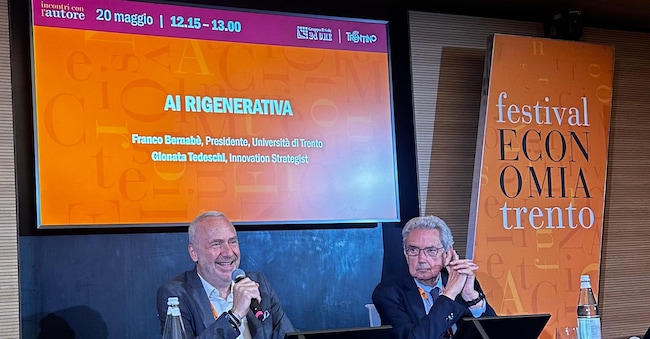
"Ai has something different from other technological revolutions. The risk is cognitive delegation. Because thinking is what defines our identity. That is why a posture of responsibility is required in the face of generative Ai'. This is how Gionata Tedeschi, Innovation strategist, introduced the themes of his "Regenerative Ai" during the "meeting with the author" in Trento , a book published by Il Sole 24 Ore where he does not give answers "because they expire in a month", but applies "a dialogical method, made up of meetings with entrepreneurs, philosophers, students and professionals to build a map through the sparks that emerge from the confrontation".
An effort that finds its way far from catastrophism and utopianism: 'Artificial intelligence is like a mirror, if we place ourselves negligently the results will be negligent, if superficially they will be superficial, but if we place ourselves with the full extent of our possibilities we can achieve extraordinary results'. According to Tedeschi, 'protecting "serendipity", i.e. the ability to leave room for the unexpected, is today a cultural and educational responsibility'.
Franco Bernabè agrees: 'The problem I see is also generational. For those who, like me, have already been through a long professional experience, artificial intelligence is an extraordinary productivity multiplier because you already have an established structure of knowledge and questions. But this advantage is not distributed in the same way. Kids today use Ai in middle school. And 90 per cent of them at university'. This has several risks, because younger people risk asking Ai questions uncritically. "Here a division arises: on the one hand, those who know how to use it and increase their cognitive and productive capacities; on the other hand, those who do not use it or use it passively and risk a progressive cognitive degradation".
On one point, however, the comparison shifts to a more structural level. 'In a world where information is freely available, even complex information, what we used to do at university - search, select and interpret information - is partly outdated'. The problem, Franco Bernabè observes, is no longer access to knowledge, but what comes next: the ability to generate creativity.
'The university is a very conservative institution,' he emphasises, 'it is not structured to develop creativity but to transmit knowledge and consolidate existing paths'. Yet, he adds, that is precisely where the decisive game is being played today, because creativity does not coincide with the accumulation of information, but with the ability to combine, take risks, and produce new solutions. An aptitude that often, he observes, also develops outside traditional academic paths, in business and in direct experience.


