Digital Economy

AI is driving the smart factory forward, but Italian businesses are struggling to keep up

Companies are implementing individual projects without addressing the issue as part of a long-term strategy. Artificial intelligence offers opportunities for development, but the data is not always used effectively

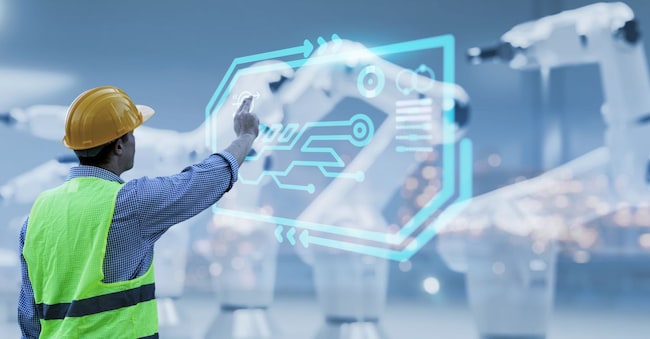
(Adobe Stock)

3' min read

Translated by AI
Versione italiana

3' min read

Translated by AI
Versione italiana

Artificial intelligence is knocking on the doors of Italian factories. But not all of them are ready to open them. This is the picture that emerges from the latest report by the Internet of Things Observatory at the Politecnico di Milano: a mixed picture of an industry that recognises the potential of new technologies but is struggling to translate this into strategy.

The figures tell the story of two industrial Italies. Among large companies, 71 per cent have launched at least one Industrial IoT project, comprising sensors, connected machinery and monitoring platforms. Among medium-sized enterprises, this figure drops to 59 per cent. But the most significant gap concerns the long-term vision: only 29 per cent of large companies and just 6 per cent of medium-sized ones have established multi-year programmes involving several departments.

Loading...

“There remains a significant gap in terms of the industrial strategies underpinning the projects,” note the researchers at the Politecnico. The majority of initiatives – 41 per cent among large firms and 69 per cent among medium-sized firms – remain confined to ‘one-off’ measures: specific projects focusing on individual production lines or machines, without an overarching strategy.

The paradox is that Italian factories are producing ever-increasing amounts of data, but often do not know what to do with it. No medium-sized company reports carrying out advanced processing of the information generated by its IoT systems: not even a quarter of large companies do so, whilst the rest merely use the data ‘in its raw form’ or, worse still, leave it unused.

When data is actually used, it is predominantly for diagnostic purposes: to monitor performance and determine when to carry out maintenance. Predictive analytics, which aims to anticipate faults, optimise consumption and forecast demand, is used by only a third of active companies. Adaptive use – which enables systems to automatically adjust processes in real time – remains marginal: just 4 per cent.

Yet things are changing, and artificial intelligence is the driving force. In 2025, around one in three large companies had used AI to support industrial projects, an increase of eleven percentage points on the previous year. Medium-sized companies doubled their adoption rate over twelve months, rising from 6% to 12%.

The results, for those who have invested, are tangible. Two-thirds of companies with ongoing AI projects report improvements in operational efficiency, whilst 40 per cent report benefits in terms of innovation and competitiveness. And for four in ten companies, these benefits have already translated into a positive financial return on investment.

The most mature areas of application? Cybersecurity and image recognition top the list (55 per cent of advanced projects), followed by predictive maintenance and production optimisation. Further down the list are supply chain management and asset monitoring, where systemic complexity is slowing adoption.

The next frontier is already on the horizon: AI agents – autonomous systems capable of perceiving their context, reasoning, acting and adapting. Today, they account for only a fraction (7 per cent) of industrial projects surveyed internationally, but market forecasts point to significant growth in the coming years.

“The first promising investments are already being made in Italia,” notes the Observatory. The challenge will be to move from individual agents to orchestration: coordinating multiple autonomous systems under a single control centre, whilst ensuring transparency and oversight. This paradigm shift will require new skills and robust governance.

Public incentives continue to support – but also to complicate – the path for businesses. The Transition Plans 4.0 and 5.0 have mobilised 2.2 and 2.5 billion euros respectively, acting as the main driver for machine connectivity. However, researchers point to ‘complexity and uncertainty in implementation’, with eligibility criteria and the availability of funds having been revised several times over the course of the year.

The Italian smart factory does exist, but it is still a work in progress. AI could be the driving force that accelerates this transformation – provided that businesses stop thinking on a project-by-project basis and start thinking in terms of the wider system.

Copyright reserved ©
Loading...

Brand connect

Loading...

Newsletter

Notizie e approfondimenti sugli avvenimenti politici, economici e finanziari.

Iscriviti