Flights

Air traffic chaos at US airports due to damage to infrastructure

A cable that was accidentally cut caused a disruption to communications on the first day of the UN meeting. Further disruption has also been reported in the UK

3' min read

Translated by AI
Versione italiana

3' min read

Translated by AI
Versione italiana

Thousands of flights were cancelled or delayed, and over 100 aircraft were diverted. A damaged fibre-optic cable in New Jersey disrupted communications for hours, putting one of the United States’ most important air traffic control systems under strain.

The result was a day of severe congestion in US airspace, which turned into a prolonged operational disruption in the north-east of the country. The problem was caused by accidental damage to a telecommunications line in New Jersey used by the Federal Aviation Administration (FAA). The disruption forced the federal agency to suspend or restrict arrivals at some of the region’s main airports for several hours, just as New York was preparing to welcome world leaders and international delegations gathered for the United Nations General Assembly.

Loading...

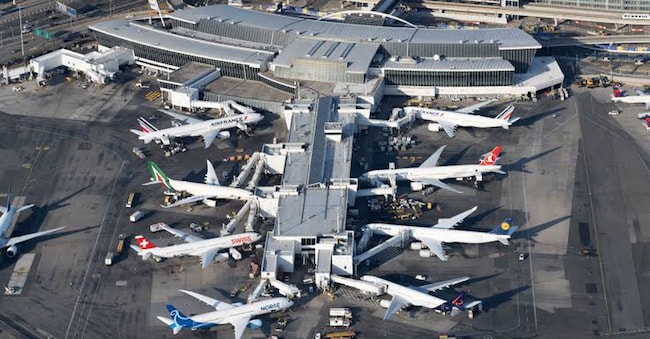
The restrictions affected the three main airports in the New York metropolitan area – Newark, LaGuardia and JFK – as well as the airports in Philadelphia and Boston and two other smaller airports in the region.

According to data from FlightAware, around 7,000 flights were cancelled or delayed during the day. At New York’s three main airports alone, the disruption affected around 1,400 flights.

The situation is particularly severe in Newark, a major hub for United Airlines. More than half of the scheduled flights have been cancelled, prompting the airline to introduce a waiver to its travel conditions to allow affected passengers to amend their bookings.

The circumstances surrounding the accident proved to be more complex than initially thought. The loss of communications was linked to a circuit at an air traffic control facility in Philadelphia which manages traffic to and from various airports in the region.

However, when the system attempted to switch to the backup line, a second problem arose: a team carrying out construction work had accidentally damaged a backup fibre-optic line as well.

The combination of the main circuit failure and the unavailability of the alternative line therefore drastically reduced the system’s capacity to handle air traffic.

The timing of the incident was particularly unfortunate, given the heavy traffic on the east coast and the arrival in New York of international delegations for the UN General Assembly.

The FAA therefore imposed the necessary operational restrictions to reduce the number of aircraft permitted to enter the affected area, with knock-on effects for airports across the entire North-East.

Loading...

Verizon, the owner of the telecommunications infrastructure involved, has confirmed that it has taken action to repair the cable and restore connectivity.

After eight hours, arrivals resumed and the situation gradually began to return to normal: Newark therefore reopened for arrivals, followed by LaGuardia. Philadelphia also resumed operations following the lifting of a second ground stop, whilst the ban imposed on Boston due to excessive traffic from other airports was subsequently lifted.

There have also been further disruption to traffic in the United Kingdom, where a technical fault on Monday caused delays and cancellations in the north of England and in Scotland, with knock-on effects on cross-Atlantic services.

The disruption was caused by National Air Traffic Services (NATS), the organisation responsible for air traffic control in the United Kingdom. The impact was felt most acutely on flights passing through Edinburgh, Glasgow and Belfast, as well as at Manchester Airport. Scotland also serves as a key corridor for numerous transatlantic flights.

The airlines have also confirmed these problems. British Airways, a subsidiary of the IAG Group, has reported disruption to passengers’ travel plans. EasyJet has also experienced delays and has criticised the recurring technical issues in air traffic management.

This incident comes just a few weeks after another serious malfunction affected the UK’s air traffic control system. On 8 September, a disruption led to the cancellation of thousands of flights over the course of several days. This latest disruption has reignited concerns about the technological resilience of the UK’s airport infrastructure, at a time when the operational continuity of air traffic control systems in one of Europe’s busiest airspaces has become a key issue for airlines, airports and passengers.

Copyright reserved ©
Loading...

Brand connect

Loading...

Newsletter

Notizie e approfondimenti sugli avvenimenti politici, economici e finanziari.

Iscriviti