Aeronautics

Airbus: announcement of a 5 billion buy-back sends the share price soaring

The group’s plan: to step up investment in defence and return to full production capacity in the aviation sector following the engine crisis.

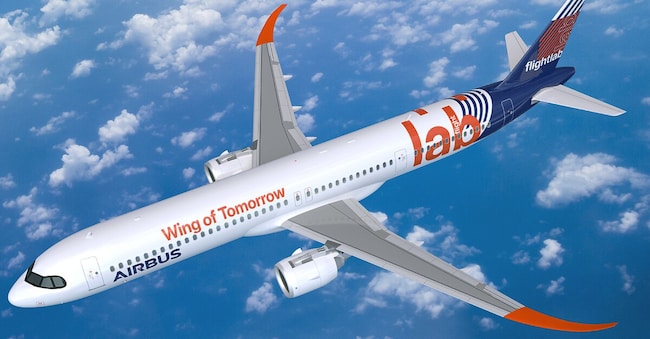
Durante l’air show di Farnborough Airbus ha presentato la nuova configurazione di ali per la nuova generazione di aerei

5' min read

Translated by AI
Versione italiana

5' min read

Translated by AI
Versione italiana

The markets have reacted positively to Airbus, which has unveiled an ambitious plan accompanied by new medium-term financial targets. Shares in the European aerospace group rose by more than 5 per cent following the announcement of a €5 billion share buyback programme and a target forecasting a significant increase in profitability by the end of the decade.

The European manufacturer aims to achieve an adjusted operating profit (EBIT) of between 12 and 13 billion euros in 2029, almost double the 7.13 billion recorded in 2024. The new target also exceeds the €7.5 billion target set for 2026, outlining a growth trajectory that management believes to be sustainable thanks to the expansion of production and the gradual resolution of supply chain issues.

Loading...

The commercial aircraft division will be the main driver of these results, with Airbus estimating that it could generate around €10 billion in operating profit in 2029. The group has reiterated its confidence in the structural demand for new aircraft and in its ability to gradually increase production rates, despite persistent supply chain pressures.

The world’s leading aircraft manufacturer had got off to a slow start to the year due to bottlenecks in the supply chain and engine production, but subsequently stepped up the pace of deliveries, increasing the number of aircraft delivered in the first half of the year by 15 per cent year-on-year.

‘The EIB credit line is not state aid’

Airbus’s move confirms a strategy based on financial prudence, rejecting the notion that its ample available liquidity represents unused capital. As CEO Guillaume Faury explained during a press briefing at the Farnborough Airshow, the net cash position should be viewed in conjunction with the company’s overall debt structure, which comprises bond issues, credit facilities and a range of financing instruments.

The stated aim is to maintain a significant financial ‘buffer’ capable of ensuring flexibility in the event of systemic shocks, as was the case during the Covid-19 pandemic. This context also includes recent bond market transactions, including a €750 million issue, and the credit facility agreed with the European Investment Bank (EIB), which Boeing has criticised as constituting state aid.

“It was negotiated on fully market-based terms, and only a marginal portion of the total €3 billion available has been utilised,” said CFO Thomas Toepfer. The message is clear: this is neither an extraordinary measure nor implicit public support, but one of the many financial instruments formed part of the group’s normal funding policy.

Structural demand underpins the aviation cycle

On the industrial front, Airbus continues to look confidently towards the long-term growth of air travel. Lars Wagner, CEO of the Airbus Commercial Aircraft division, explained that the potential market remains enormous: billions of people still do not have regular access to air travel, and this leaves scope for a structural expansion in demand. The target of reaching a global fleet of around 42,000 aircraft is considered fully sustainable thanks to the ability of the entire industrial ecosystem to gradually increase production rates.

For Airbus, the combination of growing demand and a limited number of global manufacturers represents a competitive advantage that is set to become even more pronounced in the coming years. In response to market demand, Airbus has confirmed that it is considering launching longer versions of its A220 and A350 aircraft, without giving any timeframe for a decision.

Defence: the European industrial model is changing

The analysis of the Defence and Space sector is far more detailed, with the group observing the emergence of an ecosystem that is profoundly different from that of the past. The rise in European military spending, the entry of tech start-ups and the growing importance of technologies such as artificial intelligence, autonomy, drones and space systems are transforming the traditional model of the defence industry. At the same time, the group is expanding its collaboration with innovative start-ups, as demonstrated by recent partnerships in the field of autonomous systems, including with Ukraine, as explained by Michael Schoellhorn, CEO of the Defence and Space division.

Loading...

According to the management, the European funding model is also changing: whilst in the past technological development was largely supported by government funds, companies now have to front-load an increasing proportion of their investments using their own resources, carefully selecting the strategic segments on which to focus their capital.

The priorities identified are autonomy, software, artificial intelligence and dual-use technologies. However, Airbus emphasises that the competitive advantage continues to lie in the ability to integrate advanced software with physical platforms, pointing out that ‘wars are not won by software alone’.

Helicopters: demand at an all-time high

The military helicopter sector also continues to benefit from the changed geopolitical landscape. According to Airbus, the experience of the conflict in Ukraine and operations in the Middle East has demonstrated the operational effectiveness of helicopters in both anti-drone missions and in evacuation, rescue and critical infrastructure protection operations.

Matthieu Louvot, CEO of Airbus Helicopters, emphasised that the Tiger has proven its operational capabilities and noted that 2025 saw record levels of orders, driven by growing demand for versatile, highly connected platforms.

Engines: Pratt & Whitney remains the bottleneck

In the commercial aviation sector, however, the main industrial challenge remains: the availability of engines. Airbus says it is satisfied with CFM International, which is expected to meet its production commitments for 2026 and 2027 in full, with the possibility of further increasing deliveries should additional capacity become available.

The situation with Pratt & Whitney, however, remains more complex. The American manufacturer continues to allocate a significant proportion of its production to the engines needed to return aircraft that are already operational but currently grounded to service, thereby limiting supplies for new aircraft.

Airbus has confirmed that the number of engines available for 2026 has now been finalised and is in line with the guidance provided to the market, whilst for 2027, volume agreements are in place with all engine manufacturers, although it considers the allocations envisaged by Pratt & Whitney to be insufficient.

Management remains confident, however, that the situation will gradually return to normal, forecasting a marked improvement in 2027 and the complete resolution of the issues by 2028, by which time the number of grounded aircraft should be virtually zero. In this scenario, Airbus aims to achieve a steady production rate of 75 A320s per month, an industrial target that has long been cited as a long-term benchmark.

FCAS: the deadlock has been resolved; now a new phase is needed

On the subject of European military programmes, Airbus has responded pragmatically to the suspension of the current configuration of the FCAS programme. CEO Faury acknowledged his disappointment at not having been able to take the project forward as originally planned, but emphasised that the deadlock in decision-making made it inevitable to bring that phase to a close in order to build a new industrial architecture. Rather than satisfaction, therefore, a sense of realism prevails: the deadlock has been overcome, but the new balance of the European sixth-generation fighter programme remains to be defined.

Copyright reserved ©
Loading...

Brand connect

Loading...

Newsletter

Notizie e approfondimenti sugli avvenimenti politici, economici e finanziari.

Iscriviti