
Gerald Ford, what the American mega aircraft carrier looks like
The world's most powerful nuclear aircraft carrier en route to the Middle East

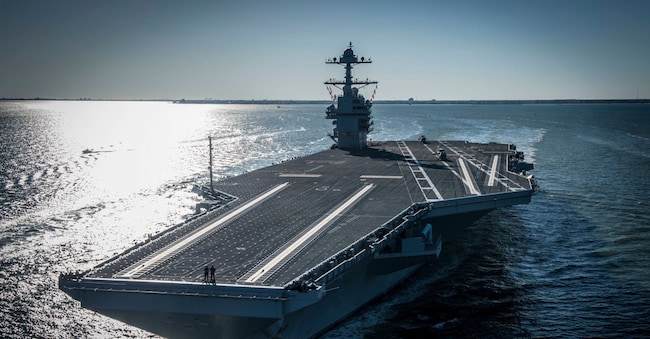
337 metres long, 78 metres wide at the widest point of the flight deck, and an impressive 41 metres at the waterline, over 100 thousand tonnes in tonnage and a displacement of 104 thousand tonnes. These are the numbers of the aircraft carrier Gerald R. Ford, the most powerful aircraft carrier in the world en route to the Middle East. It is an ultra-modern unit and the progenitor of a new class of American nuclear-powered aircraft carriers (CVN, Cruiser Voler Nuclear).The USS Gerald R. Ford (CVN-78) is named after the 38th President of the United States. Construction began in 2005 in Virginia at the historic Northrop Grumman shipyards in Newport News. The design, from the outset, updates the cornerstones of power, manoeuvrability, unlimited range and aircraft carrying capacity of the legendary USS Nimitz (CVN-68) and the Class derived from it and dedicated to Admiral Chester Nimitz, commander of US naval forces in the Pacific during World War II. The Ford-class ships are intended to replace the Nimitz-class units.
Launched in 2013, she was delivered to the US Navy in 2017. It replaces the USS Enterprise, which ceased service after more than 50 years at sea. The Ford Class includes 10 units, one of which will still be christened USS Enterprise, and another, under construction, second of the Ford Class, is christened John F. Kennedy.In the spring of 2021, it completed its test phase and entered active service with a crew of around 5,000. The costs have been pharaonic and steadily increasing during the years of construction, costing almost 13 billion dollars. The American super aircraft carrier is powered by two newly designed nuclear reactors that are more compact, safe and efficient than its predecessors.The maximum speed is 30 knots, about 55 km/h. It accommodates up to 75 aircraft that can be launched with the aid of ultra-innovative EMALS (Electromagnetic Aircraft Launch System) magnetic catapults that make their debut on the USS Gerald R. Ford and are designed to reduce the mechanical stress on the structure of the jets they have to launch and, in addition, are able to assist the take-off of heavier aircraft, and therefore fully loaded (fuel and armament) compared to the traditional catapults mounted on the Nimitz-class ships. The launch frequency has been increased by 25% compared to the Nimitz-class ships. Also innovative is the AAG (Advanced Arresting Gear) arresting system, which allows landing aircraft, including remotely piloted aircraft, to be stopped more effectively than traditional hydraulic systems, thanks to magnetic guidance.
The entire flight deck - 333 metres long and 78 metres wide - is newly designed, and compared to the Nimitz Class, allows for easier aircraft handling. The USS Ford is extremely sophisticated in terms of communication systems and radar. The Gerald Ford is the flagship of the US Navy's 12th Carrier Strike Group 12. In recent days, while sailing with the Italian Navy, it received orders from the Pentagon to approach Israel and is now heading for the eastern Mediterranean. It is accompanied by missile launching destroyers and missile launching cruisers. The US is also taking steps to strengthen the presence of combat aircraft in the region, including F-35, F-15, F-16 and A-10 squadrons.


