Air transport

Airports: using AI to predict queues. The challenge of the European Entry/Exit System

flAI, a start-up from the University of Bergamo, uses artificial intelligence to manage traffic congestion at airports

3' min read

Translated by AI
Versione italiana

3' min read

Translated by AI
Versione italiana

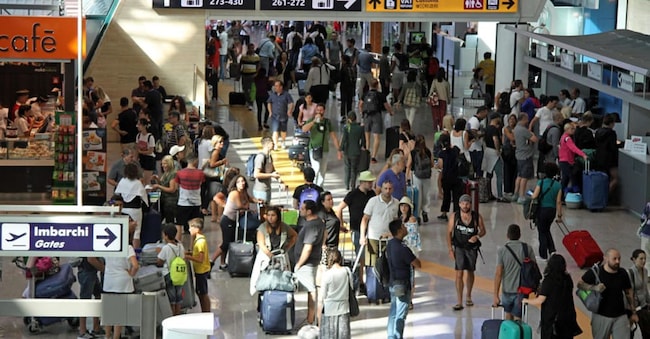
Predicting where and when congestion will occur, estimating how passenger flows will develop, and simulating operational scenarios in the event of delays, fluctuations in demand or other disruptions. This is the new frontier of airport management, which must contend with constant growth in traffic and the introduction of new border control requirements across Europe.

The long queues seen in recent weeks at various European airports mark the first operational trial of the European Union’s new Entry/Exit System (EES), the digital system that records the entries and exits of non-Schengen citizens, gradually replacing passport stamps with the collection of biometric data. The aim is to strengthen border security and controls, but the launch of the system is leading to longer processing times for passengers, particularly during the initial stages of implementation.

Loading...

The queues at border controls or security checkpoints are the most obvious aspect for travellers, but they rarely represent the problem itself. Rather, it is the result of an operational imbalance affecting the entire airport ecosystem: the concentrated arrival of flights, staff availability, service times, connections and infrastructure capacity must all remain synchronised within a system that coordinates thousands of passengers, hundreds of staff and highly interdependent services every day.

This is the field in which flAI operates: a start-up founded as a spin-off from the University of Bergamo and specialising in the application of artificial intelligence to complex mobility and air transport systems. The company develops decision-support platforms capable of predicting bottlenecks, simulating alternative scenarios and suggesting the best allocation of available resources, even in the event of extraordinary circumstances such as strikes, adverse weather conditions, accidents or sudden changes in demand.

The company’s solutions are already in use at the airports in Bergamo, Florence, Bari, Naples and Palermo, as well as at Amsterdam Schiphol, one of Europe’s main hubs. At the same time, the start-up is also developing applications specifically for airlines and transport operators.

“In the short term, these tools enable us to identify bottlenecks in advance, plan staffing levels and allocate available resources more efficiently,” explains Sebastian Birolini, co-founder of flAI and lecturer at the University of Bergamo. “In the medium to long term, however, they become a tool for strategic planning, enabling infrastructure that is nearing capacity to be utilised whilst maintaining high levels of service, safety and resilience. Reducing queues is just one of the benefits: the most important outcome is to increase the overall efficiency of the system.”

This issue takes on particular significance in light of the prospects for growth in air traffic. According to the new National Airport Plan, Italian airports are set to see passenger numbers rise from the current figure of around 230 million to over 300 million in the coming decades. In most cases, this growth will have to be accommodated by existing airports, with limited scope for the physical expansion of infrastructure.

The paradigm is therefore shifting from building new capacity to the intelligent management of existing capacity. In this context, technologies such as artificial intelligence, simulation, mathematical optimisation and advanced data analysis can increase airports’ effective capacity without the need for immediate infrastructure works, whilst at the same time improving punctuality, resilience and service quality.

The introduction of the Entry/Exit System is a concrete example of this challenge. The new European system digitises border control procedures, but does not incorporate artificial intelligence tools for the predictive management of passenger flows. The consequence is that, during peaks in demand, the risk of congestion increases unless the system is accompanied by tools capable of anticipating operational impacts and supporting real-time decision-making.

For flAI, the value of artificial intelligence lies not only in algorithms, but in the ability to integrate domain expertise with mathematical models and machine learning systems. “An algorithm, on its own, cannot solve an operational problem unless it understands the rules, constraints and dynamics of the sector in which it is applied,” observes Birolini. This is why the company develops decision-support systems that assist operators, enhancing their analytical capabilities without replacing their experience.

Loading...

flAI continues to collaborate with the ICCSAI-ITSM research centre at the University of Bergamo, one of Italy’s leading centres for research into air transport. This growth trajectory is also supported by the National Centre for Sustainable Mobility (MOST), which selected the start-up as part of the ‘Grant Call 4 Ideas’ initiative, dedicated to projects with high innovative potential. The approach developed by the company extends beyond the airport sector. The same models can be applied to all complex systems characterised by high uncertainty, limited resources and strong interdependence between processes, ranging from logistics and transport to the management of critical infrastructure.

Copyright reserved ©
Loading...

Brand connect

Loading...

Newsletter

Notizie e approfondimenti sugli avvenimenti politici, economici e finanziari.

Iscriviti