Middle East

Al-Aqsa: why the mosque in Jerusalem is so important to Muslims and Jews

The third holiest site in Islam and the holiest site in Judaism, the Temple Mount in Jerusalem has for decades been one of the most sensitive issues in the Israeli-Palestinian conflict

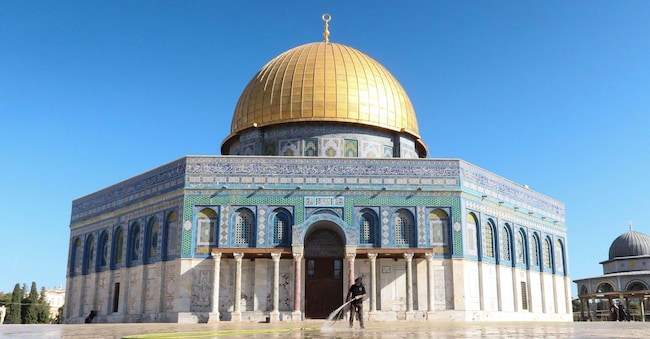
Un membro del Waqf islamico pulisce l’area antistante la Cupola della Roccia, nel complesso di Al-Aqsa, a Gerusalemme, il 13 settembre 2026. REUTERS/Sinan Abu Mayzer

4' min read

Translated by AI
Versione italiana

4' min read

Translated by AI
Versione italiana

In the heart of Jerusalem’s Old City, on a site covering approximately 144,000 square metres, two names and two religious landscapes coexist. For Muslims, it is Al-Aqsa, or al-Haram al-Sharif, the Noble Sanctuary, the third holiest site in Islam after Mecca and Medina. For Jews, it is Har HaBayit, the Temple Mount, the holiest site in Judaism, where the two ancient Temples of Jerusalem once stood. For everyone, it is one of the most sensitive issues in the Israeli-Palestinian conflict.

The complex is situated in the Old City, in East Jerusalem, which was captured by Israel during the Six-Day War in 1967 and subsequently annexed. The annexation is not recognised by the United Nations or by the majority of the international community. The Palestinians claim East Jerusalem as the capital of a future state.

Loading...

Since 1967, the Islamic Waqf of Jerusalem, supported by Jordan, has administered the complex, with the Israeli police responsible for security and access. Under the status quo established after the war, Muslims may pray on the Esplanade, whilst non-Muslims may visit it at specific times but may not practise their own religion there. The 1994 peace treaty between Israel and Jordan also recognises the ‘special role’ of the Hashemite Kingdom in the Muslim holy sites of Jerusalem.

Gerusalemme, ebrei in preghiera alla moschea di Al-Aqsa

The Israeli Minister of National Security Itamar Ben-Gvir has visited the site on several occasions, reiterating the right of Jews to pray on the Temple Mount. Last July, the far-right politician visited the site, openly celebrating the fact that Jewish visitors were praying on the Esplanade, in breach of the status quo rules. Jordan and the Palestinian authorities condemned the incident as a breach of the agreements. On several occasions, the Prime Minister Benjamin Netanyahu had, however, reiterated that Israel’s official policy on the site had not changed.

The name “Al-Aqsa” is often used to refer solely to the building with the silver-grey dome situated in the southern part of the esplanade. However, in Islamic, Palestinian and Jordanian terminology, ‘Al-Aqsa’ can refer to the entire sacred compound, al-Haram al-Sharif: covering approximately 144,000 square metres, which also includes the Dome of the Rock, with its golden dome, as well as courtyards, gates and other religious buildings.

This very enclosure is the Temple Mount in Jewish tradition. This is where the two Temples of ancient Jerusalem once stood. The Second Temple was destroyed by the Romans in 70 AD. At the foot of the complex lies the Western Wall, a central site of contemporary Jewish prayer and part of the retaining wall that surrounded the esplanade of the Second Temple.

For Islam, the central importance of Al-Aqsa predates the contemporary conflict by centuries. The first verse of Sura 17 of the Qur’an recounts the Prophet Muhammad’s night-time journey from the ‘Sacred Mosque’ to the ‘Farthest Mosque’, ‘al-masjid al-aqsa’. Islamic tradition has identified the latter with Jerusalem and has also linked the site to the ‘Mi’raj’, Muhammad’s ascension through the heavens. Jerusalem is also associated with the first ‘qibla’, the direction of prayer for the early Muslims before they began to face the Kaaba in Mecca.

Gerusalemme, fedeli musulmani alla moschea di al-Aqsa per le preghiere dell'Eid al-Adha

For many Palestinians, Al-Aqsa is an Islamic sanctuary and a symbol of their presence in Jerusalem. For Judaism, the Temple Mount is the holiest site in its tradition. For Jordan, the custodianship of Muslim holy sites is a historic responsibility also recognised by the peace treaty with Israel. For Israel, the Esplanade is situated in a city over which it claims sovereignty.

On 28 September 2000 Ariel Sharon, then leader of the Israeli opposition, visited the Temple Mount/Haram al-Sharif accompanied by a heavy security detail. Violent clashes broke out the following day. The visit helped to trigger the clashes at the start of what would become the Second Intifada, also known as the Al-Aqsa Intifada.

In May 2021, Al-Aqsa was one of the epicentres of a crisis that spread rapidly from Jerusalem to Gaza. For days during Ramadan, Palestinians and Israeli security forces clashed in and around the mosque compound. Tensions were already running very high due to protests against the threat of eviction facing some Palestinian families from their homes in the Sheikh Jarrah neighbourhood of East Jerusalem. On 10 May Hamas issued an ultimatum to Israel, demanding the withdrawal of Israeli forces from Al-Aqsa and Sheikh Jarrah. When the ultimatum expired, several Palestinian armed groups fired rockets towards Jerusalem. Tel Aviv responded with strikes on the Gaza Strip. This marked the start of eleven days of war, which ended with a ceasefire on 21 May.

Loading...

The name Al-Aqsa resurfaced on 7 October 2023, when Hamas described the attack on Israel as the “Al-Aqsa Flood”. For the Islamic movement, the site has long also served as a tool for mobilisation, a symbol capable of linking the Palestinian national cause to the religious dimension and, precisely for this reason, of appealing to an audience that extends far beyond Gaza and the West Bank.

It is this intertwining of religion and politics that explains why the status quo is much more than a set of rules governing access to a place of worship. For the Palestinians and for Jordan, allowing Jewish prayer on the Esplanade with increasing openness risks paving the way for a more profound shift in the balance of power governing the sanctuary. The view is the opposite for Jewish movements that claim the right to pray on the Temple Mount. Prohibiting this, they argue, means denying Jews full religious freedom in the very holiest site of Judaism.

But the Jewish religious camp is not united either. Leading rabbinical authorities, particularly within Orthodox Judaism, have long prohibited or severely restricted Jewish access to the Temple Mount. The reasoning is religious: following the destruction of the Second Temple, it is not possible to establish with certainty where its most sacred areas were located and, according to these authorities, entering them without the necessary conditions of ritual purity would risk violating their sanctity.

Copyright reserved ©
Loading...

Brand connect

Loading...

Newsletter

Notizie e approfondimenti sugli avvenimenti politici, economici e finanziari.

Iscriviti