
Alan Greenspan, former Fed chairman, has died. He was 100 years old
Appointed Chairman of the US Federal Reserve in 1987 by President Ronald Reagan, Greenspan led the US Federal Reserve until 2006

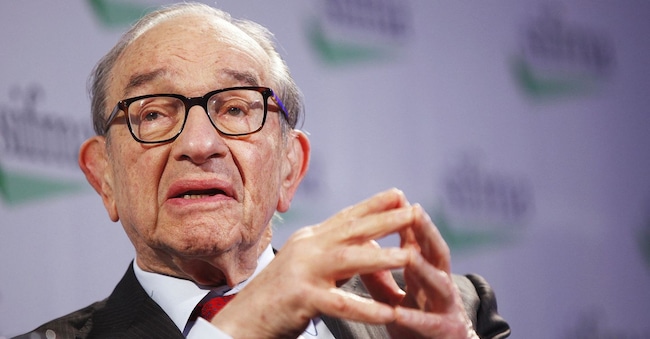
Former Federal Reserve Chairman Alan Greenspan has died today at the age of 100 following complications from Parkinson’s disease. The announcement was made by his wife, NBC News journalist Andrea Mitchell. Appointed Chairman of the US central bank in 1987 by President Ronald Reagan, Greenspan led the US central bank until 2006, steering it through periods of economic boom and recession. His tenure was the second longest in the Fed’s history, surpassed only by that of William McChesney Martin.
His most famous statement dates back to 5 December 1996, when, speaking about the difficulties of monetary policy, he wondered whether ‘irrational exuberance’ might be inflating the values of financial assets excessively. The markets interpreted the remark as a warning that share prices were overvalued, triggering a wave of profit-taking on the world’s major stock exchanges. However, the rally continued until the dot-com bubble burst in 2001.
Just 69 days after he took office, Wall Street was rocked by the Black Monday crash of 19 October 1987, when the Dow Jones Industrial Average fell by 22.6 per cent in a single trading session – the worst single-day fall in its history. The following day – as CNBC recalls – Greenspan reassured the markets by stating that the Fed was ready to provide all the liquidity necessary to support the economic and financial system, cutting short-term interest rates to encourage bank lending. The strategy adopted by Alan Greenspan helped to reassure the markets following the 1987 crash and avert a recession and a banking crisis. Within two days, the Dow Jones had recouped more than half of the losses suffered during Black Monday. That success helped earn him the nickname ‘The Maestro’. In the years that followed, however, some critics attributed part of the conditions that would later lead to the Great Recession to his accommodative monetary policy — the so-called ‘Greenspan put’, that is, the Fed’s willingness to intervene to calm market turbulence.
In March 1996, *Fortune* magazine ran the headlines “It’s His Economy, Stupid” and “In Greenspan We Trust”, highlighting just how central his role had become in the US economy, even during Bill Clinton’s presidency. After a difficult start in 1987, Greenspan steered the Fed through two recessions, the 1997 Asian financial crisis, the 1998 Russian default, the bailout of the hedge fund Long-Term Capital Management, the attacks of 11 September 2001, and the boom and subsequent burst of the dot-com bubble between the late 1990s and 2001. Throughout his tenure, he prioritised controlling inflation over promoting full employment. His supporters credit him with presiding over the longest period of economic expansion in American history. His critics, however, argue that the low interest rates maintained for years contributed to the formation of the housing bubble that would burst during the Great Recession, shortly after his successor, Ben Bernanke, had taken the helm of the central bank.

