
Carlos Alcaraz: between tennis success and the search for personal balance
With this title in Spanish, in a mini TV series for Netflix the champion tells his story, showing his family background, his friends, his moments of relaxation. And the desire to reconcile this dimension with tennis

4' min read
4' min read
The family, the childhood friends, the smiling expression and that slightly carefree air that take us straight back to Spain, even before the cadenced musicality of the language: in the TV miniseries Carlos Alcaraz. My way, three episodes produced by Morena Films for Netflix, we enter the world of the champion from Murcia and fully understand what sometimes, on the tennis court, has unclear contours.
The lapses, some mistakes not like him and a long pause in the consistency of results from his triumph at Wimbledon 2024 until the one in Monte Carlo two months ago, can be explained by the impetuous emotionality of his character, but not only. There is something more structural: the inner disagreement between the desire to become the greatest player in history and the feeling that the price to pay is too high. That renunciations are unacceptable at his age. That happiness is not always and only tennis.
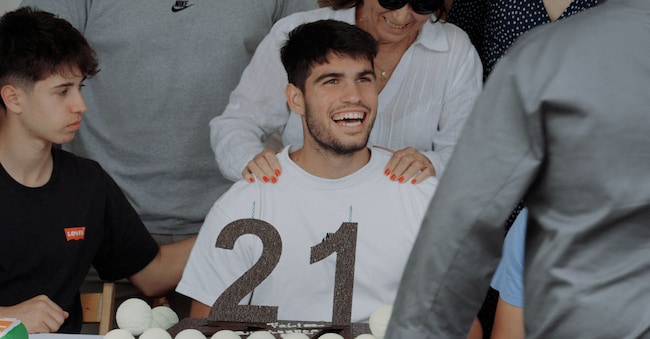
The series chronicles Carlos' life over the past 12 months, interspersed with images from the past, when at the age of 13 his father entrusted him to an agent, Albert Molina. It was he who bet on Juan Carlos Ferrero, the former Slam champion who took Alcaraz to the top of the ranking by building a winning team with doctor Juanjo López, athletic trainer Alberto Lledó and physiotherapist Juanjo Moreno. They are the protagonists of a united, simple and cheerful family. The father always loved the sport and played but could not afford, as a boy, to really think about the world of professionalism: too expensive. Molina procured sponsors for his son, who was accepted into the Ferrero Academy. He has a talent on his hands. He forges him by glimpsing a personality and a desire to arrive that can make the difference. And so it will. The ascent is quickly accomplished, in parallel with Carlos' physical explosion, which is structured by reaping successes and, above all, having fun. His smile conquers all. The most important consecration, at the age of 19 in New York, on the concrete that exalts his strokes: in 2022 he won the Us Open and became the youngest number one in history. At the same time, Carlos is very attached to his roots, returns home as soon as he can, loves sleeping in his room. You can see the many pairs of tennis shoes of various colours on a shelf, his trophies... She caresses the one from Wimbledon where she won two consecutive years, in '23 and '24. 'Nobody cooks like my mother,' he declares proudly amid general laughter, as his birthday is celebrated. Grandma Victoria hugs him, his brother Álvaro warns him that he will always give him a slap on the wrist. His friends celebrate him with toasts.
This dimension, so Latin, clashes with the daily grind of ever more pressing training sessions, constant travel on a circuit that gives no respite, dizzyingly rising expectations. A pincer, an obligation that suffocates him. And so, surprising everyone, Carlos announces that he is going to Ibiza a few days after winning Roland Garros... heresy for the team, it is not the time, there is the Queen's tournament that preludes a much more prestigious grass. But he hears no reason, he needs to get away, to see his friends, to go out. Situations he does not want to give up but, evidently, with latent guilt.
Then there is another source of frustration: the torment of the constant comparison with Nadal (an idol for him since childhood), a persecution amplified by the media that always portray him as the heir, the one who picks up the baton, the new Rafa. His gaze pierces when he says 'I am Carlos Alcaraz Garfia', even mentioning his mother's surname. But the drama of the Olympics unfolds in Paris: he loses the doubles match with Nadal, and misses out on the gold medal in the singles with Djokovic, whom he had just beaten at Wimbledon. Carlos bursts into tears at the end of the match, dressed in Spain's colours, in the interview with Álex Corretja who tries to calm him down: 'Take your time Carlitos'.


