Poetry

Alejandra Pizarnik, the rebel with death in her eyes

All the poems by the great Argentine author, who took her own life in 1972 at the age of 36, have been published

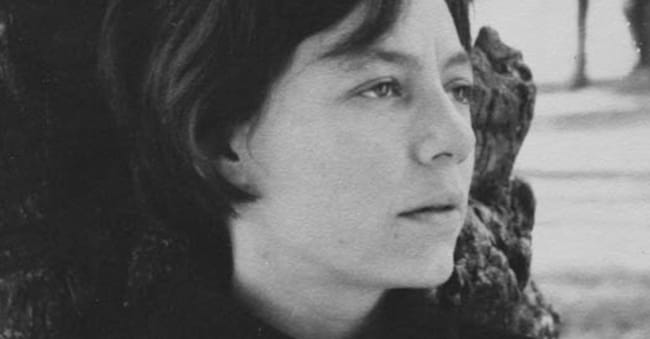
Alejandra Pizarnik Alamy Stock Photo

4' min read

Translated by AI
Versione italiana

4' min read

Translated by AI
Versione italiana

‘Rebellion is looking at a rose / until your eyes crumble.’

The author of these verses, Alejandra Pizarnik, an Argentine poet born 90 years ago, was a rebel through and through: throughout her short life she ‘longed to distance herself/ from the hour in which she was born’, she ‘sang of the sadness of that which is born’, the dismay of coming into being, the longing for that absolute innocence which is non-existence, the beginning that gives birth to the end. Torn as she was by the ‘desire to be’ and by realising, instead, that she was two (‘Fear of being two/ as I approach the mirror:/ someone who sleeps within me/ eats and drinks me’). Indeed, of being multitudes.

Loading...

A ceaseless search for herself, knowing that it is impossible to find herself: ‘now/ in this innocent hour/ I and the woman I once was sit/ on the threshold of my gaze’.

Uncompromising, she watched the rose of her life wither away, her ‘reality recede’. She wrote about it right up to the very end, until she took her own life. ‘I have consumed my life in a single moment,’ she stated, aged just twenty-two. ‘With all my deaths / I surrender myself to my death,’ she declared in the same collection, published in 1958: *Le avventure perdute*. Her early verses already contain the chronicle of her end; they are elegies referring to herself. Whilst she was still alive, she already considered herself dead. ‘She died whilst explaining her death.’

‘I know little of the night / but the night seems to know me, / and rather stands by me as if it loved me, / tucking my consciousness in with its stars’. These expressionist verses from her early years, when she was associating with the Surrealist artists of Buenos Aires, already return obsessively to her ‘grandiloquent unease’ – as the Hispanist Matteo Léfevre describes it in the introduction to the volume Poesia completa, which he edited and which brings together in full all the poems by the poet born in Buenos Aires to a Jewish family of Russian origin, translated with the original text alongside.

Compared to his later poems – those written shortly before his death at the age of thirty-six – these poems contain only a little more light: ‘What does it matter if we press on / from smile to smile / until the very last hope?’. They contain only a little more longing: ‘But who will give me the answer I’ve never used?/ A word to shelter me from the wind,/ a small truth on which to rest/ and from which to live my life,/ a phrase all my own/ that I may embrace every night,/ in which I recognise myself, in which I exist’.

Pizarnik ‘devoured herself whilst looking in the mirror, whilst stubbornly trying to step beyond it’, observes the journalist Concita De Gregorio – who had known her as a child – in a passionate recollection included in the book.

‘Beware of me, my love / beware of the silent woman in the desert / of the traveller with the empty glass / and of the shadow of her shadow.’ So warned Pizarnik, with her solemn verses, whose power is often concentrated in one, or at most three, lines – almost like aphorisms.

A traveller with an empty glass, or perhaps – judging by the stubbornness of her idealism – with the feeling of having an empty glass. After publishing her first collections of poetry, in the first half of the 1960s Pizarnik went to Paris, where she met Georges Bataille, Italo Calvino, Simone de Beauvoir, Julio Cortázar and Octavio Paz, and began working as a translator. ‘From this point onwards,’ observes Lefèvre, ‘her poetry becomes more complex, more mysterious.’

The subtle trace of love for other women is captured in some of her less sombre poems, such as Amanti: ‘a flower/ not far from the night/ my silent body/ opens up/ to the delicate urgency of the dew’. Yet even love is a disappointment: better to ‘recognise my emblem in thirst’. Hers then becomes a wandering ‘like a she-wolf in the woods/ in the night of bodies’. Always on the other side of life, of the night.

‘I foresaw a total form of writing,’ she lamented. Her poems are full of wind and of birds that are petrified, desolate, metaphysical – birds reminiscent of those in Max Ernst’s paintings, birds that draw ‘little cages’ in her eyes, and poems full of cages that fly away, yet leave the author bewildered and frightened. They always resound with deadly echoes: ‘an abandoned fire kills its own light’.

‘Death ever at my side./ I listen to its voice./ I hear only myself.’ His life is a state of being-towards-death, a condition endured, yet never accepted. ‘I wanted to enlighten myself in the light of my own lack of light,’ he confesses. The last few years have become increasingly desperate: ‘By now I have lost the name that called me,/ its face slips past me/ like the sound of water in the night,/ of water falling upon water.’

Flora, Buma, Bumita, Sasha, Blimele, Alejandra were her names and nicknames. ‘There were so many of us, so many; we were a multitude. In all my lives I have been thirsty. I have shut everything away, yet there is a wind within.’ Pizarnik attempted suicide on several occasions; she succeeded on 25 September 1972 by swallowing several barbiturate tablets. ‘When the night becomes my memory / my memory will be the night,’ she wrote. From her tragic end arose ‘the myth of her poetry’, concludes Lefèvre, who describes her as ‘one of the most interesting Latin American authors of the twentieth century’. As happens almost exclusively to tragic, unhappy, deceased poets – preferably those who died young, in despair, by suicide – she has been able to enter the slender, almost intangible, heterogeneous canon of great women writers.

© ALL RIGHTS RESERVED


Alejandra Pizarnik

Full poem

Edited by Matteo Lefèvre

With an article by Concita De Gregorio

Crocetti, pp. 450, €25

Copyright reserved ©
  • Lara Ricci

    Lara Riccivicecaposervizio curatrice delle pagine di letteratura e poesia

    Luogo: Milano e Ginevra

    Lingue parlate: Inglese e francese correntemente, tedesco scolastico

    Argomenti: Letteratura, poesia, scienza, diritti umani

    Premi: Voltolino, Piazzano, Laigueglia, Quasimodo

Loading...

Brand connect

Loading...

Newsletter

Notizie e approfondimenti sugli avvenimenti politici, economici e finanziari.

Iscriviti