
Alexa+ arrives in Italia today. How the new generative voice Ai works
The Seattle-based company brings the generative version of the voice assistant to our country. Here's how to try it out and the main functions

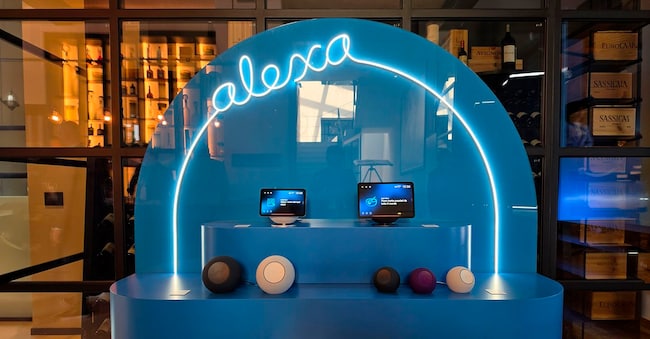
Alexa+ arrives in Italia. As of today, anyone who buys an Echo device, i.e. Amazon speakers, will find the new generative version of artificial intelligence integrated. Which thus moves from rigid commands and keywords to a more conversational and contextual version. And the ability to directly conclude actions. Those who already have an Amazon speaker can sign up for early access from amazon.it/nuovalexa and wait for activation. The expansion of the service will therefore be gradual.
In terms of devices, the only ones that are not compatible belong to the first generation, which is no longer on sale. For now, the service is free, then it will remain so for Prime users only, or it will have to be paid 23 euros per month (taking into account that Prime costs 50 euros per year, Amazon's desire to add a subscription reason is quite evident).
With today, therefore, the voice assistant capable of responding to voice input but in a static manner also introduces generative elements. In the era of chatbots such as ChatGPT to which we are now accustomed, capable of understanding context, having memory and real dialogue, this is a technological update that brings the voice command experience into this new paradigm. Not only that, Alexa introduces agent elements, thus carrying out tasks autonomously. On this aspect, the ecosystem will be decisive.
"We are working on integrating third-party services, such as news, recipes and radio, and are finalising new partnerships. On-demand services will also arrive soon: ProntoPro for finding an electrician at home, Treatwell for hairdressers, WeTaxi for travel and Tripadvisor for travel and reviews. The first will be TheFork, which will be the first partner to be integrated in the coming weeks to book restaurants,' explains Giacomo Costantini, head of Alexa in Italia.
How does Alexa+ work?
Alexa+ is not a new LLM. It is based on Amazon Bedrock, the cloud infrastructure that allows orchestrating different language models instead of using just one. In practice, it combines proprietary models such as Amazon Nova with external models such as Anthropic's Claude, in which Amazon is one of the first investors, each time choosing the one best suited to the task.


