
Alfa Romeo Cuorerosso, a closer look. Everything we know
The Biscione concept makes its debut at the Paris Motor Show, featuring the Giorgio platform, a 2.9-litre V6 full-hybrid engine and a design set to be adopted by Alfa Romeo models from 2028

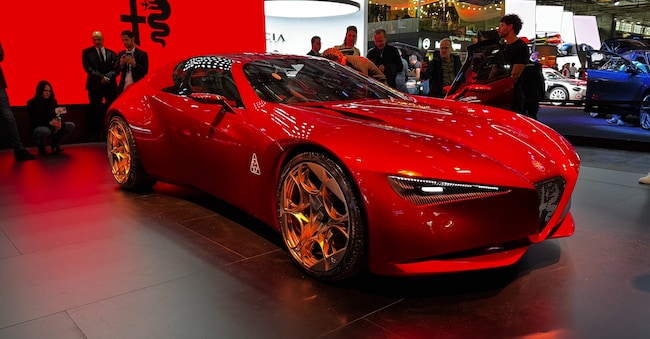
In the automotive world, there are few certainties. One of these is that all it takes is an Alfa Romeo concept car with captivating lines to generate the sort of media attention that every advertising professional would envy. For despite falling sales figures and a range increasingly focused on SUVs, Alfa Romeo enthusiasts have responded enthusiastically to the launch of the Cuorerosso, one of the most photographed concept cars at the Paris Motor Show. And the good news is that, although it is a prototype, it is based on an evolution of the Giorgio platform and features a hybridised V6 engine that may well see the light of day on public roads. Not only that; sources within Stellantis have confirmed to us that CEO Antonio Filosa was impressed when he saw the car in the flesh.
Alfa Romeo Cuorerosso: more than just a design exercise
The Cuorerosso does not directly foreshadow a production model, but it is difficult to regard it merely as a stylistic exercise. The project points to the direction the brand will take in the coming years, and some of its design elements are expected to feature on production Alfa Romeos from 2028 onwards. Starting with the successor to the Tonale and, subsequently, the new C-segment compact car planned for the product line-up. Even more interesting is what lies beneath the bodywork. The Cuorerosso has been developed on an advanced version of the Giorgio platform, whilst for the powertrain Alfa Romeo has opted for a configuration based on the 2.9-litre twin-turbo V6 paired with a full-hybrid system. The total power output has not been disclosed, but the setup includes Q4 all-wheel drive, an automatic gearbox with a torque converter and a carbon-fibre driveshaft. This solution opens up the possibility of seeing the six-cylinder engine featured in future high-performance Alfa models.
A 2+2 coupé 4.70 metres long
In the flesh, the Cuorerosso is particularly striking for its proportions. It is 470 centimetres long, 198 wide and just 133 high, whilst the wheelbase measures 293 centimetres. The stated weight is 1,750 kg. These figures place it just above the current Giulia Quadrifoglio in terms of size, with a 2+2 coupé body and four doors, the rear ones opening outwards.
The very long bonnet, the rear-set cabin and the wedge-shaped flanks lead to a high, almost vertically cut tail. It is a reinterpretation of the ‘Coda Tronca’ design used on several Alfa Romeo models of the past. Aerodynamic optimisation has resulted in a drag coefficient (Cx) of 0.28, thanks in part to the integrated rear diffuser and the particularly clean body surfaces.
At the front, the badge emerges directly from the bonnet and incorporates a pattern of backlit triangular elements. The headlights also form part of the air intakes, whilst the traditional door handles have been removed from the sides. The doors are opened via touch controls fitted to the roof. The forged alloy wheels, meanwhile, feature the classic Alfa Romeo design, with six circular elements distributed across the three spokes.

