Test drive

Alfa Romeo Junior Veloce, the 280 hp electric test: how the Biscione baby suv is made and goes

It is the most powerful version in the range that includes the 156 hp electric and the 136 hp hybrid. The new model from the Italian brand of Stellantis differs from its group cousins in performance and driving dynamics

by Mario Cianflone

Alfa Romeo Junior, spiegata in 5 minuti in un “walk around”

5' min read

5' min read

Alfa Romeo Junior has only just been born and is already a celebrity. On the one hand, the visibility of the new model has been boosted enormously by the change of name from Milano to Junior, two days after the launch to appease political controversy over Italian sounding (which at the moment, however, strangely does not concern Ford Capri), on the other hand Alfa Romeos always capture attention and in the age of social media even more so with factions of fans and detractors, often keyboard lions criticising assembly in Poland and the use of a Stellantis platform.

In fact, Biscione's first b-suv, which is also the Italian brand's first electric car, is built on the Cmp2 architecture, the evolution of a Peugeot platform used on many of the group's models, including the Jeep Avenger and Fiat 600 sisters.

Loading...
Jean-Philippe Imparato: “Ecco i miei piani per Alfa Romeo, i modelli in arrivo tutti Made in Italy”

Similar of course are the hybrid (mild hybrid) and electric engines. Components in common with other models in the group, such as the Peugeot 2008, and rightly so: costs are reduced and can be allocated, as CEO Jean-Philippe Imparato explained, to technical solutions and components such as steering, suspension and the Torsen differential to create that Alfa Romeo driving feel.
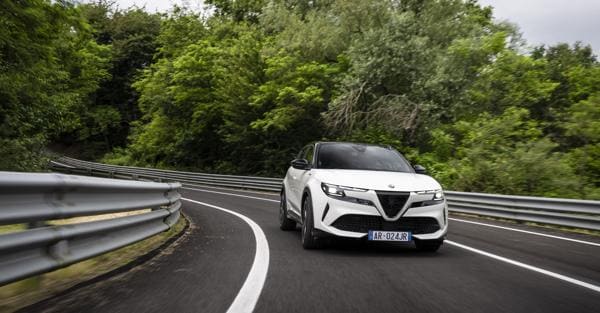
Alfa Romeo Junior, the test and features

We tested the new Junior in the Veloce electric version, the top of the range, the most powerful and performance-oriented one. It boasts 280 hp, a maximum torque of 345 Nm and a range of around 330 km thanks to a 54 kWh battery. The performance? Sporty, without ifs and buts: 200 km/h (which for a Bev is a lot) and acceleration from 0 to 100 km/h in 5.9 seconds.

Eligio Catarinella (Alfa Romeo): “Valore residuo e flotte nel mirino di Alfa Romeo Junior”

The Junior Veloce costs 48,500 euros. Undoubtedly that's a lot of money for a front-wheel-drive electric, but it has to be said that in practice it has few rivals. It is true that the Tesla Model 3 costs less and is an excellent electric car with a formidable charging network, but the Junior aims to be something other than a 'people mover' from point A to point B. Even in B Suv format, it wants to arouse emotions for driving pleasure and also from an aesthetic point of view. And the Veloce, perhaps with Tortona Black livery and 20" rims, elicits more than a wow at first sight.
The Veloce is at the top of a range that also includes a hybrid and an electric variant. The former is powered by an evolution of the PureTech engine (developed in-house at Psa) three-cylinder 1.2-litre, 136 bhp engine with chain-driven distribution (the oil bath belt, it is known, has caused problems for various brands and Stellantis models). The three-cylinder, an architecture that psychologically never ceases to please, works on the Miller cycle and boasts a variable geometry turbo. It is a 48-volt lithium-ion mild hybrid and a 21 kW electric motor integrated in the 6-speed dual-clutch gearbox. Tested on other models, it is a mild that behaves almost like a full hybrid. The hybrid is offered in two-wheel-drive or all-wheel-drive versions. The basic electric, on the other hand, adopts the familiar 156 hp electric motor, powered by a 54 kWh lithium-ion battery and offers 410 km of range. It only supports 100 kW (not the top) direct current, but it takes less than 30 minutes to charge the battery from 10 to 80 per cent. Both the hybrid and the electric are offered in the full optional Speciale version and prices range from 29,500 to 32,000 euros for the MHEV and from 39,500 to 41,500 for the 156-horsepower electric.

Alfa Romeo Junior Veloce, driving impressions

The Veloce, on the other hand, is a story in itself because it focuses on performance and the fact that it is electric with zero emissions is secondary. In the Veloce, the electric motor is at the service of driving pleasure and performance, not sustainability: its task is clear. To show that an Alfa Romeo can be electric and go fast. Even without sound. In fact, the engineers of the "biscione" have avoided digital sounds, sound bars and ridiculous gadgets, but have staked everything on Alfa Romeo handling. And in our test at Balocco on the track and on the 'Langhe' circuit, a 20 km track that simulates a particularly winding suburban road full of curves and ups and downs, it showed off true sports car qualities. Despite being a baby suv and the type of engine.

Where is the trick compared to its Fiat 600 and Jeep Avenger cousins? In small but important things: specific dampers, a well-thought-out rear wishbone (the more critical would prefer a nice multilink), but in the end the scheme chosen by Domenico Bagnasco, responsible for vehicle dynamics, is rewarding and precise in bends and goes well with front-wheel drive. The steering is specific and more direct (with a 14:6 ratio). In addition, in the service of handling, the Veloce boasts a sports set-up lowered by 25 mm, front and rear anti-roll bars with sporty calibration, and a braking system at the front with 380 mm discs and 4-piston callipers. Among all the devices that make the little Alfa very fun to drive, especially on the mixed road, the TorSen D differential stands out. Applied for the first time to a front-wheel drive car (it was born with the 147 all-wheel drive Q2 in 2006), it distributes the torque of the front drive wheels dynamically and continuously. The result? On the one hand there is the roadholding of a front-wheel drive, but on the other hand it improves stability on release, reducing understeer under acceleration. And in this respect the Veloce seemed to us as precise as a Japanese blade and able to take more than one satisfaction from us. Quick and precise cornering entry and contained body roll complete the picture. These are, of course, driving impressions of the top model, which, as mentioned, finds its ideal terrain in curves and in the mixed, with a powertrain that pushes hard and the front wheels that follow the trajectories with precision and optimal management of load transfers. In September it will be the turn of the mild hybrid versions, which of course are expected to be less performance oriented but suitable for a wide audience, including corporate fleets.

Alfa Romeo Junior, size and style

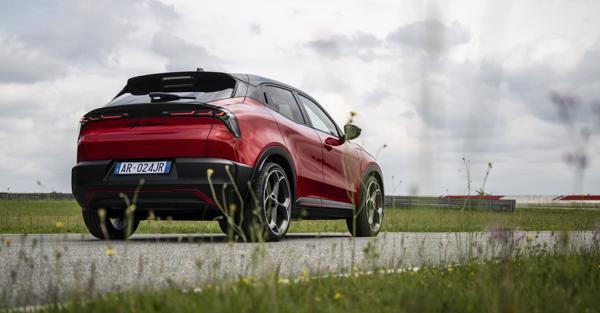
The Bisione's compact SUV is 4.17 metres long, 1.78 metres wide and 1.5 metres high. The mass of the Veloce version is 1590 kg, a good figure for an electric car. The styling by designer Alejandro Mesonero is original and at times divisive, especially in the font where a rather daring reinterpretation of the classic Alfa Romeo trilobo stands out. Aesthetically there are many references to iconic models of the past, such as the truncated tail that brings to mind the Giulia TZ. At the front, the '3+3' headlights and adaptive Full Led Matrix light clusters stand out. There is no shortage of details typical of a Biscione car, such as the legendary shield present on the variants named Leggenda and Progresso. Of the Junior, everything can be said less than banal: perhaps the least harmonious part is the rear with the C-pillar junction, but it certainly stands out for its light signature with a coast-to-coast lighting. All in all, the Mesonero team has done a great job: concealing any kinship with the group's cousins with which it shares the platform.

Copyright reserved ©
Loading...

Brand connect

Loading...

Newsletter

Notizie e approfondimenti sugli avvenimenti politici, economici e finanziari.

Iscriviti