
Algerian writer Kamel Daoud wins the Goncourt
The prize was won by the novel 'Houris', which was banned in his country. We republish one of his texts
by Kamel Daoud
6' min read
6' min read
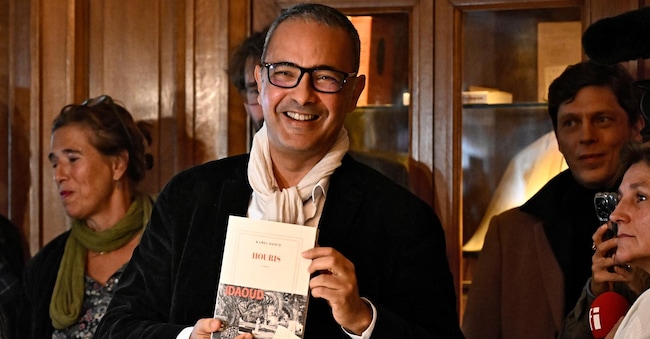
Algerian journalist and novelist Kamel Daoud, 54, received the Prix Goncourt 2024 for Houris, published by the Parisian publisher Gallimard. The novel was elected in the first ballot with six votes, ahead of novels by Hélène Gaudy, with Archipels (L'Olivier), with two votes, Gaël Faye, with Jacaranda (Grasset), and Sandrine Colette, with Madelaine avant l'aube (JC Lattès), with one vote each. Houris was also shortlisted for the Grand Prix du roman de l'Académie française, the Prix Interallié and the Prix Renaudot. "This book was born because I am in France. It is a country that gives me the freedom to write. It is not easy to talk about war, it takes time, mourning and distance. This is a book that offers hope,' commented Kamel Daoud after thanking the jurors. The protagonist of Houris is Aube, a young Algerian woman who has to remember the war of independence, which she did not live through, and forget the civil war of the 1990s, which she experienced. Her tragedy is marked on her body: a scar on her neck and destroyed vocal cords. Mute, she dreams of regaining her voice with a transplant. She can only tell her story to her soon-to-be-born daughter. But does she have the right to keep this child? Can you give life when it was almost taken from you? In a country that has passed laws punishing anyone who talks about the civil war, Aube decides to return to his home village, where it all began and where the dead could answer his questions. The novel sold 77,000 copies, was banned in Algeria and cost its author and publisher a ban from the last Salon d'Alger, one of Africa's most important book festivals. In Italy it will be published in May 2025 by Nave di Teseo with a translation by Simona Mambrini.
With his first novel, Il caso Meursault (Bompiani, 2015), he had already won the Goncourt prize for a debut book. When it was published in Algeria, we asked him to write about it in Domenica del Sole 24 Ore. He sent us a letter, which we republish here, telling why, in that novel, he had decided to continue the story of Albert Camus's Stranger, imagining the brother of the Arab killed in anger because everyone talks about the murderer and no one about the victim, who does not even have a name. In the end, however, the protagonist realises that he feels more like the murderer than the victim, he too feels 'foreign'. (La.Ri.)
The Stranger by Albert Camus continues
by Kamel Daoud
A sequel to Camus' The Stranger? Why not? With the unpublished point of view of the Arab's brother, who tells a bit of the background, the other's version. To restore balance to the trial against Meursault, judged not for his crime but for losing his soul and God. To write to keep Meursault's questions alive, his face to face with a godless world. The idea is simple, yet no one thinks about it, caught up as they are in the denial of the other. The dead man is first and foremost an 'Arab', and then he does not speak, does not defend himself, has no right to a name and, worse still, no one has ever thought of giving him a voice in over half a century.

