
Alighiero Boetti: art as a game for engaging with reality
Bringing together around a hundred works, the retrospective at the Procuratie in St Mark’s Square, Venice, brings to Italia the ‘playful approach’ of this artist, one of the most eclectic of the twentieth century.

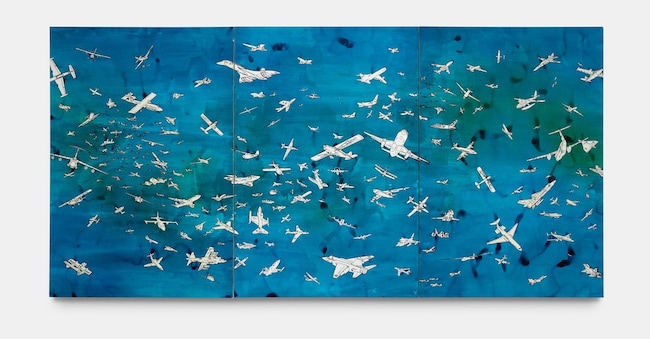
Things arise from necessity and chance. Just over thirty square centimetres of embroidery in this hugely famous textile work from 1988 manage to weave together the many threads of the cosmogony from which Alighiero Boetti’s (1940–1994) colourful world originates. A creative universe in which art is generated as much from asbestos cement pipes as from postage stamps: because ‘you can use anything to make art’, as he stated in an interview. A way of thinking that for decades made him ‘a creator of games’ – ‘for myself, or for the public’, as he put it – capable of using mosaic patterns and grids, series and iterations, alphabetic and mathematical combinations, and colour permutations with great flair. These works themselves arise from a necessity – that of setting a direction with its own very specific requirements – and then encounter chance when he entrusts their execution to others – distant and over a long period of time – as is the case with the ballpoint-pen backgrounds hatched by students and, above all, with the tapestries woven by Afghan embroiderers.
It is this ‘constellation’ – as the organisers describe it – that today illuminates the eight rooms of the Procuratie in St Mark’s Square in Venice for the exhibition *Alighiero Boetti*, curated by Elena Geona for SMAC Venice (Anna Bursaux, David Gramazio and David Hrankovic), with the support of the international gallery Ben Brown Fine Arts and in collaboration with the Alighiero Boetti Archive. An exhibition that aims precisely to highlight the artistic trajectory of a body of work that is at once rigorous and open, where – as they explain – ‘structure and chance, autonomy and collaboration, system and play are maintained in a productive relationship’.
An exhibition spanning more than twenty-five years of the second half of the twentieth century, from the late 1960s to the early 1990s. Almost a hundred works are on display, some of which have rarely or never been seen before, alongside his most famous series: the Biro drawings, the Embroideries and Maps, the Aeroplanes, and the Calendars. Themes of time and travel, and works exploring identity, from *Self-Portrait* and *Twin* right through to *San Bernardino (Open Hand, Clenched Fist)*. Following the major retrospective *Alighiero Boeatti Game Plan* – organised almost fifteen years ago by MoMA in New York, the Reina Sofía in Madrid and the Tate Modern in London – this is an important Italian opportunity to introduce the public to one of the most prominent figures in post-war art. This allows us to grasp – through the material diversity, conceptual complexity and visual beauty of his work – the constant rhythm of the varied polyphony of expressive voices of this artist with multiple identities, which he has asserted since 1971 through his dual signature: Alighiero & Boetti.
One of the best-known figures of his generation, Alighiero Boetti was born in Turin into a noble family. He abandoned his university studies in Economics and Business to become a self-taught artist within a ‘community’ that included Luciano Fabro, Mario Merz, Giulio Paolini and Michelangelo Pistoletto. With the sixteen asbestos cement tubes that make up *Catasta* in 1967, he took part in the exhibition in Genoa curated by the critic Germano Celant, which marked the birth of the Arte Povera movement. Yet, whilst he was among the first to embrace the movement, he was also among the first to distance himself from it, once he moved to Rome in 1972, in favour of a more conceptual approach. Always keeping a close eye on the complexity of the world around him, his name is inextricably linked to Afghanistan: in 1971 came his first journey and his first ‘Map’ – coloured world maps and flags reminiscent of the game of Risk, which Afghan women also embroider in exchange for the medicines their families need. “‘A visionary,’ emphasises the exhibition’s curator, Elena Geuna, ‘who, as early as the 1970s, tackled issues such as nomadism and globalisation – themes that are highly relevant today.’ An artist whose ‘playful strategy’ is to incorporate into his work everything that already exists in the world, and to transform it into memorable art.
Alighiero Boetti. Venice, SMAC Venice (San Marco Art Centre) – Procuratie, Piazza San Marco, until 22 November 2026. Curated by Elena Geuna. smacvenice.org

