
AlixPartners: 'Chinese cars up, prices down and risk of overcapacity rises'
Increased production through partnerships with European manufacturers who do not use their factories to the full.

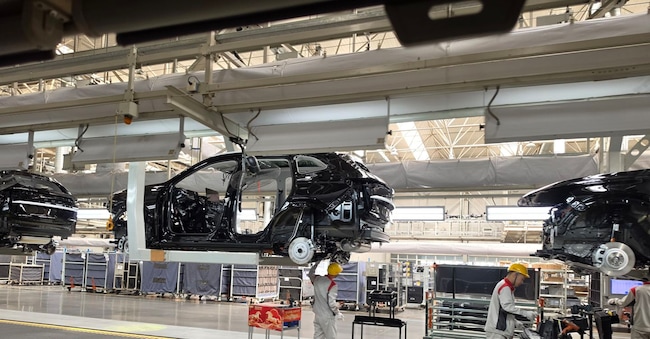
According to a recent report by AlixPartners, Chinese carmakers are set to triple their production capacity outside their home country to 3.4 million vehicles by 2030. This massive expansion aims to escape domestic market saturation and evade import tariffs, with Europe and Latin America identified as key regions. The shift from the 'export-only' model to on-site production is a direct response to falling prices in China (down 20% in two years) and the European Union's introduction of punitive tariffs on imported electric vehicles. "The cost and speed of Chinese companies remain world-class. Western rivals must respond with a ruthless approach to the product attributes that customers really care about," reads the AlixPartners study.
Chinese automotive is by now a mature market, where competition is fierce and, for this reason, prices are falling (-23% in two years on Bev vehicles), although product levels are rising. Moreover, on the electric side, Nev's share has reached 50 per cent of the total, thanks to a consistent electrification strategy, which is why Beijing is gradually reducing state incentives for the purchase of green cars, after disbursing more than USD 230 billion over 15 years, moving instead towards market discipline. This is according to an update of the Global Automotive Outlook by global consultancy AlixPartners, according to which the country is now focusing on exports. "Exports from China exceed 7 million vehicles in 2025, +21%, plus about 1.2 million produced in other countries. They record higher profits than domestic ones: the Ebitda of the top 5 exporters was 60% higher than the average of all Chinese manufacturers in 2024. In this context, Chinese manufacturers plan to triple their production capacity abroad, reaching 3.4 million vehicles in 2030, of which 1.6 million in Europe," said Dario Duse, Emea Leader Automotive & Industrial and Italy Country Head of AlixPartners, pointing out that "the Chinese market is no longer growing in volume, it is involuting: in rapid sequence it is developing, maturing and commoditising technology mostly offered as an increase in content against decreasing prices. Looking ahead, the Chinese market is heading for a wave of consolidation: in 2025 there were 143 brands in the Chinese market, mostly small or super-small, but 'in the medium term there will not be room for all of them, especially as most volumes are catalysed by the largest manufacturers'.
In Europe, car sales volumes remain broadly flat and far from pre-Covid levels (18.7 million units in 2025, -10% compared to 2019) and the marginal recovery expected to 2030 will be driven almost exclusively by the growth of Chinese brands, which are expected to sell around 800,000 more vehicles with market share rising from 9% in 2025 to an expected 13% in 2030. This is what emerges from the Global Automotive Outlook update by AlixPartners, a global consultancy firm. In Italia, the picture is even more critical: the market is still at 1.7 million units, but the share of Chinese brands has doubled in a year (from 3% to 6%) and is accelerating further (7% in the last quarter). While 'established' Chinese brands such as MG have been shrinking slightly, the share growth of other Chinese brands, including Byd, rose 7-fold in one year, from 0.4% to 2.8%. "The data on the growth of Chinese brands in Italia is a symptom of a structural phenomenon: the cake is not growing, the shares are changing. And it is no longer just a question of manufacturers," said Emanuele Cordone, Automotive & Industrial Partner at AlixPartners, during the presentation of the report, emphasising that "Chinese suppliers are also arriving in Europe, accustomed to operating at home under extreme price pressure and with a super-lean operating model that makes AI a lever for accelerating product development: between 2022 and 2028, 19 new Chinese supplier plants are announced in Europe, against a reduction of 36 plants among European suppliers". According to Cordone, 'it is a threat, but also an opportunity for the reconversion of unused capacity, which can pass under new ownership and make a technological leap forward', also because 'the European ambition to be able to make up for lost ground on certain components and technologies through an Industrial Acceleration Act with principles that can also be shared, but without adequate support, remains a pious illusion'.
To accelerate integration, many Chinese brands are signing strategic alliances to reuse underused European factories. Stellantis and Leapmotor: leapmotor EV production will start in October at a Stellantis plant in Spain; Geely and Ford are in advanced talks to use the Ford site in Valencia, Spain, as a production hub for Geely models; Nissan and Chery are holding talks to produce Chery cars (Omoda & Jaecoo brands) at Nissan's historic Sunderland factory in the UK; Xpeng and Magna Steyr with production for European markets already underway at the Austrian contract manufacturer.
In addition to collaborations, plans are advancing for wholly Chinese-owned factories on European soil. The first Byd plant in Hungary is imminent, with Spain being considered for a second site. MG Motor (Saic) has chosen Spain (Galicia) for a European factory due to its proximity to the UK market and strong maritime connections. Great Wall Motor is targeting Central/Southern Europe with the goal of producing 300,000 units per year by 2029 to counter the decline in sales in China, and Changan is considering a plant in northern Spain (Aragon) for Bev models. The export-oriented strategy is already bearing fruit: in March, Chinese manufacturers sold a record 149,094 vehicles in Europe (+97% year-on-year) with MG leading the list, closely followed by Byd and Chery.

