
The Entire Ostia Museum in a Guide
The venue has been refurbished and the volume is a handbook of art history, especially that following the eruption of Vesuvius that destroyed Pompeii
3' min read
3' min read
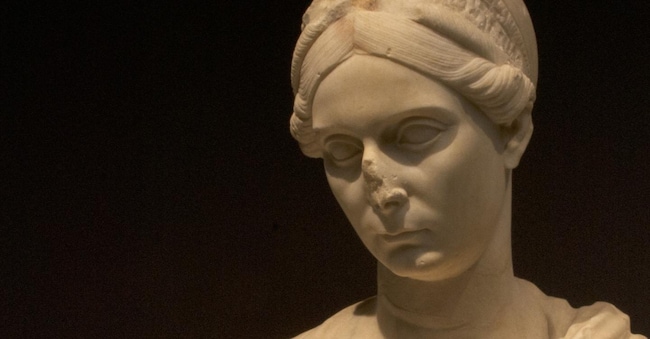
The face of Iulia Procula, portrayed as the goddess Hygieia, is slightly tilted and looks like the gaze of many visitors to the Ostia Antica Archaeological Park, enraptured by the everyday. She looks at us from the cover of the new Guide to the Ostiense Museum, as if to remind us that Ostia, like very few other archaeological sites, offers the monumentality of the everyday. And the art that came after the destruction of Pompeii in 79 AD.
The Museum, housed in the Renaissance Casone del Sale and newly refurbished according to the new museum concepts and with a view to physical and cognitive accessibility, is an art history textbook because Ostia was central to sculptural, mosaic and pictorial production, without forgetting the architectural monumentality of the site: "Ostia gave birth to a truly multiethnic and multicultural society, an unprecedented melting pot that perhaps only today returns to our globalised civilisations," writes Alessandro D'Alessio, director of the Ostia Antica Archaeological Park.
The Birth of the Museum
Established in 1870, the museum was moved to the Casone del Sale in 1934 and houses the artefacts that make up the history and beauty of the ancient city. Ostia, in its etymology from the Latin ostium, 'mouth' (of the Tiber), was founded, according to tradition, by the fourth king of Rome, Anco Marcio (640-616 BC approx.) but the oldest archaeological remains can be traced back to the castrum of the Roman colony in the 4th century BC. Its position and trade made it so fortunate that first Claudius (42 A.D.) and then Trajan (c. 110 A.D.) expanded the seaport. Thus, between the 1st and 3rd centuries, the city changed its skin thanks to an exceptional demographic and economic development that led to precise and rich urban plans. Then came the decline, also linked to the decline of the Roman Empire. But abandonment also led to new pages of history: the city became an open-air quarry and a place where ancient objects were found - from the Renaissance onwards. Those preserved, despite a dispersion that spanned the centuries, are the wealth of the Museo Ostiense.
Fitting and driving
.The rearrangement, and the guide, tell the story of history and art in the flow of days, of religion, of political power. Which takes the form of the statues of Trajan or Iulia Domna, portrayed as Ceres, or a togatus (so-called Maxentius). Then there are the people, those who could afford busts and memory, and also those artisans, merchants and small entrepreneurs immortalised in marble and terracotta reliefs. It is the objects - lavishly described in the Guide - that become the narrative voice of everyday life, such as the statues of the taurocton Mithras or that of Isis that testify to the spread of oriental cults in Ostia.
From life to death, necropolises are the mirror of living: sarcophagi, urns and marble reliefs, in addition to the value connected to aspects of ritual and funerary ideology, testify to artistic preciousness and the presence of highly specialised local manufactures. Among the objects on display is the decorative element of a sepulchral door from the Via Ostiense necropolis: the refined panels of the two wings depict geniuses personifying the seasons. After all, these winged figures remind us that life and death are nothing but the passing of the seasons, from spring to winter. In the 1st-2nd century A.D. as today.


