
All the doubts surrounding the agreement between the United States and Venezuela
Many American oil companies have doubts about the feasibility of a project that has to contend with the state of the Venezuelan oil industry

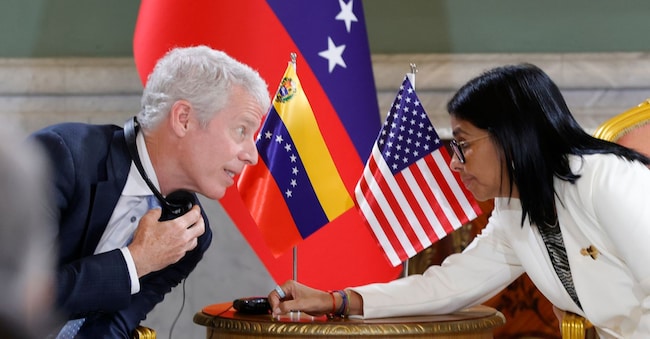
The recent agreement between the United States and Venezuela in the oil sector could significantly alter the structure of the entire global oil industry, as well as part of the geography of the United States’ own international crude oil trade.
The agreement comes as no surprise, given the statements made by President Trump in the wake of Maduro’s appointment, in which he made no secret of US ambitions regarding Venezuela’s oil resources. These statements were given further weight by the immediate transfer of several tens of millions of barrels of Venezuelan oil to American ports. Added to all this is the crucial element of the new hydrocarbons law, adopted with surprising speed by the Caracas Parliament, a law which abolishes the state monopoly held through the company PDVSA. Behind this historic measure lies the direct support of the United States, whose most visible contribution has been the introduction of Production Sharing Agreements, through which private oil companies can now obtain operational and commercial control of the oil fields.
The full details of the agreement are not yet known, but there are nevertheless various doubts surrounding it, starting with the legal ones. Both international law and the Venezuelan constitution are very clear on the issue of ownership of oil resources. These are public assets and must remain so as inalienable assets, protected by the State’s imprescriptible right of possession, known as permanent sovereignty. On this issue, the statements from the US and Venezuelan presidencies appear inconsistent, if not downright contradictory. Whilst, on the one hand, Trump, in announcing the agreement to the world, spoke of US ‘control’ over significant Venezuelan oil resources, on the other hand, President Rodríguez, in emphasising the benefits for her country, insisted that her country would nevertheless retain sovereignty over its own resources.
According to information released by the White House, the United States will be allocated 35 per cent of North American Blue Energy Partners free of charge, in recognition of its political influence, the assistance and legal protection it has provided, and for having lifted the embargo on Venezuelan oil introduced by Trump himself in January 2019. In addition to the stake to be held by the Department of Defence’s Office of Strategic Capital, the United States has been granted governance rights equivalent to strategic and operational control of the company. The Pentagon also has the right to purchase 20 per cent of production at cost price, as well as first refusal on the remaining 80 per cent.
Assuming that this is a form of control compatible with the relevant legal framework, some legal experts also question whether a provisional government has the power to tie up the country’s strategic resources under such a long-term agreement. The hastily implemented reform of the system for selecting judges to the Supreme Court of Justice also raises suspicions; the international community views this reform as an attempt by the Venezuelan Government to secure the necessary ratification of the agreement.

