
All the women of Piero di Cosimo
The exhibition starts from the 'Magdalene', painted as a young girl, to tell the story of the material culture of wives, nuns, craftswomen and writers

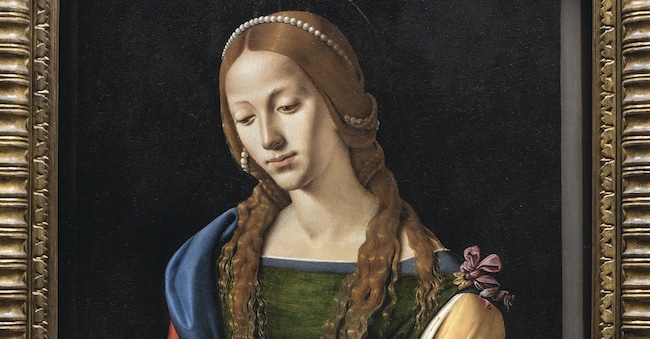
"The beautiful penitent entered my house all smiling. [...] She lives and sleeps in my room, next to my bed, and we look at each other for a long time with love [...]. Sometimes she seems so beautiful to me that I ask her: 'But were you perhaps born of Leonardo da Vinci, instead of Pier di Cosimo? And she immediately replies: 'No, no, Morelli has always assured me that I am descended from Pier di Cosimo'. This is the moving and amused story that the baron and art collector, Giovanni Barracco (1829-1914), tells Giovanni Morelli, who had urged him to buy the Maddalena by Piero di Cosimo, the jewel at the centre of the exhibition at Palazzo Venezia in Rome that, from the grace of those features, takes its cue to tell the story of the women of the Florentine Renaissance. One, none, a hundred thousand women, those that Piero di Cosimo portrayed in filigree behind the modesty of his Maddalena and those of Florence rich in florins and beauty, of bankers and merchants.
It was the connoisseur Giovanni Morelli himself who, after seeing the work reappear in Rome at the end of 1870, in a sale organised by Monte di Pietà, as Portrait of a Woman dressed as Magdalene, attributed it to Piero di Cosimo rather than Andrea Mantegna and had it bought by Barracco, who sold it to the Italian State in 1907 for 38,000 lire. If today the paternity of the canvas housed in the Gallerie Nazionali di Arte Antica of Palazzo Barberini is certain, the dating is less so because, as the curator of the exhibition Edith Gabrielli points out, "Piero di Cosimo remains a mysterious, enigmatic artist". Born in 1862 into a family of well-off artisans, Piero di Lorenzo Ubaldini stole the trade from his father Lorenzo, a 'succhiellinaio', i.e. a blacksmith specialised in the working of small metal objects, and went to work as a painter and miniaturist under Cosimo Rosselli. In addition to the patronymic, from the master he derives the full-bodied volumes of the figures and, following him between 1481-82 on the site of the fresco decoration of the middle band of the Sistine Chapel in the Vatican, he met Pietro Perugino, Sandro Botticelli and above all Domenico Ghirlandaio. They are a thunderbolt like the chiaroscuro of Leonardo, the softness of Filippino Lippi and the light of the Flemish. In 1489-90 he painted the Visitation and Saints made for the Capponi Chapel in Santo Spirito, now in the National Gallery of Art in Washington, in 1493 the Madonna Enthroned with Child and Saints for the church of the Spedale degli Innocenti, a work fully 'à la Piero'. Precisely in the years between the two canvases, the Madonna in the exhibition is placed. It is a fulcrum of light and sweetness, no longer just the saint announcing the Resurrection, but a young 15th-century Florentine woman, as did the coeval iconographic tradition of Flanders. The face, the hairstyle, the jewellery, the attribute of the ointment jar, as well as the devotional book and the letter tell of Mary Magdalene and the female type of those decades. Magdalene transfigures maidens, brides, wives, nuns and sisters, artisans and writers, nannies and domestic slaves.
For the curator and the historical consultants Fernanda Alfieri, Serena Galasso and Isabella Lazzarini, Piero's painting is the picklock to tell the story of women in the Florentine Renaissance, from birth to education, from religious life to marriage and motherhood, up to household management, devotion, occupations and body care. In short, the exhibition, also with very explanatory videos, moves from art to the socio-cultural universe to the material culture of those decades made great by Lorenzo the Magnificent's vision. After centuries, fabrics, ceramics, glassware and cutlery are the mirror of a world that loved beauty, that had the money to seek out the excellence of craftsmanship in the decorative arts and make palaces and villas richer. Even the Antique Kitchens of Palazzo Venezia, which house the artefacts, make the tour intimate, almost like a visit to the rooms of a family of the 15th-century Tuscan élite, which, as Francesco Guicciardini recalls in his History of Italia, "flourished with men who were very capable in the administration of public affairs, and very noble minds in all doctrines and in any preclarine and industrious art". And the objects on display cannot better demonstrate this refinement, starting with an 'agoraio', the needle case for little girls, with niello work and the inscription 'VERBB / UM / CH / ARO' ('Verbum caro factum est', the beginning of an oration to the Virgin), or 'love pottery' from the Montelupo museum with inscriptions such as 'Nanina bell[a]' or 'amore', 'ardente'.
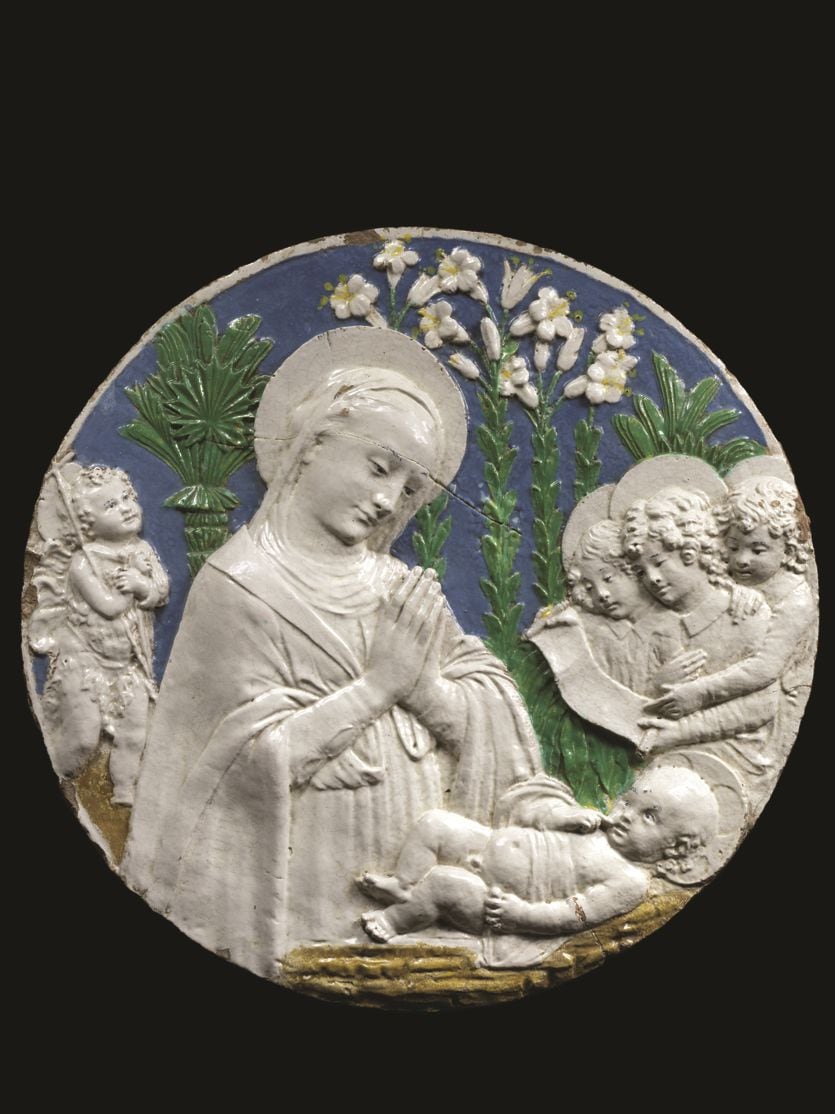
Women often entered seclusion but it was not uncommon for them to master writing or counting, one only has to look at some of the account books. In the wealthy classes, women's writing was widespread, as can be seen in the letter Lucrezia Tornabuoni wrote to her husband Piero de' Medici, after meeting Clarice Orsini, Lorenzo's future wife and therefore his in-law: "and I do not believe that there is at present a more beautiful maiden to marry". Precious fabrics used as tablecloths - the same as Ghirlandaio's The Last Supper at the Convent of San Marco -, glassware typical of the Gambassi manufacture, wedding chests, jewellery boxes and also works for public (these are the years of Savonarola) and private devotion are depicted. Women pray with books of hours, in front of the polychrome terracotta of the Madonna and Child by Michele di Niccolò Dini or the glazed terracotta tondo by Benedetto Buglioni.
Wonder is a status symbol to be exhibited, like classicism: in 1428, Lorenzo Ghiberti inserted a delightful carnelian depicting Apollo, Marsyas and Olympus into a gold-mounted seal. Then, in 1487, Lorenzo de' Medici bought it, having it engraved with 'LAV.R.MED', and, finally, Sandro Botticelli immortalised it in the Feminine Portrait (1480-5) preserved in Frankfurt am Main. Classicism never goes out of fashion and is worth far more than millions of florins.


