
Alliance between Lombardy and Catalonia to support the chemical industry
Catalan minister Sàmper and Lombardy councillor Guidesi: 'Let's strengthen the synergy between two economic engines of Europe

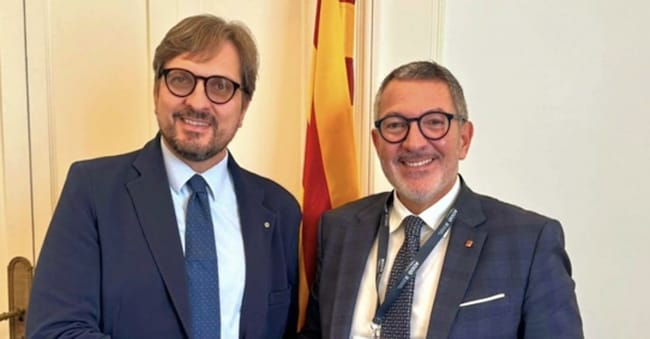
(Il Sole 24 Ore Radiocor) - Lombardy and Catalonia join forces to support the chemical industry. Today in Barcelona, the Lombardy Region's Councillor for Economic Development, Guido Gudesi, and the Minister of the Generalitat de Catalunya for Enterprise and Labour, Miquel Sàmper, signed a collaboration agreement to intensify relations between the two ecosystems, activate shared projects, and join forces with regard to relations with the European Union. The two regions are already part of the European Chemical Regions Network (Ecrn), the European network of leading regions in the chemical industry and officially recognised as an interlocutor by Brussels, as well as of the Esra (European Semiconductor Regions Alliance), the network of leading European regions in the semiconductor industry, of which Catalonia will assume the presidency from 1 January 2026, and of the 'Four Motors of Europe'.
Each year there will be two bilateral meetings
In particular, the aim of the agreement signed in Barcelona is to strengthen this cooperation by setting up working groups involving the technical structures of the respective regional governments, trade associations, and the world of innovation of the two regions, as well as two annual bilateral meetings in Milan and Barcelona. With this in mind, the Lombard mission to Catalonia was also attended by Acció with its own delegation, Federchimica with its vice-president Aram Manoukian, Milan Polytechnic professor Pierangelo Metrangolo, and Ecrn network director Folco Ciulli. At least two common priorities will be developed each year, covering aspects such as training, research, environmental sustainability, joint commitment at EU level and meetings between Catalan and Lombardy companies to create synergies, collaborations and business opportunities.
Guidesi: "We implement the work done with the Ecrn network"
'Lombardy and Catalonia are two similar regions from an economic and social point of view and contribute significantly to the European GDP. Working together in a structural way means strengthening support for their respective chemical sectors, a vital sector for manufacturing and in general for the international competitiveness of our territories. Let us implement the work already underway with the Ecrn network to protect companies, employment and know-how,' Guidesi said. 'The chemical sector in Catalonia is a very important sector for our industrial economy. This unites us with Lombardy, which, like us, boasts an entire chemical ecosystem that is the result of the best public-private collaboration. Now more than ever, we can certainly unite in an Alliance that allows us to multiply synergies in the European context,' Miquel Sàmper added.
Lombardy among the top five European chemical regions
In the chemicals sector, Lombardy is among the top five regions in Europe in terms of the number of employees (45,000) and the third for fine and specialised chemicals for industrial use. The region provides support tools and works to facilitate connections between companies, universities and advanced plant and service companies. Added to this is the political-institutional work promoted by councillor Guidesi, at European level, to consolidate Lombardy's role as a political and economic player capable of influencing the tables in Brussels and seizing new opportunities through interaction with other regions of Europe. For Catalonia, the chemical sector is also strategic and a priority.
Esra Assembly in Barcelona
As part of his mission to Barcelona, Guidesi also attended the Esra (European Semiconductor Regions Alliance) assembly. An opportunity to reaffirm Lombardy's role in the microelectronics sector, with the Region working to enhance territorial districts. An example of this is the Pavia microelectronics district, identified as the first case study for the experimentation of the Zis (Zones of Innovation and Development), the new Region's instrument designed to support spontaneous aggregations of public and private entities that share a well-defined production-economic vocation in a given area.


