
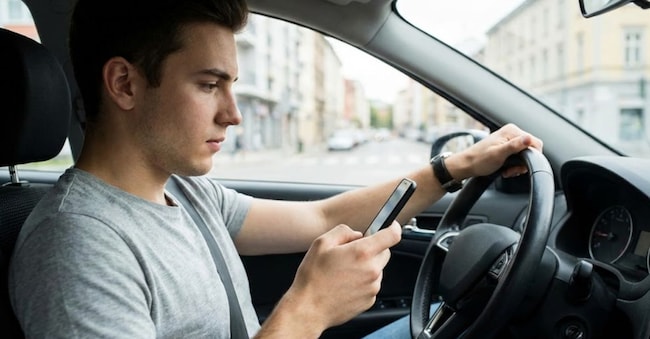
Almost one in two young people drive (still) using a smartphone
'Don't Close Your Eyes' observatory carried out by Skuola.net for Autostrade per l'Italia. But when road safety education is provided, risky behaviour is reduced
Distraction, fatigue, speeding, smartphone use while driving: among the younger generation, road safety continues to be a critical issue. But there is good news. In fact, a certain type of road safety education - the kind made up of meetings with experts, victims of road accidents and their families - can have a positive impact both in the short and long term.
It is precisely those directly concerned who are talking about it openly: 2,100 girls and boys - aged between 16 and 24 - who took part in the 'Don't Close Your Eyes' Observatory, conducted by Skuola.net in collaboration with Autostrade per l'Italia, as part of the awareness-raising project of the same name aimed directly at students and schools, i.e. where road safety education is one of the central themes of civic education hours, especially with the new guidelines introduced last year.
Awareness-raising
And, precisely because of this opportunity, the effects of classroom meetings are increasingly encouraging, especially if they are held with experts, police forces, people involved in accidents or relatives of road victims. Something quite different - and therefore complementary - compared to traditional driving courses that prepare for driving licence examinations, where the focus is more on quizzes and driving technique than on civic values.
Not surprisingly, 41% of those who have taken part in training events of this kind claim to have made a significant and lasting change in their behaviour, whether as a driver, passenger or pedestrian. And a further 43% speak of a positive, albeit temporary, impact. In total, therefore, 8 out of 10 young people recognise a concrete effect of such activities.
The figures
Returning to the general picture of road behaviour, there is still a lot of work to be done. For example, almost 1 in 2 young people - regular drivers of a means of transport (from cars to motorbikes, including bicycles and scooters) - frequently use a smartphone while driving; 1 in 5 admits to having been behind the wheel more than once while under the influence of alcohol, substances or drugs that reduce alertness; 2 in 3 drive often and willingly when tired or fatigued; 4 in 10 regularly exceed the speed limit. At the same time, however, comparing these figures with those of previous editions of the Observatory - which has been active since 2023 - almost all the indicators show an improvement: a sign that the combination of actions undertaken in recent years - from road safety education in schools to changes in the Highway Code, via awareness-raising campaigns and the increasing spread of driving aid technologies - is bearing fruit.
The use of smartphones at the wheel (or at the handlebars), for example, is dropping by around 20 per cent: in 2025, 56 per cent of respondents say they never use them when 'on the move', when exactly two years ago it was 46 per cent.
Overall alertness also seems to be growing: the proportion of those who say they are 'always or often distracted' now stands at 17 per cent, compared with 21 per cent in previous years.
Respect for basic safety rules is also on the increase: those who say they always wear helmets, seatbelts or observe the limits on the number of passengers on board rise to 70 per cent, an improvement on the 60 per cent two years ago.
Respect for the rules
At the centre of girls' and boys' thoughts, moreover, is not only the protection of their own safety or of those they meet along the way. A great many young people, in fact, also require their 'guests' to respect the rules: 60% now do so, an increase of over 10% compared to the first edition of the survey. More generally, what has just been described is the result of a growing awareness of risk in the round. This is confirmed by 58% of respondents, who say they often think about the possible consequences of their actions when driving: in 2023, 49% of drivers responded in this way.
The difference
The main consequence of this comforting trend is a clear fall in the percentage of young people who, in recent times, say they have caused accidents - or risked doing so - precisely because of a superficial approach to the Highway Code: from 58 per cent two years ago to 49 per cent today.
As mentioned above, however, we must continue - it has to be said - on this path, since the goal - zero fatalities - is still a long way off. To begin with, road safety education at school should be further intensified. To date, more than 1 in 2 students - 55 per cent - say they have never done such an activity during their education.
Brand connect


Newsletter Scuola+
La newsletter premium dedicata al mondo della scuola con approfondimenti normativi, analisi e guide operative
Abbonati