
Along the Ruta verde with stops in the Paradores
There are now 100 establishments in the state-owned hotel chain that was founded almost a century ago to enhance the great architectural heritage often located in remote areas

Key points
- Sleeping in castles and monasteries
- From the Basque Country to Galicia
From the scents of the Cantabrian coast to the lands of Galicia with a foray into the Picos de Europa National Park and its immense oak and beech forests. This is the itinerary in the Spaña Verde, an expression that unites the Basque Country, Cantabria, Asturias and Galicia because it is the prevailing colour of the lush nature and rural landscape of the regions that unites this corner of the north of the Iberian Peninsula, which plunges into the waters of the Cantabrian Sea and the Atlantic Ocean. There are many ways to explore it, one being the famous Camino del Norte, a historic pilgrimage route to Santiago de Compostela to be done at a leisurely pace on foot or by bike. But there is also the alternative by car on the road, perhaps staying in the Paradores, emblematic buildings of the country that tell the history of these places.
Sleeping in castles and monasteries
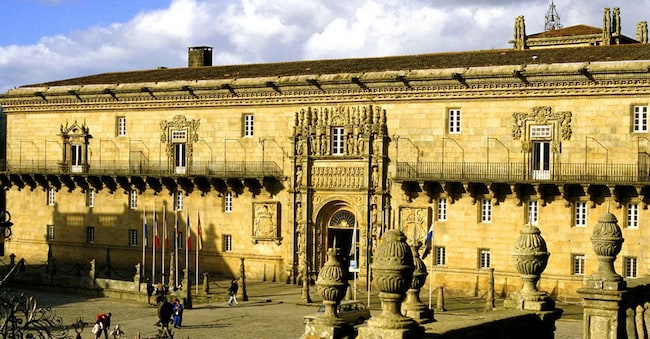
Castles, palaces, monasteries and fortresses, often located in extraordinary natural settings, with the aim of enhancing historical buildings and making their surroundings known, have for almost a century given rise to the famous Spanish state hotel chain (Paradores de Turismo). Crossing the threshold of one of them takes one back in time: one sleeps in a four-poster bed or in a medieval tower, sits in a damask armchair in front of a gigantic fireplace in a noble salon, eats in an ancient refectory... The idea of creating the network of Paradores de Turismo de España came to King Alfonso XIII and the Marquis de la Vega-Inclán with the desire to unite tourism and the protection of architectural heritage. In 1928, the Parador de Gredos in Castilla y León marked the beginning of this project. Then, during the tourism boom of the 1960s and 1980s, the network expanded and valuable buildings such as the Parador de Santiago de Compostela in the former Hostal dos Reis Católicos, considered one of the most spectacular hotels in Europe, were added. Today, we are close to the 100th Paradores milestone, with the arrival of the Parador del Monastero de Veruela in Zaragoza in Aragón and the recent openings of the Parador de Molina de Aragón in the province of Guadalajara and the Parador de Ibiza in the historic centre of the UNESCO World Heritage city.
From the Basque Country to Galicia
It can be done in seven days, each night in a different Paradores touching places off the classic routes The atmosphere is unique and atmospheric in the Parador de Argómaniz, an elegant Renaissance palace (Larrea Palace) nestled in the Basque countryside of Álava. Even Napoleon stayed here before his assault on the nearby city of Vitoria-Gasteiz, which has preserved a beautiful medieval centre with the churches of San Miguel and San Pedro, the tower of San Vicente, all surrounded by a large green ring. There is no lack of cultural venues such as the Artium, the Basque Museum of Contemporary Art, the Museum of Sacred Art or the BIBAT, Fournier Museum of Playing Cards. The itinerary continues in Cantabria on the East Coast. We stop at the Parador de Limpias in the Eguillor Palace, which King Alfonso XIII chose as his summer residence because of its beautiful gardens. Limpias owes its fame to the Christ of Agony, known for its manifestations of life in the form of tears, sweat and blood. But it is the sea around it that is the real attraction, with seaside resorts such as Laredo and its La Salvé, one of the most extensive beaches in the region, ideal for canoeing and kayaking. From there you can reach Santander, with its gastronomy and Centro Botín, and Bilbao with its famous pintxos and the Guggenheim Museum. From the sea, return inland by staying at the Parador de Fuente Dé, at the foot of the Picos de Europa, surrounded by the spectacular verticality and idyllic landscape of the mountains of the Picos de Europa National Park.
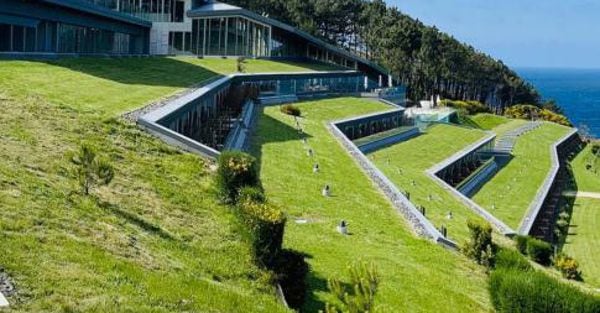
Ascent by funicular to an altitude of 2,000 metres, the view is unique, a gateway to magical forests and belvederes of incomparable beauty. Nature and taste go hand in hand. After a nice hike to recover energy, you can treat yourself to a cocido lebaniego, a traditional dish (stew with chickpeas, potatoes and kale). History takes over again at the Parador de Cangas de Onís on the banks of the river Sella where the Benedictine monastery of San Pedro de Villanueva once stood in the heart of the Asturias region, an ancient land with unexpected scenery around it, such as the Lakes of Covadonga (Enol and Ercina) and the Ruta del Cares. Continuing on, we arrive at Ribadeo, a seaside town in the province of Lugo, on the border between Galicia and Asturias. The Parador de Ribadeo, a Galician manor house at the mouth of the river Eo, offers the necessary rest to discover seaside places and great beaches such as the Playa de las Catedrales, one of the most spectacular in the world for its set of cliffs over 32 metres high that, sculpted by the wind and the sea, form arches and vaults (it is a Natural Monument). Needless to mention the excellence of Galician cuisine (seafood, lacón, brothy rice with Cantabrian lobster). Legendary Galicia is still revealed at the Parador de Vilalba, where the natural landscapes of the area's rivers and La Charca do Alligal, a natural thermal water pool, are of interest. Worth visiting are the nearby Mondoñedo, a small cobbled town surrounded by green mountains, declared a Historical-Artistic Complex, and Lugo, with its Roman Wall, a World Heritage Site. Here you will be delighted by one of the best-kept cuisines in Galicia and where tapas are a true religion. Returning to the sea if you wish, the itinerary can continue to the Parador Costa da Morte in Galicia, which with its Nature for the Senses programme allows you to discover the breathtaking views of the Costa da Morte, participate in traditional fishing experiences and walk along paths between cliffs and historic lighthouses. The Parador Costa da Morte, overlooking the beach of Louridó and a short distance from Cape Finsterra, is a magnificent balcony overlooking the end of the world and is one of the most recent additions to the Paradores network.


