
Even salami likes to be sliced: after Covid growth in tubs unabated
Already more than half the production of Salame Piemonte Igp has been cut, and about 10% of the product for both Felino Igp and Cacciatore Italiano Dop, which will grow by 23% in 2024 (the fifth consecutive) in this segment

4' min read
Key points
4' min read
The increase in sales of cured meats in trays began during the Covid period, driven by at least three reasons: greater certainty about the hygiene of the product, longer shelf life (for less frequent shopping) and less time spent in supermarkets for purchase (and therefore less chance of becoming infected, perhaps while queuing at the cutting counter). Then, albeit with alternating fortunes depending on the type of sausage, this type of packaging became increasingly popular as a consumer habit, even if the higher cost per kilo sometimes slowed down the trend at a time when consumption was curbed due to the crisis and inflation.
Pre-sliced grows more than whole product
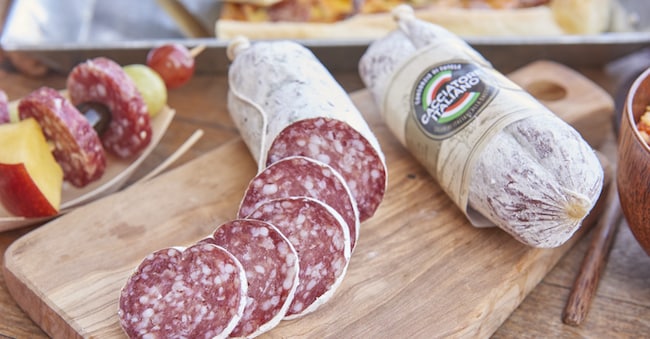
.A trend that remains evident, however, and that has also infected a cured meat that is certainly less difficult than others to slice at home and which by its very nature has a longer shelf life: salami (even in small formats). Being able to slice it in different ways and at the moment of consumption according to need and taste is also an added value and a 'ritual of conviviality' - at least in the opinion of writers - but many Italians do not seem to think so.
Data provided by the Consortium of the Italian Sliced Meat Producer show that while the product placed on the market remains substantially stable (3.8 tons in 2024) there is a "notable increase in sliced products in trays that has continued its positive trend for over 5 years now". In 2024, with 337,820 kg produced, there is a 23% increase, "confirming the end consumer's preference for a format that is practical to use and convenient to stock up on". It is also true, however, that this is less than 10% of production.
Il Cacciatore Italiano Dop exports 30%
.For Cacciatore Italiano Dop, which is worth a turnover of about 70 million euros, exports cover almost 30% of production, but show a contraction of 5.6%, "mainly due to the drop in sales in Germany", not compensated for by the performance of other markets such as Austria (+26%), Belgium (+13%) and Switzerland (+21%). In particular, for the last two countries, "the increase can also be attributed to the promotional programmes in these markets, which the Consortium is implementing, thanks also to EU co-financing, with an articulated series of activities in the territory that also involve the large-scale distribution channel," reads a note.
In terms of sales channels, large-scale retail trade remains the leader with 58.7% followed by discount stores with 35.1% and normal trade (6.2%).


