
Altec secures services for the ISS until 2029 and opens a new control room
The joint venture between ASI and Thales Alenia Space wins a 60 million contract and relaunches the Space Economy

3' min read
3' min read
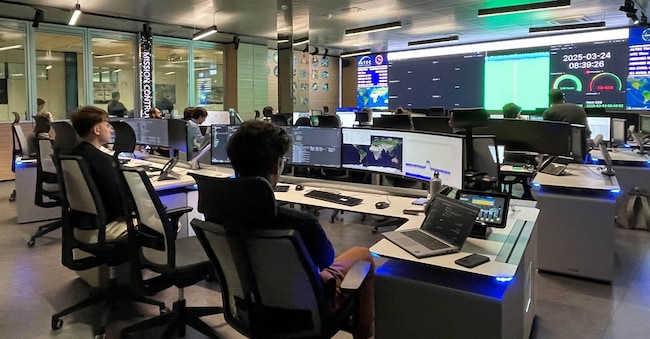
It brings home a €60 million contract for future mission controls for the International Space Station. This is the latest major order that Altec, a company owned by the Italian Space Agency and Thales Alenia Space, is bringing home, but it is not the only new development for one of Italy's leading aerospace players. "We have bet on the future by investing in a second control room at the service of future space missions, more modern and flexible," explains Vincenzo Giorgio, the CEO of Altec, a company chaired by Fabio Grimaldi.
An operation that went hand in hand with the acquisition, from Leonardo, of the building in Corso Marche in Turin, close to the future Aerospace City. In Colorado Springs a few hours ago, Altec signed the contract assigning the Italian company the management of European logistics for the ISS and astronaut training for the coming years.
Mars and the Moon
In addition to low orbit and Mars, Altec's future also includes a role in future missions to the Moon. In Turin there is the only one in Europe of terrain simulating the Martian one, here the rover that will be sent to the Red Planet was trained and here future operations on the Martian surface will be controlled. Also in Altec will be a twin area that will reproduce the Moon's terrain.
"We have laid the foundations for a company that has the ability to simulate different planetary situations, to operate the different missions in real time, whether in low orbit or, in the future, on the lunar surface, and to manage a huge amount of data. The Italian Houston has twenty years of experience in mission control and data collection for purely scientific missions. This is the case with the Euclid mission, a programme dedicated to the study of dark matter and dark energy in deep space.
Science missions
."Altec is the Italian Science Data centre for this mission, as it was for Gaia, an observation programme of our galaxy that has just ended and that still foresees two years of data processing that will be gradually delivered to the scientific community," Giorgio explains.


