Opinions

China and Russia's alternative reading of history at the expense of the West

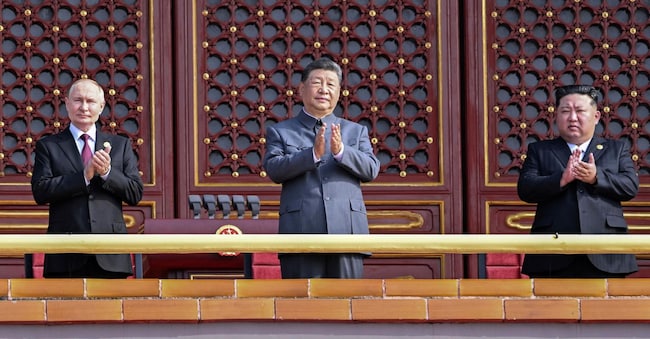
Vladimi Putin, Xi Jinping, Kin Jong Un. (AP)

3' min read

3' min read

The 3 September military parade in Beijing, organised for the 80th anniversary of the victory against Japan, is part of the 'war of memory' initiated by Xi Jinping in 2015. The decision to commemorate the anniversary of the 'global war against fascism' helped to consolidate the narrative of the patriotic war as the founding historical precedent of the People's Republic of China, functional to legitimise Beijing's geopolitical ambitions, in particular its control over Taiwan. Indeed, the anniversary also evokes the return of Taiwan to China after half a century of Japanese occupation.

It should be remembered that the myth of the 'great patriotic war' is also promoted by Vladimir Putin, who used it to legitimise the annexation of Crimea in 2014 and the current conflict with Ukraine.

Loading...

In this way, China and Russia propose an alternative reading of history, as opposed to the Western narrative of the Allied victory, which is more centred on the decisive role of the United States and Western Europe.

These efforts to 'downplay' the Western narrative pursue three main objectives. First, they aim to show that China and the USSR contributed far more than is commonly acknowledged to the defeat of fascism. Secondly, they aim to draw attention to the post-World War I allied agreements negotiated in Cairo and Potsdam, which in their view provide not only a legal, but also a moral basis for their current territorial and strategic interests. Finally, they promote the idea of preserving the post-war international order, as opposed to the Western commitment to defend a liberal international order.

Russia, in particular, exploits an amplified interpretation of the Soviet role in the defeat of fascism to support its claim to have a say in the expansion of NATO and the European Union.

In the case of the 'war of memory' initiated by Beijing, one of the central issues of contention with the West concerns the disagreement over which Allied documents from the Second World War can be considered legitimate sources of international law with binding force. Three agreements, negotiated during and after the conflict, contend as foundations of the subsequent order: the Cairo Declaration (1943), the Potsdam Declaration (1945) and the San Francisco Peace Treaty (1951).

The Cairo Declaration and the Potsdam Proclamation are now of strategic value to Beijing in supporting its claim to sovereignty over Taiwan, as well as in maritime disputes in the East and South China Sea. The United States, on the other hand, attaches greater significance to the 1951 Treaty of San Francisco, signed in the midst of the Korean War, which formally ended the state of war and the Allied occupation of Japan.

The implications of these reinterpretations are far-reaching, both for China and for the international order. On the Chinese side, the aim is to legitimise sovereign control over Taiwan; while Taipei claims its autonomy, arguing that China's internationally recognised legal government during the war was that of the Republic of China, led by the Nationalist Party - at a time when the People's Republic of China did not yet exist.

This also relaunches a broader discussion on the 'international order'. The fact that the United States has traditionally understood the 'order' as a liberal world order, while China understands it as a 'post-war order', creates a normative divide that is difficult to bridge. In fact, Beijing and Moscow have aligned their messages on the significance of victory in World War II and the need to 'preserve' the post-war order.

When we look at China's military parade on 3 September, with Xi donning the Maoist uniform for the occasion, we should not read it merely as a demonstration of military power. In fact, the accompanying narrative aims to reinforce, internally, China's national identity and, internationally, the legitimacy of the People's Republic of China's position on sovereign control over Taiwan and territorial claims in the East and South China Sea.

Copyright reserved ©
Loading...

Brand connect

Loading...

Newsletter

Notizie e approfondimenti sugli avvenimenti politici, economici e finanziari.

Iscriviti