
Amadori at Mimit: a plan is needed to bridge the skills gap in agribusiness
Table with institutions and companies on the mismatch between demand and supply of skilled labour. Focus also on nutrition education in schools

Key points
Italy's agri-food industry is worth around EUR 600 billion a year, accounts for 15% of GDP and employs over 4 million people. Made in Italy exports exceed 70 billion in the two-year period 2024-2025, and Italia leads the European ranking for designations of origin with over 900 PGI and PDO specialities. Yet, behind these record numbers, there is a lack of qualified professional figures.
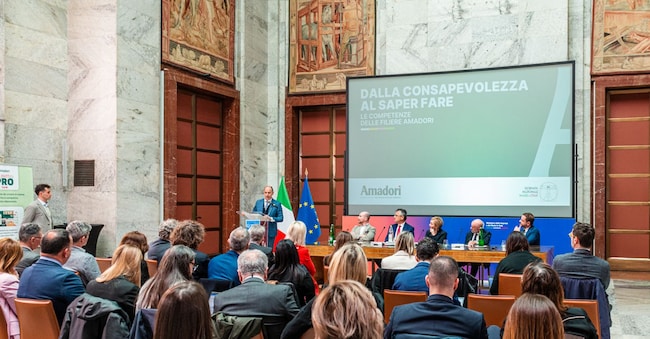
This was the crux of the round table 'From awareness to know-how - The skills of the Amadori supply chains', held at the Ministry of Enterprise and Made in Italy (Mimit): a discussion on the mismatch between demand and supply of specialised labour in the agri-food sector on the occasion of the National Made in Italy Day.
The industry paradox
"We are the second largest manufacturing country in Europe, yet we struggle to find veterinarians, food technologists, sustainability experts, and automated plant maintainers," stressed Gianluca Giovanetti, Amadori's corporate general manager. "Italia invented food, but food technologists are in short supply," he explained, listing the most sought-after figures as experts in digital transformation and managers of sustainability and animal welfare. A paradox that Giovanetti also defines as cultural: the sector is growing but in the eyes of young people it appears static and unattractive.
The Amadori Group's response comes through a series of structured partnerships with the academic world: a master's degree course in digital transformation with the University of Bologna, collaborations with the Milan Polytechnic for practical internships as part of master's degree courses, and participation in the founding of Fooder, the food valley hub in Emilia-Romagna. Added to this is the launch, a year ago, of the internal corporate university, to guarantee continuous training even after employment. A new programme is planned by the summer to accelerate the entry of new graduates into the world of work.
Positive signs on training
From the institutional front, Federico Eichberg, chief of staff of Mimit, framed the initiative in the broader project of the Made in Italy Day, now in its third edition with a focus on training. "We must inspire young people to devote themselves to Made in Italy," he said, emphasising the good results of higher technical institutes and the recently approved Ddl pmi, which introduces facilitated forms for development contracts. "Made in Italy is experiencing a phase of great growth, albeit in a complex moment, and the agri-food chain represents a strategic asset, also confirmed by the recognition of Italian cuisine as a Unesco Heritage," he concluded.

