
Logistics, Amazon accelerates on robots and digital transition
The giant has invested EUR 700 million in Europe in warehouses and finances refresher courses for those moving from manual to technological roles

3' min read
3' min read
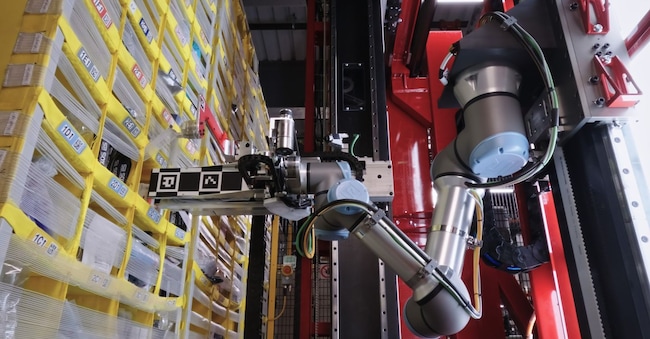
Trying with our fingers to lift a coin lying on a plane is something we have found ourselves doing many times, but rarely have we stopped to think about the skills required to perform this simple task. Grasping a coin, threading a bracelet, handling a fragile object require a combination of sight, touch, strength and fine coordination. It is precisely this distance - between the naturalness of human gesture and the rigidity of machines - that represents one of the most complex challenges for robotics. Today, however, something is about to change. Or at least that is what Amazon wants to do, bringing Vulcan, the first robot capable not only of seeing, but also of 'feeling', into its warehouses. Behind the appearance of a thin metal arm, Vulcan hides a sophisticated sensory intelligence. It was first presented in Dortmund, in the heart of Germany, inside the Last mile Innovation centre, where Amazon is building its next-generation logistics. Vulcan is already operational in Hamburg and Spokane, USA, and has so far already handled over half a million orders.
The Vulcan robot revolution
.The e-commerce giant is no stranger to automation: it already has over 750,000 robots in the field worldwide. Vulcan, however, represents a quantum leap, because it introduces a 'physical intelligence' that until now was only the preserve of humans. The result is not only greater efficiency, but a radical transformation of work. The robot works with a combination of computer vision and machine learning techniques that allow it to create three-dimensional representations of the environment and make decisions based on what it 'sees'. Added to this is its ability to evaluate based on data analysis. 'Vulcan uses artificial intelligence to reason, to decide where to place an object, how to rearrange a container that is already full, and how to manage the movement itself, in response to direct physical contact with the object,' explained Aaron Parness, Amazon's Director of Robotics and Artificial Intelligence, emphasising that Vulcan was not designed 'to replace people, but to support them'.
How does Amazon work behind the scenes?
Around Vulcan moves an entire ecosystem of technologies, not visible to the end user, but decisive. Like the made-in-Italy machine shown in Dortmund and which the company should soon distribute throughout its European network, capable of creating a tailor-made package for each item in seconds, cutting paper and cardboard without waste. It is one of the many innovations that are transforming the 'behind the scenes' of e-commerce. In the last three years, Amazon has invested over 700 million euros to bring this new generation of technology to its European sorting depots. Today, operations that used to require hours and physical strength - such as lifting parcels, sorting them by hand and reading barcodes - are entrusted to systems such as Tipper, which empties trolleys automatically, or Echelon and the six-sided scanners, which identify parcels from every angle, without the need for human intervention. Furthermore, with systems such as Agility, Matrix and ZancaSort, the parcel routes are optimised to avoid unnecessary handling even by employees, while with Vass, a machine vision-guided station, it is the technology that visually shows workers where to place each parcel.
Training Funding
."With the technologies we have implemented, especially in the last five years, we have reduced accidents globally by 34 per cent and serious accidents by 65 per cent," said Susan Rhoads, Amazon's Vice President, Global Workplace Health and Safety, emphasising that this revolution has not stopped recruitment. On the contrary, it has transformed them. "In 2024 alone, more than 20,000 European employees gained skills in automation and Ai. And thanks to the Career Choice programme, Amazon funds professional development courses for those who decide to move from manual to technological roles,' says Rhoads.
In short, if the first industrial revolution brought machines to replace human labour, this fourth revolution seems to want to protect it. Even in logistics. A scenario that allays some fears, such as the one revived by Goldman Sachs economists according to which, by 2030, as many as 300 million jobs worldwide could disappear in the home of Ai and many other roles could be radically transformed.

