
Amazon looks to space with Leo: challenging Elon Musk's Starlink
The Bezos-founded company is working on a total constellation of 3,236 satellites and has already exceeded 150 units in orbit

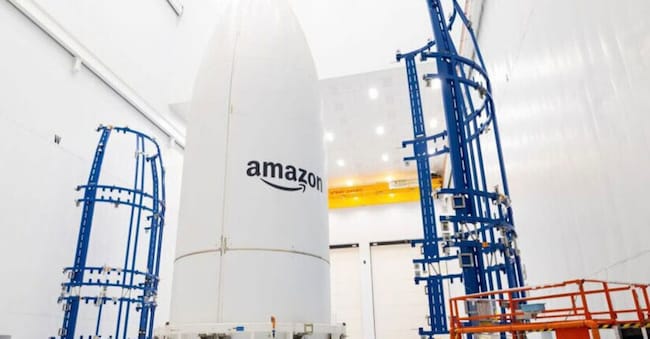
Amazon changes the skin of its satellite project and does so at a time when competition in space has become an industrial, geopolitical and commercial issue. The Project Kuiper programme, with which the colossus founded by Jeff Bezos had launched the first satellites around the globe, officially becomes Amazon Leo. A definitive name that marks the transition from the laboratory to the arena, where the only true ruler is called Starlink. The announcement comes with a simple formula: Kuiper was a code name, Leo will be the brand under which Amazon will try to build a constellation of over 3,200 satellites in low Earth orbit. At the moment, around 150 satellites have already been launched and the service is not yet operational. Ergo: compared to Elon Musk's project, there is a huge delay. But Amazon is a company that has the potential (especially financial) to accelerate.
On the other side of the ring, as mentioned, there is Starlink, SpaceX's constellation that today counts almost 9,000 satellites and over 6 million customers worldwide. The numerical disproportion speaks well of the distance between the two projects, but also clarifies Amazon's ambition: to enter the most competitive game in the telecommunications sector, that of low-orbit satellite networks.
The strategic shift seems rather obvious: Amazon aims to use its industrial assets as leverage. That is, high-capacity production lines, a vertical integration between AWS cloud services and the future satellite network, and a global customer base that could simplify the distribution of terminals. The presence of already announced contracts with JetBlue Airways and L3Harris Technologies shows that Leo's idea is not just for domestic consumption. And that aviation, defence and business are already in its sights.
The comparison with Starlink, as mentioned, remains complicated. SpaceX has years of operational advantage, a launch rate that is difficult to match, and large economies of scale. Many analysts, quoted mainly by Reuters and the FT in recent years, have pointed out how expensive the segment is, technically complex and subject to ever-changing regulations: orbital traffic management, collision risks, radio interference. And after all, even Amazon, in order to obtain the necessary licences in the United States, is bound by strict deadlines: it must have a significant number of satellites in orbit by 2026.
The rebranding announced in recent hours, however, sends a clear message to competitors and investors: Amazon no longer considers the project a side bet, but a pillar of its own infrastructural expansion. And in a market where satellite connectivity is increasingly demanded by governments, airlines, businesses and users in remote areas, the presence of a second giant could redraw the balance and prices.


