Big Tech

Amazon, robotics at an all-time high. And human employment falls

Over one million robots take care of eCommerce orders in huge warehouses every day. Employees in the flesh number 1.5 million

by Biagio Simonetta

2' min read

2' min read

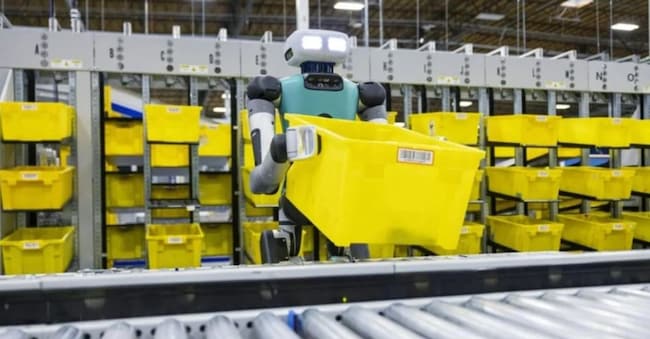
Over one million robots taking care of eCommerce orders in huge warehouses every day. And an increasingly reduced presence of humans. No, this is not a dystopian scenario from some Hollywood film. Instead, it is Amazon, the giant created by Jeff Bezos, which has reached a very high level of robotization.

According to a Wall Street Journal investigation, in fact, the eCommerce giant now has over one million robots in its warehouses. And that is the highest number ever, approaching the total number of human workers in the same facilities.

Loading...

The company's warehouses are filled with metal arms that pick items from the shelves and droids on wheels that move across the floor carrying goods to the packing areas. In other areas, automated systems help sort items, and other robots assist in packing for shipment.

One of the latest robots, called Vulcan, has a sense of touch that enables it to pick up items from different shelves. Almost as if it were a human being. And the company explained that it has recently started integrating the robots with order fulfilment processes, so that they can collaborate with each other and with human workers.

Currently, according to the company, about 75 per cent of Amazon's global deliveries are supported in some way by robotic systems. Increasing automation has enabled Amazon to increase productivity while reducing the pressure to solve chronic problems such as high staff turnover in logistics centres.

For some workers, this change has meant moving from strenuous, repetitive tasks to more skilled tasks, such as managing automated systems.

But while this sounds like the best part of the story, it is also true that robots are in some cases replacing part of the human workforce, contributing to a slowdown in hiring. The numbers say that Amazon now employs about 1.56 million people globally, most of them working in warehouses.

And according to the Wall Street Journal, the average number of employees per facility in 2023 - around 670 - was the lowest in 16 years. Also according to the analysis, the number of parcels shipped by Amazon each year per single employee in the US rose from about 175 in 2015 to 3,870 today, a sign of the strong productivity gains driven by robotization.

Some new centres, designed for same-day deliveries, have very little human presence and allow Amazon to make faster shipments.

The CEO, Andy Jassy, has made no secret of the fact. He has spoken several times in recent months about how the company is pushing towards the integration of artificial intelligence into warehouses, to improve inventory management, demand forecasting and robot efficiency. And that there will be a reduction in the overall size of the workforce in the future seems no mystery.

Amazon started introducing advanced robots after it bought Kiva Systems for $775 million in 2012. At first, the robots were mainly responsible for transporting bulk goods, a tiring task for humans. Over time, they took on more complex roles: packing, sorting and lifting. And today, the efficiency of robotics inside the Seattle giant's warehouses is very high.

The future seems already written.

Copyright reserved ©
Loading...

Brand connect

Loading...

Newsletter

Notizie e approfondimenti sugli avvenimenti politici, economici e finanziari.

Iscriviti