Ces 2026

Amd responds to Nvidia with new chip family for enterprise data centres

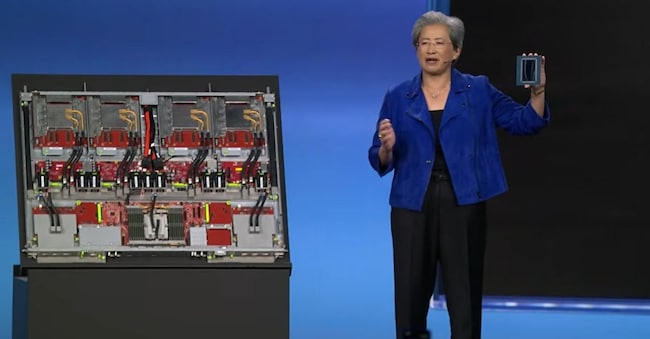
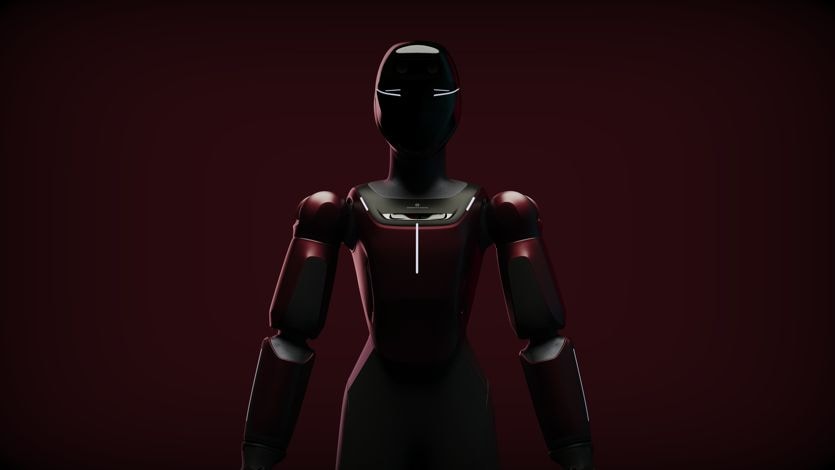
At Ces 2026 ceo Lisa Su relaunches with data centre chips. With her on stage was Italian Daniele Pucci, who presented the humanoid robot GENE.01
by Luca Tremolada

3' min read

Translated by AI
Versione italiana

3' min read

Translated by AI
Versione italiana

LAS VEGAS (USA) . On the morning of Monday, 5 January, Nvidia boss Jensen Huang spilled onto the CES table in Las Vegas a model of AI for autonomous driving, dozens of demos and robots training with its AI Physics, and, finally, the promise that Rubin, the new computing architecture for artificial intelligence, is already in production and more powerful than ever.

A few hours later, Lisa Su, the CEO of Amd, another US-made semiconductor bigwig, responded by presenting a new chip for enterprise data centres, trying to outline how this market, which the entire AI world is watching with extreme attention and trepidation, will evolve.
Loading...

With the i's on stage were Generative Bionics CEO Daniele Pucci, who presented his humanoid robot GENE.01, and OpenAI co-founder Greg Brockman, who emphasised the partnership with AMD and plans for the future use of its systems. The two spoke of their shared belief that future economic growth will be linked to the availability of artificial intelligence resources.

Loading...

What does the MI440X chip look like?

The chip is called MI440X, designed for smaller enterprise data centres, where customers can install local hardware and maintain data within their own facilities. The announcement came during a keynote at CES, where CEO Lisa Su also promoted the flagship MI455X model, stating that systems based on this chip represent a significant leap forward in terms of capacity.

AMD has long since ceased to be the eternal runner-up chasing Intel or the player looking down on Nvidia's monopoly in heavy computing. Today, the Santa Clara-based company has put its cards on the table for the next two years. And they are heavy cards.

"We don't have nearly enough computing power for everything we could do," Su said. "The speed and pace of innovation in AI in recent years has been incredible. We are just at the beginning."

Where is Amd going?

Amd is considered Nvidia's main competitor in the market for chips used to create and run artificial intelligence software. Over the past two years, the company has built a new multi-billion dollar business around AI chips, increasing revenues and profits. Investors, who have been pushing up the stock, now expect more concrete progress in winning some of the tens of billions of dollars in orders that Nvidia takes in.

AMD's Helios system, based on the MI455X chip and the new Venice CPU architecture, will go on sale by the end of the year.

Amd Ryzen Ai Embedded arrives

In addition, Amd unveiled the Amd Ryzen AI Embedded processors, a new portfolio of embedded x86 processors designed to support artificial intelligence-based applications at the edge. The processors integrate the high-performance 'Zen 5' core architecture for scalable x86 performance and deterministic control, an RDNA 3.5 GPU for real-time visualisation and graphics, and an XDNA 2 NPU for low-latency, low-power AI acceleration, all in a single chip.

Amd is also reportedly making a new mini PC for artificial intelligence developers. The Amd Ryzen AI Halo is based on the Ryzen AI Max Plus series processors and is 'capable of running up to 200 billion model parameters locally', AMD says. Its launch is 'planned' for the second quarter of 2026, while information on pricing and commercial availability will be shared 'closer to launch'.

The 'X3D' factor: gaming remains the fort

For those who chew on frames per second, the announcement of the new Ryzen 7 9850X3D and 9950X3D is confirmation that gaming is the laboratory where AMD experiments with pure speed. With 144 MB of cache on the top model, we are looking at processors that not only process data, but also seem to anticipate the next frame. It is the 'V-Cache' that continues to make the difference, keeping Nvidia and Intel at a safe distance in extreme gaming.

The laptop war: Gorgon Point and the challenge to Qualcomm

But the real chess game is played on mobility. With the Ryzen AI 400 chips (codenamed 'Gorgon Point'), Amd throws down the gauntlet to Apple and Qualcomm's ARM chips. 60 TOPS of AI power. It means your next laptop won't need the cloud to translate a video in real time or generate images: it will do everything locally, safeguarding privacy and battery life. It is the democratisation of 'on-device' generative AI.

With FSR 4 AMD enters software

Finally, FSR 4: AI gets into the pixels. Finally, the software. FSR 4 ('Redstone') marks Amd's (intelligent) surrender to the need for machine learning for upscaling. No longer just 'fixed' mathematical algorithms, but a neural network that reconstructs the image. It is the direct answer to Nvidia's DLSS and, from the first tests shown on stage, the quality gap finally seems to have been closed.

Copyright reserved ©
  • Luca Tremolada

    Luca TremoladaGiornalista

    Luogo: Milano via Monte Rosa 91

    Lingue parlate: Inglese, Francese

    Argomenti: Tecnologia, scienza, finanza, startup, dati

    Premi: Premio Gabriele Lanfredini sull’informazione; Premio giornalistico State Street, categoria "Innovation"; DStars 2019, categoria journalism

Loading...

Brand connect

Loading...

Newsletter

Notizie e approfondimenti sugli avvenimenti politici, economici e finanziari.

Iscriviti