
Amelio Castro Grueso: on the run from Colombia I explain how fencing and Italy welcomed me
Amelio Castro Grueso. The Team Refugee athlete lives in Rome and trains with the Italian national team: 'I am here to prove that sport saves and regenerates'
by our correspondent Maria Luisa Colledani
 Aggiungi Il Sole 24 Ore
ai preferiti su Google
4' min read
4' min read
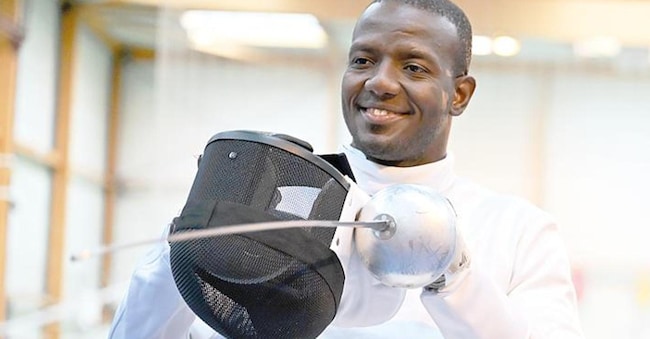
"Annamo, Profe, it's time to train," is how Amelio Castro Grueso rushes us as we chat in the Olympic Village. He closes the interview with an overwhelming smile, as he is, and seeks the complicity of his fencing teacher, Daniele Pantoni, a bit of a professor, but above all a bit of a prophet. Because Amelio's story has something prophetic about it, it is a romance of love and darkness: Amelio is one of the eight athletes on the paralympic team of refugees and he is in Paris to play his destiny with fencing.
In 2018, Pantoni-Profe is in Cali, Colombia, for a leg of the World Cup with the women's national epee team - yes, the one of Fiamingo, Santuccio, Navarria and Rizzi who won gold at the Games - and while they are training there is a boy in a wheelchair full of questions who eventually snatches a few lessons with Italy and a mobile phone number. That boy is Amelio, he was 26 years old. He had already lost his mother, the pillar of the family, and the use of his legs; he had also received threats in that country with such a high density of violence and death. But he had found an idea for the future, wheelchair fencing. He wrote to Pantoni, they kept in touch. Then, in 2022, Amelio calls him, he had made a stopover in Madrid in his wheelchair, destination Rome. He had decided and done it all by himself. Pantoni was in Australia at the time but Amelio, who had seen the despair, was not discouraged. He was welcomed at Caritas in Rome: 'I could no longer stay in Cali. Those few training sessions with Italy were love at first sight. Running away was a mix of courage, recklessness and faith that always guides me. When I was in hospital, abandoned by my family after the accident that made me a paraplegic, I kept wondering why all that evil was happening to me. And I no longer believed. Everything was dark. Then everything changed. I glimpsed small gestures, small helps, I arrived in Italy and found a home, people following me, colleagues at the gym: God manifested Himself to me with people, in small kindnesses. Love is the only force that can transform the world in depth and no one can exist unless close to another person'.
Amelio starts training under Pantoni's guidance, in Rome, in the Fiamme Oro centre at Tor di Quinto with the other blue Olympic and Paralympic athletes, Olympic champions Rossella Fiamingo and Alberta Santuccio pull epee with him from sessions. His level grows, he longs for the Games. After applying for international protection, he is granted refugee status and here he is in Paris with the Paralympic Refugee Team to represent the 120 million people on the run, including 18 million disabled people who, as UNHCR High Commissioner Filippo Grandi recalls, 'have suffered a double loss, physical and human, having had to leave their country'. "I have no nostalgia for Colombia,' he confesses. Rome and Italy are now my new home. Fencing is my job and I like it a lot because it is a sport of tactics, of quick thinking, move and countermove, finding the way to anticipate the opponent and make a point'. And this is how he trains with constancy and passion, it's just a pity that to get from Centocelle to the Tor di Quinto centre it's as if he had to do yet another job: two hours there and two hours back, with the aggravating factor of the San Giovanni underground station without a lift (mayor Gualtieri, when are we going to remedy this?) which forces him to climb to the surface clinging to the escalator. But he, who has seen death and tragedy, moves on and appreciates what he likes best: 'Carbonara is an explosion of flavours' and the interjections in Romanesco are a fact, so much so that Pantoni invites him to use a more correct Italian and Amelio recalls how, in the last year, he always attended the basic course for foreigners because the advanced courses were on the first and second floors of a building without a lift.
Here in the Village, training is tight, morning and afternoon. The first competition is approaching, it will be on 6 September, and Amelio will immediately face very high-ranking swordsmen, which he does not have because he still has little significant international experience: "God is beside me, He is guiding me and the determination to get results is great. I know I have been training and I want to be an example, I want to tell the 120 million refugees in the world without food and without a home that there is tomorrow, there is room for hope".
He raises his eyes and silently surveys the Village buildings, where world flags are hung, as if to remind us that, yes, coexistence is possible. Starting with sport, which breaks down rankings, pre-established orders and fears.


