The acts

Amendolara massacre, the report: 'They wanted to kill us because we asked for a contract'

In the Castrovillari Gip order, the account of Taj Mohammad Alamyar, the only survivor of the car fire in which four migrant labourers died. Ali Raza and Safeer Ahmed arrested: multiple aggravated murder and attempted murder charged

by Ivan Cimmarusti

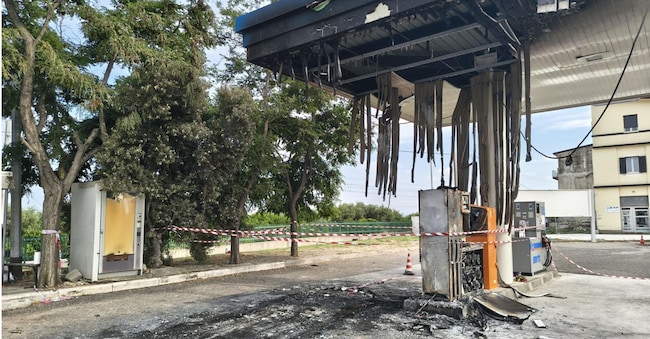
Il punto esatto dove é stato dato fuoco al minivan su cui viaggiavano le vittime, Amendolara/Ansa

4' min read

Translated by AI
Versione italiana

4' min read

Translated by AI
Versione italiana

'Ali and the other wanted to kill us because we had asked for money or a work contract'. The key to the Amendolara massacre lies in this sentence. It is written in the statement made on 2 June 2026 by Taj Mohammad Alamyar, an Afghan born in 1991, the only survivor of the Fiat Ulysse turned into a fire trap at the IP service station, along the 106 state road in Calabria.

Inside that car, four migrant labourers burnt to death: Waseem Khan, Fazal Amin Khogyani, Ismat Ullah Qiemi and Amjad Safi. Alamyar, burnt and with a fractured arm, managed to save himself by jumping out of the boot while the vehicle was burning. It is his story, now, that goes to the heart of the order by which the Castrovillari Magistrate's Court, Orvieto Matonti, validated the arrest and ordered that Ali Raza and Safeer Ahmed, both born in Pakistan in 1994 and living in Villapiana, be remanded in prison.

Loading...

The charges are very heavy: aggravated multiple murder and attempted aggravated murder, with the aggravating factors of premeditation, intentional motive and cruelty.

The survivor's tale: the fight, the knife, then the fire

In front of investigators, Alamyar reconstructs the hours before the fire. He recounts the fight in the morning. He recounts the hashish. He recounts the knife. And he links everything, from the beginning, to the demand to be paid or to have a regular contract.

"Ali had been smoking hashish. The boy on the passenger side took a knife and put it to the throat of one of the boys travelling with us. (...) The reason for these arguments was the lack of a contract'.

Then comes the decisive step. The stop at the IP petrol station in Amendolara. The car stopped. The windows closed. The petrol. The lighter.

"The boss turned off the car, closed all the windows and got out. He sprinkled the petrol all over the ground. (...) The boss doused the luggage with petrol, then set fire to the car with a lighter. I was in the boot. I didn't understand anything, I jumped out of the boot. I got out of the petrol as I was on fire".

It is a direct, physical, almost unbearable narrative. Because it does not just describe a fire. It describes, according to the prosecution, a car locked from the outside and from the inside to prevent the victims from getting out.

"Ten of us slept in a room": undeclared work and exploitation

The condition of the labourers also enters into the record. Not only the violence of the fire, but the context in which that violence allegedly took place: irregular work, cash pay, degraded housing, dependence on the 'boss'.

"We had a contract but still worked off the books, as our wages were paid in cash. We were in a state of slavery with the boss. In a one-room house we were sleeping 10 people".

These are words that move the Amendolara massacre beyond pure crime news. They place it within the undergrowth of exploited agricultural labour, in the fields of Ionian Calabria, where the boundary between employment, blackmail and control of the workforce can become very thin.

Alamyar also insists on the final stages of the burning: '(...) both Ali and the other blocked the doors. I saw that Ali and the other one were pushing the doors. I saved myself because I jumped from the boot'.

The findings: video surveillance, broken handle and witnesses

The order, however, does not only rely on the survivor's report. The Gip values a series of findings that, according to the investigators, consolidate the circumstantial framework.

There is video surveillance footage from the IP petrol station. According to the judicial police, they show the driver pouring the flammable liquid and setting the fire. The images would also document the behaviour of the right front passenger, who breaks the door handle from the inside. That handle will later be found next to the car by the forensic police.

There is also a check that took place shortly before the fire. Carabiniere Antonio Donadeo had stopped the occupants of the Fiat Ulysse for throwing rubbish out of the window. He later recognised Ali Raza as the driver and Safeer Ahmed as a passenger, noting the latter's swollen right eye.

Another note by the Cassano all'Ionio carabinieri documents an earlier incident: at 5.35 a.m., Raza himself had called the judicial police to settle an argument between one of the victims, Fazal Amin Khogyani, and Safeer Ahmed.

Then there is the statement by Umair Ali, who spontaneously presented himself to the investigators. The passage in the order is clear: 'Ali told me that the burnt car was his, that he had set fire to his car to kill the people inside it.

The Gip: "granitic" circumstantial picture

For the Gip of Castrovillari, the circumstantial picture is 'granitic'. Ali Raza and Safeer Ahmed, assisted by an interpreter, availed themselves of the right not to answer. But for the judge, the elements collected indicate intentional intent and allow all aggravating circumstances to be charged.

Premeditation is inferred from the division of roles and the choice of location. The futile motives are linked to the demand for money and a contract, or to the quarrel that occurred in the morning. Cruelty is seen in the manner of the crime: conduct described as 'extraordinarily bloody', capable of causing intense and prolonged suffering to the victims trapped in the burning car.

The order also confirmed the danger of flight. After the fire, according to the investigative reconstruction, the two allegedly ran away. And when they were tracked down, they would have locked the doors of the house. For the Gip, there is also the risk of repetition. Hence the decision: prison, the only measure deemed appropriate.

The Amendolara massacre thus takes shape through the survivor's report and the evidence gathered by investigators. Four labourers died in a car fire. One survived for a few seconds and a gap in the boot. In the background, the most basic demand: to be paid, or to have a contract.

Copyright reserved ©
  • Ivan Cimmarustigiornalista

    Luogo: Roma

    Lingue parlate: Italiano, inglese

    Argomenti: Sicurezza, giudiziaria, inchieste, giustizia tributaria

    Premi: Nel 2011 tra i vincitori del Premio Internazionale Antimafia Livatino-Saetta

Loading...

Brand connect

Loading...

Newsletter

Notizie e approfondimenti sugli avvenimenti politici, economici e finanziari.

Iscriviti